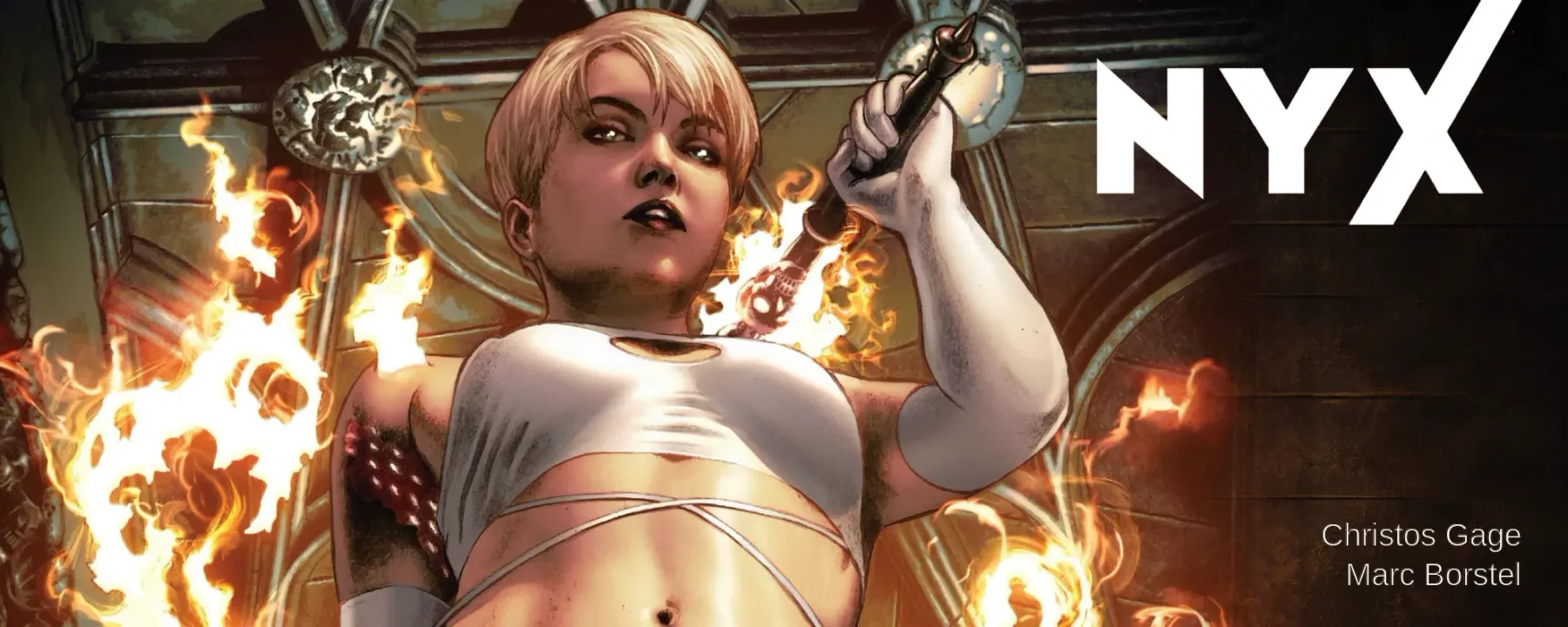
Nyx can turn into living fire. She can also massacre a gang of thugs without much trouble. Breakfast at the home of a man she has only just met is rather more difficult. There are pancakes, there’s his daughter and there’s a very real chance someone might want to see her again. Nyx’s father takes a dim view of such earthly ties. He is the Mad God Chaos, and he has rather different plans for his offspring. In his family, the children can either die or kill Dad.
Script Christos Gage
Art Marc Borstel
Colours Jordi Escuin Llorach
Letters Taylor Esposito
Editor Matt Idelson
Publisher Dynamite Entertainment
Issues published 10 November 2021 – 16 March 2022
When I first read Nyx in 2022, I had the impression that Christos Gage was stitching together some fairly loosely connected stories. The heroine meets a man, eats a criminal every now and then, and runs into Vampirella in the third issue. It was my first encounter with Vampi, as it happens. It was only with the fifth issue that I felt the series gather momentum and come together as a coherent whole. When I reread the issues, this time in one sitting, I noticed how much of the finale depended on seemingly incidental conversations, dates and brawls from earlier issues.
For the record, Nyx appeared in Vampirella comics back in the Harris era, in 1996. She was created by Tom Sniegoski and Ed McGuinness, and got her own series at Dynamite after appearances in Vampirella and Sacred Six. Gage turned the former antagonist into our guide to a world where caring about people can complicate even something as basic as finding a bite to eat1. The first five issues make up the later collection Daddy’s Girl, while issues 6–10 were collected as Family Matters. The discussion below covers the first story arc and makes no attempt to avoid spoilers.
Issue 1. Woman on Fire
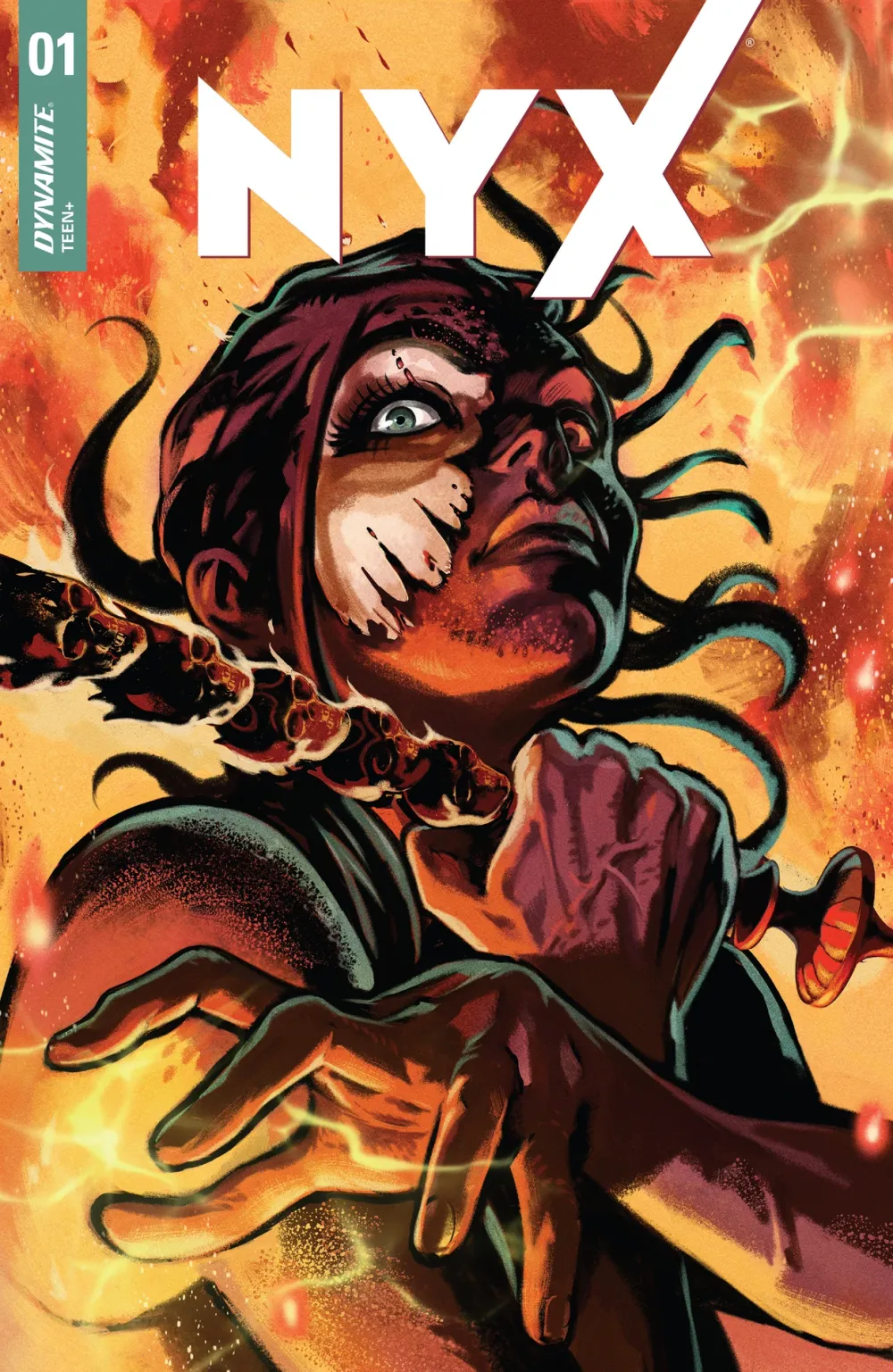
What’s for breakfast?
When we meet Nyx, she is attacking people involved in dealing and smuggling drugs. They are a source of food for her, which matters more than any concern for earthly law. To survive, Nyx must absorb other people’s life energy, which she does with a magic sceptre. She usually picks victims whose deaths she can more easily justify to herself. The trouble is that the hunger keeps coming back, and people tend to die before the half-demon has eaten her fill. When she accidentally kills a police officer who was doing his job, she finds it harder to keep up the convenient distinction between people she can and cannot kill.
At first, her attacks seem to have little bearing on the plot. Gage moves past each death so quickly that it is easy to take them as examples of what’s usually on Nyx’s menu and little else. The first issue ought to give her a little more time to process what she has just done. To think about whose life is worth less, whose is worth more and how that affects her own psyche and view of the world. Fortunately, Gage returns to this idea in quite concrete terms with the ritual in the fourth issue, which improves the first issue in retrospect.
In the meantime, Nyx meets Scott, a likeable divorcé trying to get back into dating. She has lived for centuries and has already sampled far more elaborate pleasures than sex with a nice bloke, but what interests her is what happens afterwards. What happens when there’s an actual emotional connection. She can have breakfast, talk and arrange to meet again another evening. She can also meet Anna, Scott’s daughter. The girl reminds her of a child who used to call her ‘Auntie’. That memory involves the Blood Red Queen of Hearts and enough misfortune that Nyx would rather run before anyone starts counting on her again.
The arrival of a delegation of demons in Scott’s kitchen makes her decision easier. Gage gives Nyx a glimpse of what an ordinary life could mean for her through a kind, decent man, his little girl and pancakes they eat together. Unfortunately, between meeting him and the fire in his kitchen, we learn little about Scott himself. He is meant to represent an ordinary human life for Nyx, set against her demonic half, but Gage starts wrecking his home before the reader has a chance to feel how much he matters. A plot that moves too fast is the main problem with this and other early issues of Nyx.
Adramelech’s offer
The demons come with an offer of promotion. Among them is Adramelech, who thinks Chaos’s daughter should reign and tells her he would be happy to administer her kingdom. The Mad God has grown weak, so Adramelech sees a chance for a change of ruler. The choice of name for this demonic adviser is quite apt. In the Second Book of Kings in the Old Testament, Adrammelech is a deity worshipped by the people of Sepharvaim. In the writings of the French author and occultist Jacques Collin de Plancy, he is the Grand Chancellor of Hell, also responsible for the wardrobe of the ruler of demons2. An infernal official who brings a candidate the crown and immediately offers to run things on her behalf fits the latter tradition particularly well.
Gage also reminds us in the first issue that Nyx’s mother is Lucrezia Borgia. She is known for legends of poison, incest and sexual transgression. The Borgias’ political enemies helped cement that reputation, as did later writers eager to repeat the most sensational stories about them3. In a comic about a demon’s daughter, the use of this legend has undeniable pulp appeal. The suggestion that Nyx could have been conceived through either rape or consensual sex works less well. The possibility of a violent conception becomes here just another salacious detail of Borgia’s life. Nyx’s mixed parentage also accounts for her duality, both physical and psychological. The Mad God Chaos gave his daughter power over fire and a demonic identity, while from her mother she inherited an attractive body and a human conscience.
Adramelech’s offer is tempting enough to make it clear why he bothered to make it. In Hell, Nyx could go back to doing things she has centuries of experience in, and in her subjects’ eyes her future would have been settled long ago. She could soon forget the worries that come with growing attached to mortals. If she turns him down, she has a conversation ahead of her with a man whose kitchen has just burnt down.
Art and covers
Marc Borstel draws Nyx in her fiery form convincingly. Jordi Escuin Llorach also does much of the work in the fire sequences. The city’s cool greys and blues let the oranges and yellows come through, and deep black separates one patch of fire from the next. In ordinary conversations, the stiff poses and uneven facial expressions are more conspicuous. Borstel draws Nyx as an adult woman, though at times he frames her as if he were getting ready to draw another cover.
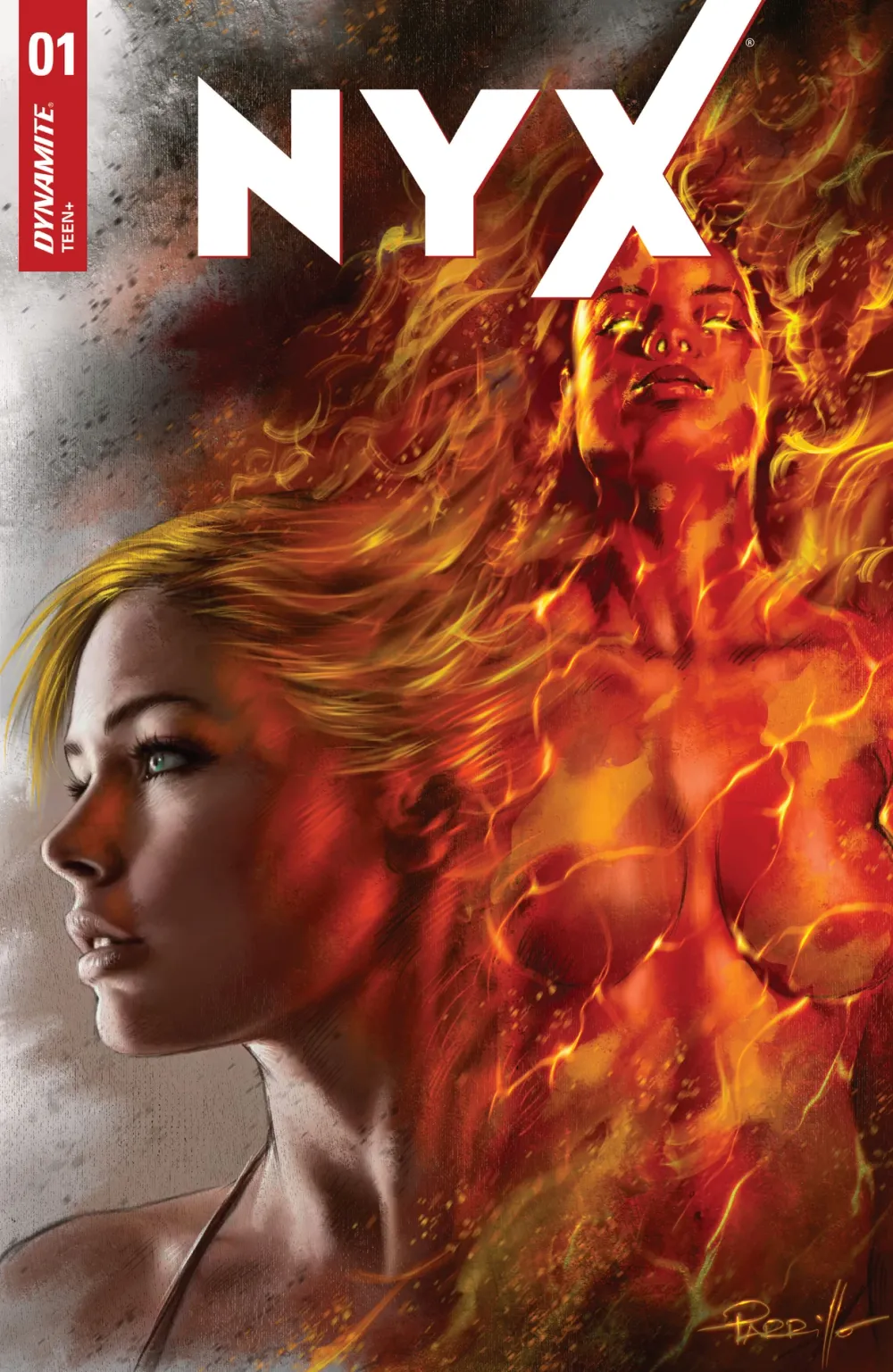
Speaking of covers, Lucio Parrillo painted cover A for the first issue and Rose Besch produced cover B4. What bothers me most about Besch’s variants is the combination of a heavily sexualised outfit and pose with a face with enormous eyes, a tiny nose and an equally small mouth. These proportions make her look childlike, which has a rather unpleasant effect when combined with such ostentatious styling. All the more so because inside the issue Borstel shows a woman who is equally easy to imagine having breakfast with Scott or as a demon several centuries old.
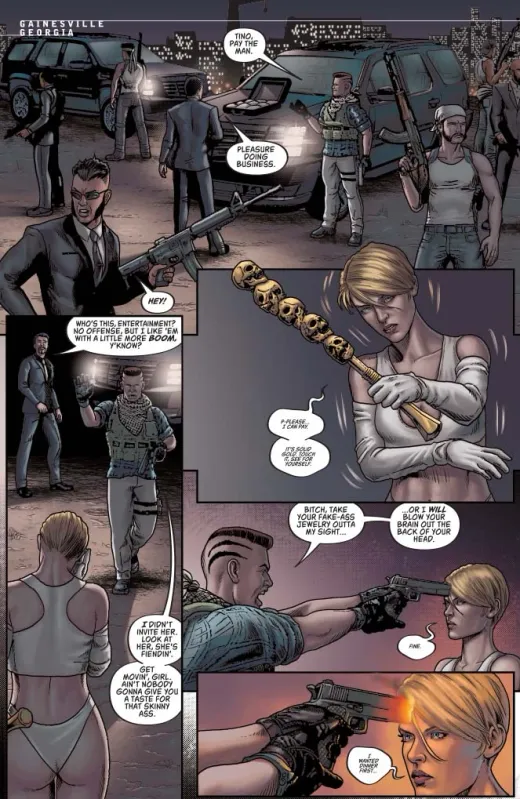
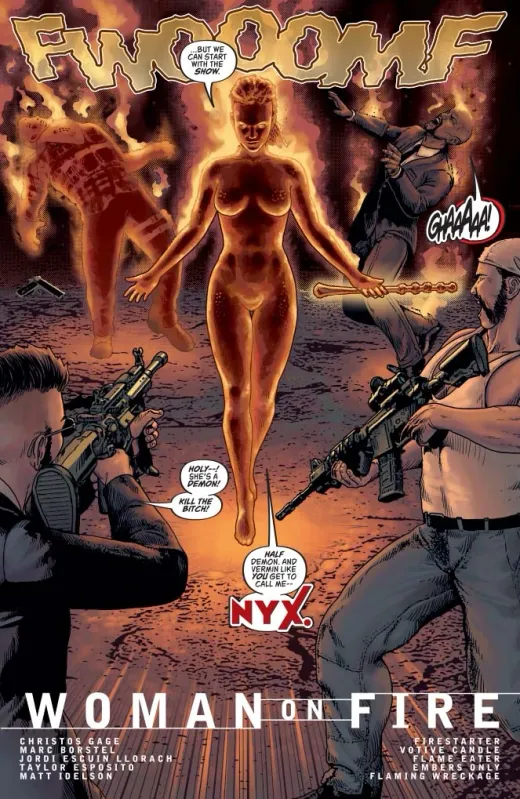
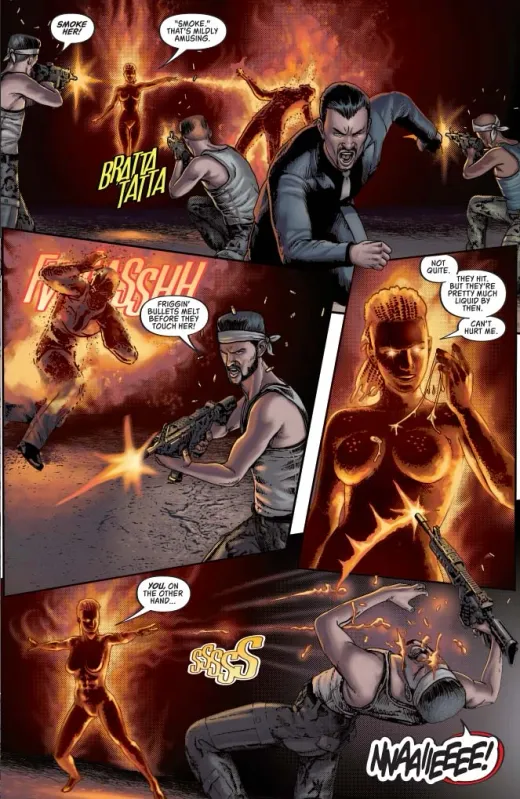

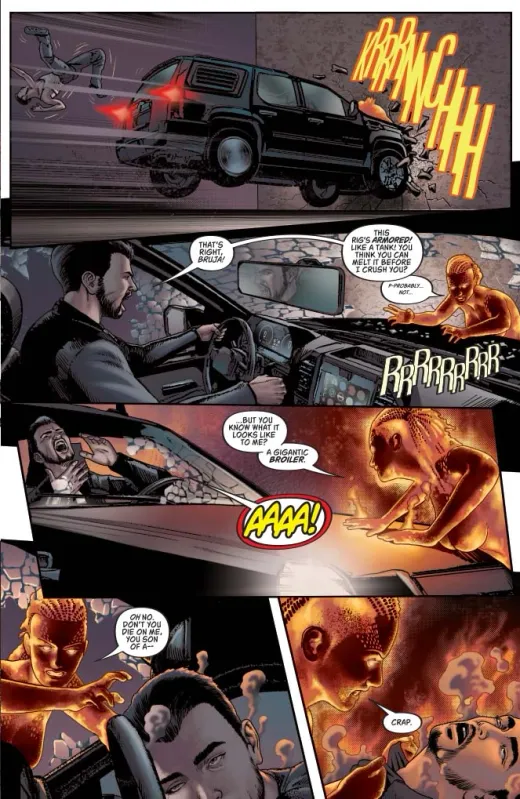
Promotional pages from Dynamite Entertainment. Comical Opinions.
Issue 2. Tales to Admonish
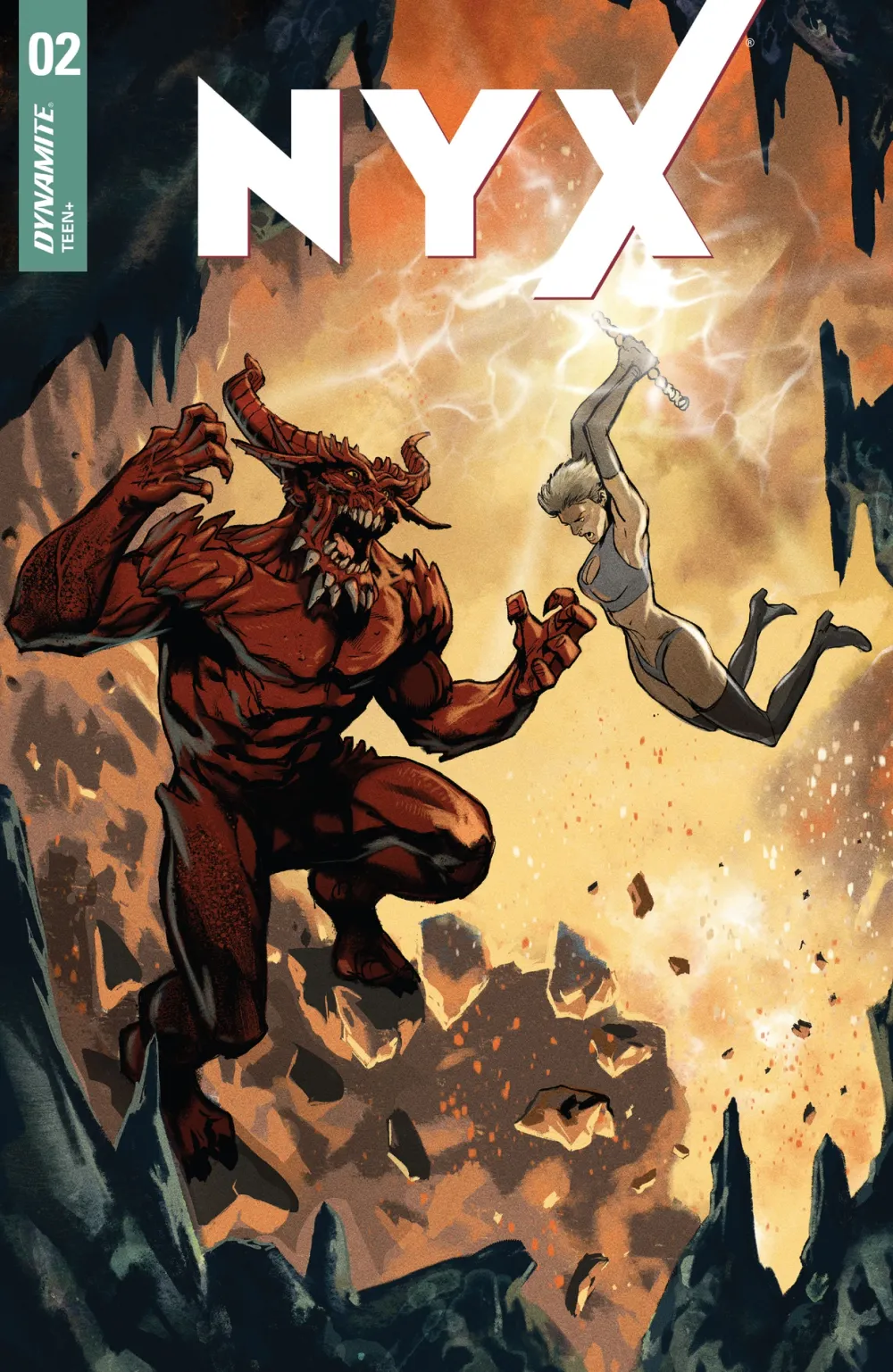
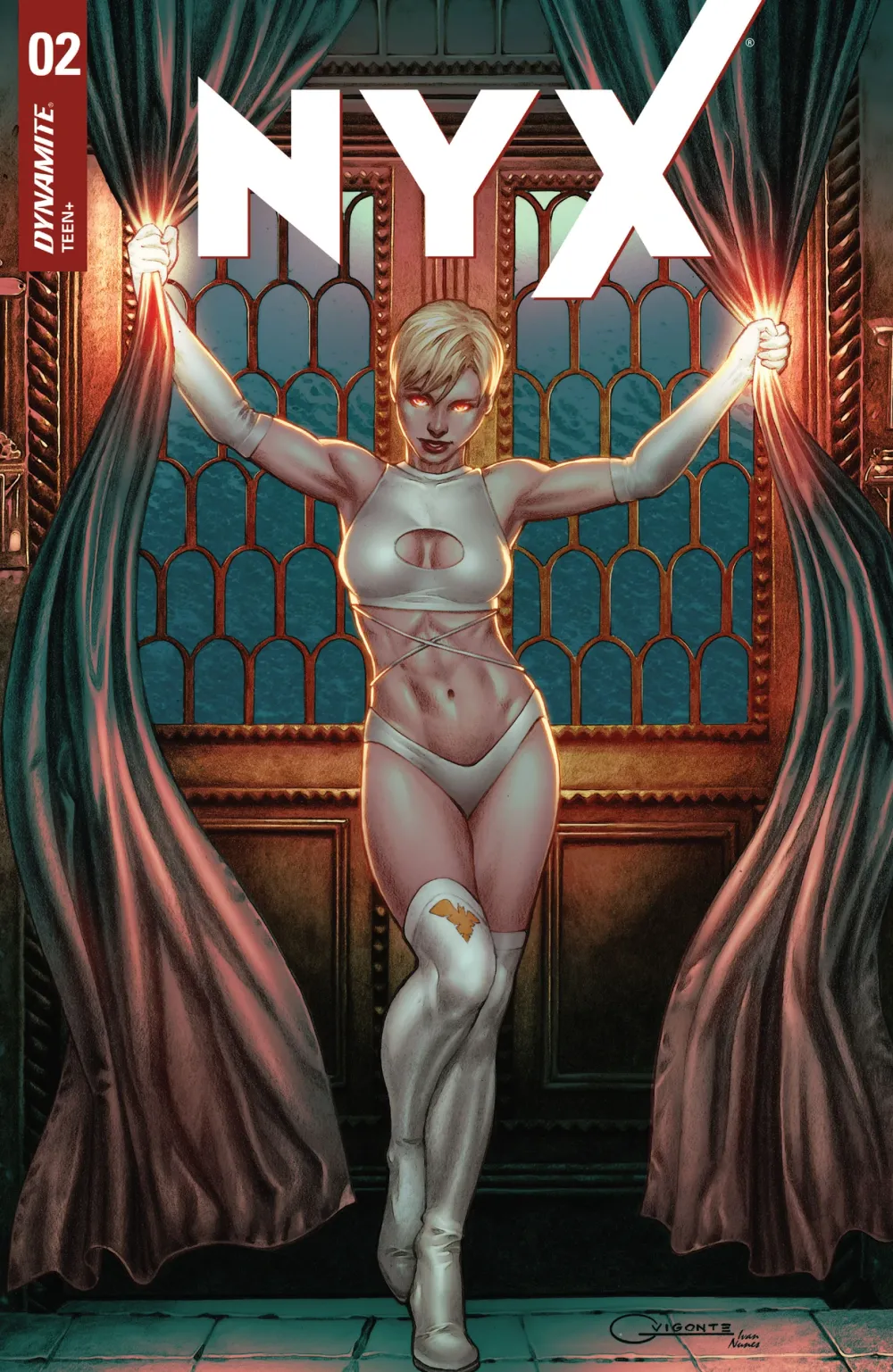
A family prophecy
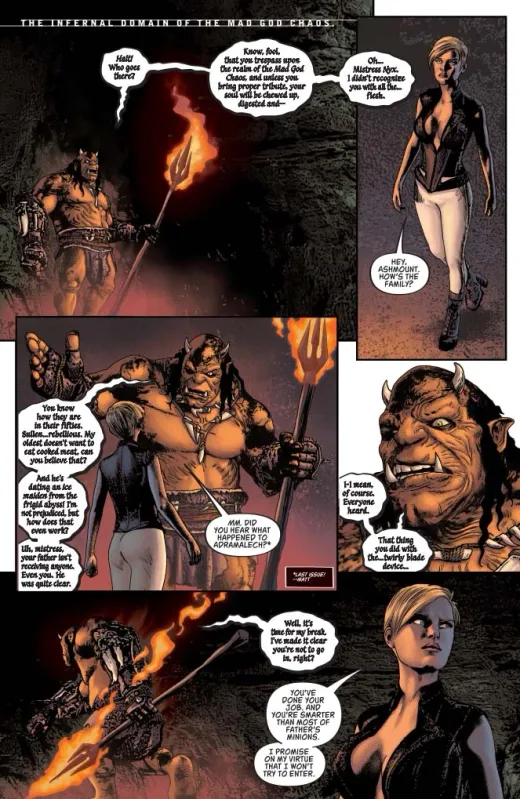
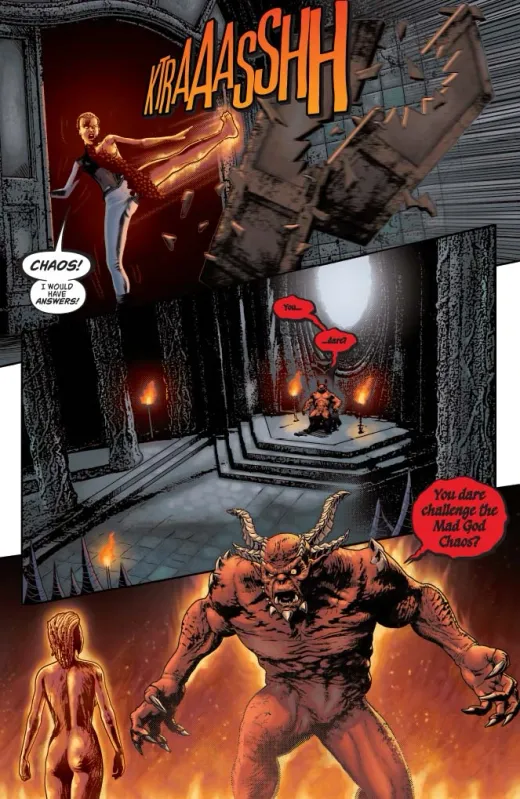
In the second issue, Nyx goes to see her father to find out what exactly is happening to her human side. The Mad God Chaos tells her that her two natures will be at war for ever, and the fate of his older children shows how that struggle might end. Those whose human side prevailed could not live with what they were capable of and took their own lives. The rest tried to kill their father and take his place. Borstel surrounds this conversation with the misshapen heads of Nyx’s dead siblings, emphasising the danger of her divided nature and the grotesque horror of her father’s realm.
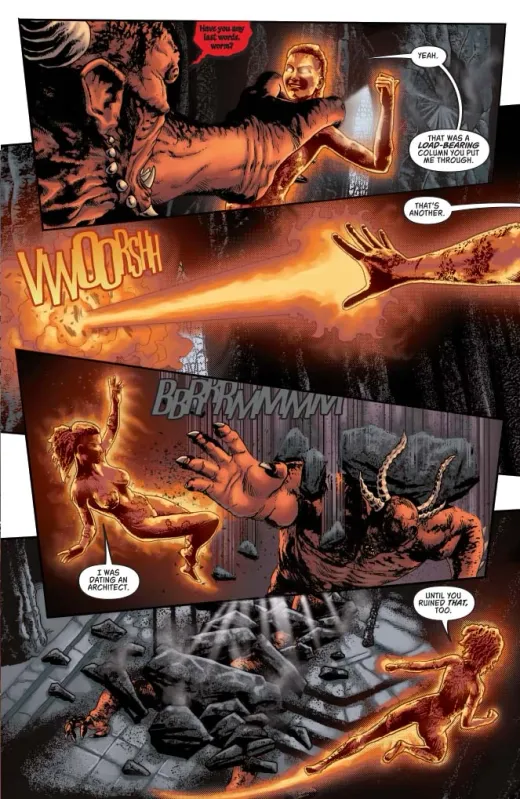
It turns out, however, that although Chaos holds the power his infernal courtiers covet, there are times when he would quite like to die. Part of the hope he places in his offspring is that one of them might finally manage to kill him. He can even sincerely wish his daughter good luck. In the first issue, lesser demons hoped to profit from his possible death and made ruling the infernal realm sound desirable. Now we learn that the Mad God himself sees certain advantages to giving up the throne. It is hard to imagine a less encouraging account of what you actually get when you inherit a crown.
Nyx finally asks him whether there is even one version of the future in which she is happy. Chaos is almost indignant at the very thought that a demon might care about happiness. His experience is of fear, uncertainty and madness, so he scarcely knows what to make of his daughter’s wishes. After the scenes with Scott and Anna in the previous issue, the reader understands what Nyx means, but a quiet life at home would probably never occur to her father.
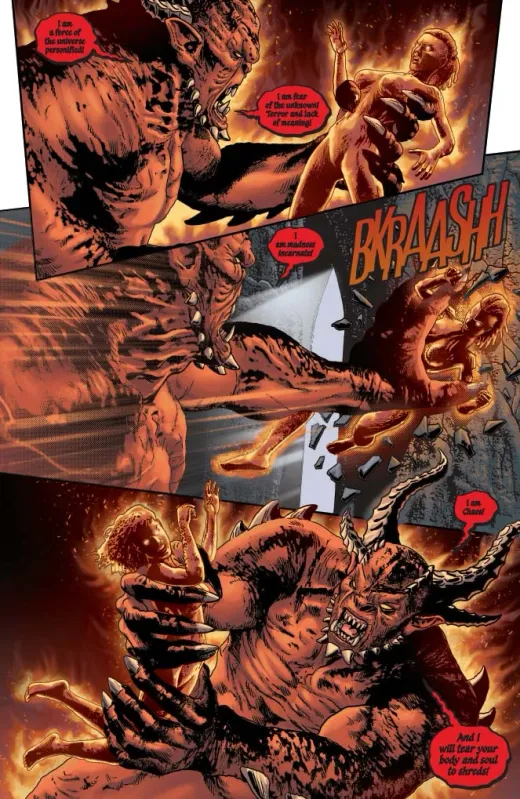
There is something funny about the conviction with which the embodiment of uncertainty allows his daughter only two possible futures. Chaos draws a general rule from the experience of children who grew up under his influence and knew they could take power after him if they managed to kill him. How much of their fate however came down to their nature as half-demons, and how much to what life is like in this particular family? The answer to that question unfolds over almost the entire series.
From Hesiod to Warren
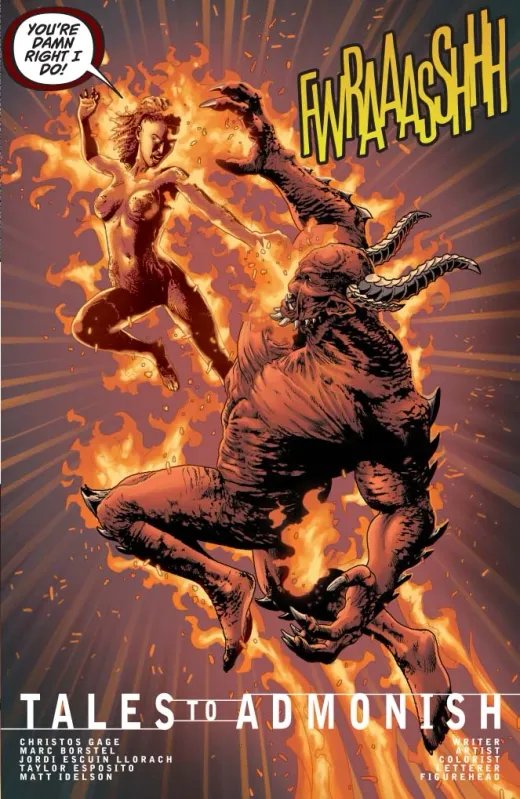
In Hesiod’s Theogony, Erebus and Nyx, or Night, emerge from primordial Chaos. The relationship between father and daughter in the comic recalls that genealogy. Hesiod’s Chaos is more like a primordial abyss5, while Gage uses a god with a history of his own in Vampirella’s mythology. The family habit of fighting for power also calls Greek myth to mind. Cronus overthrows Uranus, and Zeus defeats Cronus. Chaos would evidently welcome another link in that chain. What his daughter wants above all, though, is to see what she can do with the life she already has.
The issue also has the playful title Tales to Admonish, which recalls Marvel’s Tales to Astonish. Replacing ‘astonish’ with ‘admonish’ suits the warnings Nyx’s father gives her, backed up with the most macabre examples he can muster. Visually, Borstel and Llorach do better here than in the opening issue. In Chaos’s realm, white bursts through ordinary space and the borders of the panels become unsteady. The father is huge and contorted, while the daughter retains her slender, agile figure. The energy around them is similar in colour, so their family likeness is visible on the page before another lecture on their origins begins.
The closing pages bring back the Crimson Chronicles, a book linked to the Cult of Chaos. Both the cult and the book come from ‘Who Serves the Cause of Chaos?’, a story written by Archie Goodwin and drawn by Tom Sutton, published in Warren’s Vampirella #8 in 1970. Gage brings the book back just when Nyx could use the knowledge her father is withholding from her. More than fifty years on, the cultists’ book still has its uses in the universe.
Promotional pages from Dynamite Entertainment. Dynamite Entertainment.
Issue 3. Demon in a Bottle
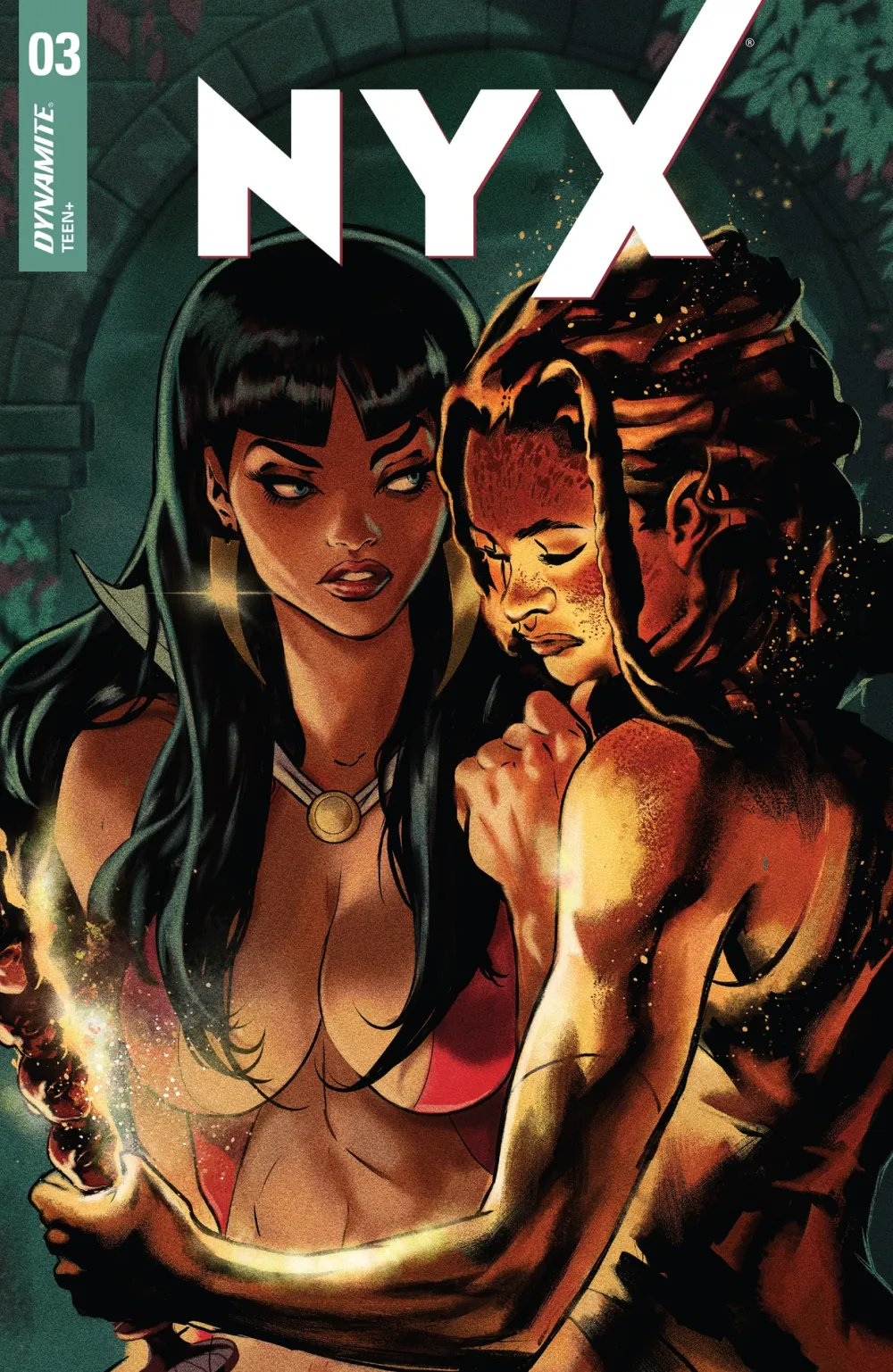
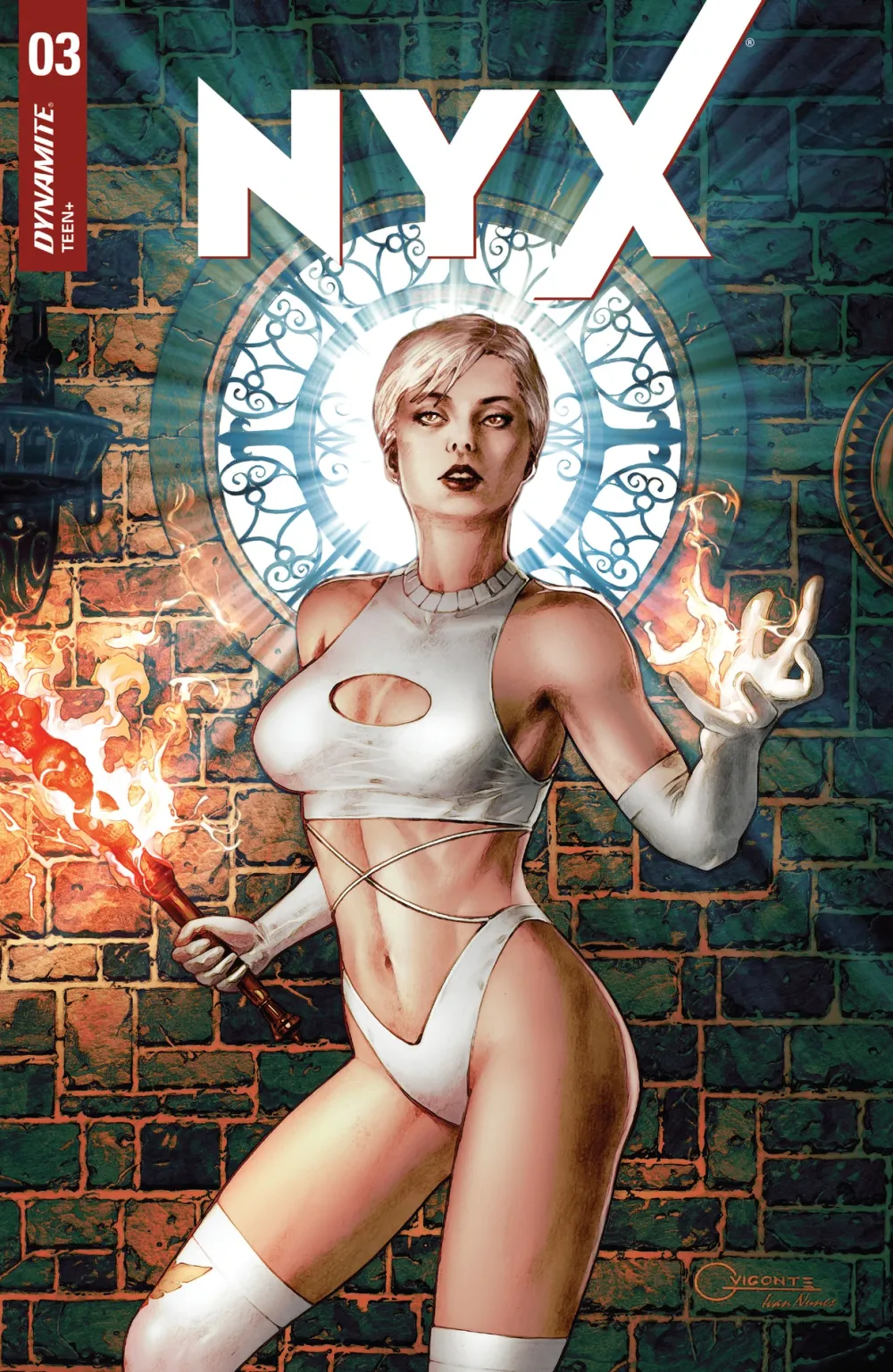
How does Vampirella get on with people?
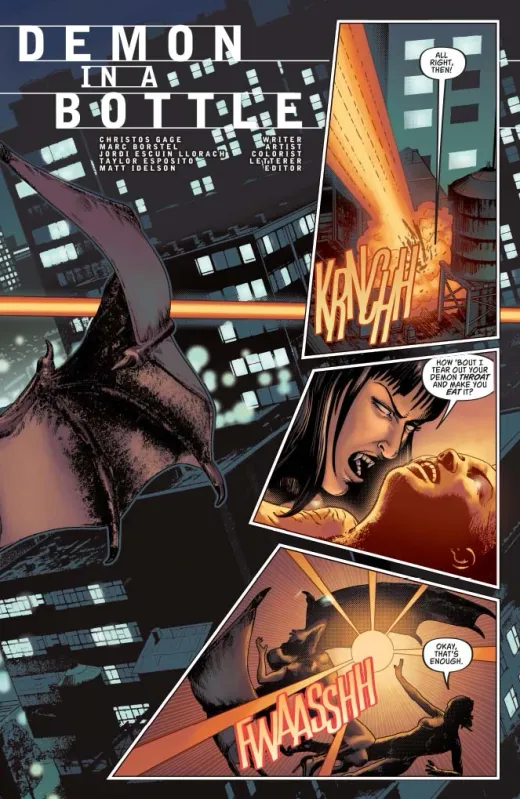
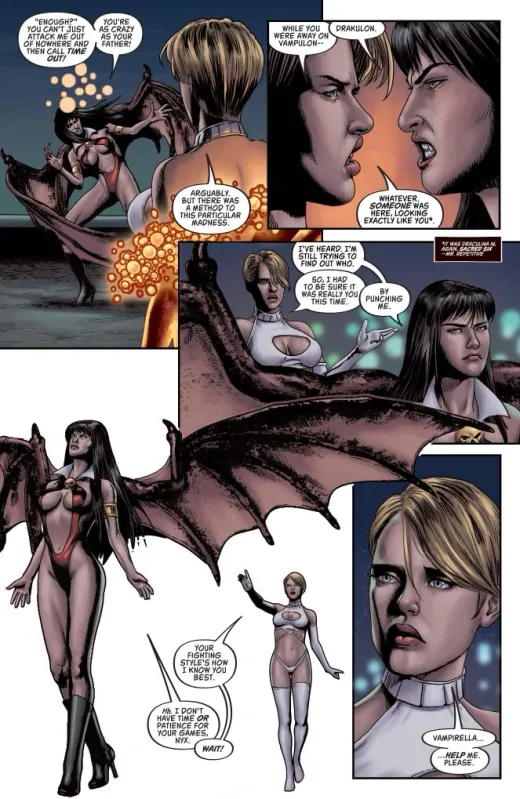
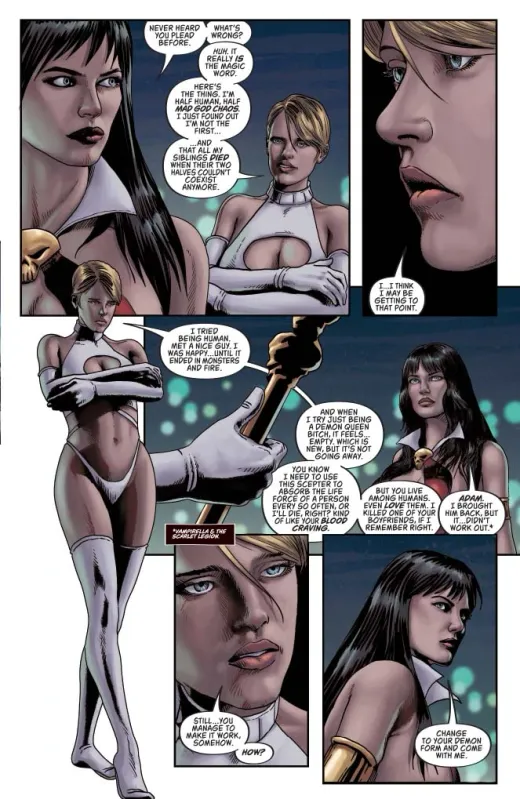
Vampirella makes a guest appearance in Nyx’s third outing, and their first conversation begins with a brawl above the city. It starts when Vampi is mistaken for Draculina, and the two women have more than enough reasons to distrust one another anyway. After all, Nyx once killed Vampirella and was also responsible for Adam Van Helsing’s death. For a better understanding of their relationship, turn to Vampirella and the Scarlet Legion, though what the two say about themselves in this issue is enough to understand what is at stake in their meeting. Nyx is looking for help from someone who also feeds on people to survive, but who has far more experience of making a life among them. Given what their previous encounter cost her, Vampirella is surprisingly open to the possibility of friendship.
The alien from Drakulon steers Nyx towards a more human way of life, but her answer to the half-demon’s doubts is hardly optimistic. Her advice comes down to being careful to keep mortals at a distance. With someone strong enough to defend themselves, at least you needn’t keep wondering what will happen if you lose control. Chaos and Vampirella thus arrive at surprisingly similar conclusions. He takes them for cosmic law. She remembers how many times she has tried to get close to people and how it ended for her.
In the same issue, she tries to save the lives of the cultists attacking the two women, then kills one of them when she is weakened and needs blood. The scene makes the danger of hunger clear and shows how much it weighs on Vampirella to know she has just harmed a human being. In the next issue, Nyx will draw a very particular conclusion from that lesson. If it is so hard to stop hurting people, perhaps it would be better to try to stop caring about it all.
Darts, a mechanical bull and the Cult of Chaos
The issue’s title is a clear reference to Demon in a Bottle, the 1979 story about Marvel’s Tony Stark and his alcoholism. Gage’s version features an actual demon, plenty of alcohol and a few memories neither heroine would care to revisit. The visit to the bar is altogether more agreeable than Stark’s struggle with addiction, though. The two women are a little bored at first, then move on to drinks, darts and eventually the mechanical bull. On one page Gage and Borstel leave it almost entirely to the pictures to show how the drinking session unfolds. It is one of those moments when the writer knows to quieten down for a while and leave things to the artist.
Vampirella is convinced that Drakulonian physiology makes it impossible for her to get drunk. As the glasses empty, though, she starts reminiscing about her old performances with Pendragon and remembering Adam, and finally bursts into tears. Gage manages to make a joke at that point without diminishing the weight of what he has revealed. The woman who has a ready answer to Nyx’s question about living among humans lets slip, once she is drunk, how much effort it costs her to live by her own advice.
Then the cultists turn up. As far as Nyx is concerned, they are geriatric cosplayers she is about to turn into briquettes. Vampirella, meanwhile, remembers that they have been a nuisance to her since the 1970s. The joke takes on another meaning if the reader remembers when the Cult of Chaos first appeared. Publishers have changed twice in that time, and Vampi still has to put up with worshippers of the same god. They also summon an ice demon named Chimonas then and there. His name sounds like the Modern Greek χειμώνας, meaning ‘winter’, which is all the characterisation he needs when facing a woman made of living fire.6
The fight turns out to be one of the easier ones to follow in the volume. Llorach gives Chimonas icy whites and blues, Nyx has oranges and black at her disposal, and Vampirella’s dark silhouette moves between them. The blazing Nyx makes use of the mechanical bull we have already seen during the drinking session. In other action scenes, Gage is quick to bring in another power or another explanation. Borstel once again does better with two distinctive silhouettes than with close-ups of faces meant to convey subtle changes of mood. Some of the panels in the bar look very much like pin-ups, although the humour and rhythm of the scenes carry them easily.
The Vatican lead
The cultists have also served as a reminder of the power of the Crimson Chronicles. Nyx connects the book with a copy she saw centuries ago, so she sets off for Rome and finds a hidden Vatican library. To learn more about why she does this, take a look at the seventh issue of Sacred Six. Fortunately, the essential information comes across in the panels themselves. Among the skulls and old volumes, Nyx finds an object whose power she senses as soon as she comes near it. It is an agreeably pulpy ending to an issue in which two long-lived beings have tried to work out over drinks how to make a life with others. Her conversation with Vampirella leaves Nyx feeling that she must change something about herself, and the book gives her a chance to see how far she can go.
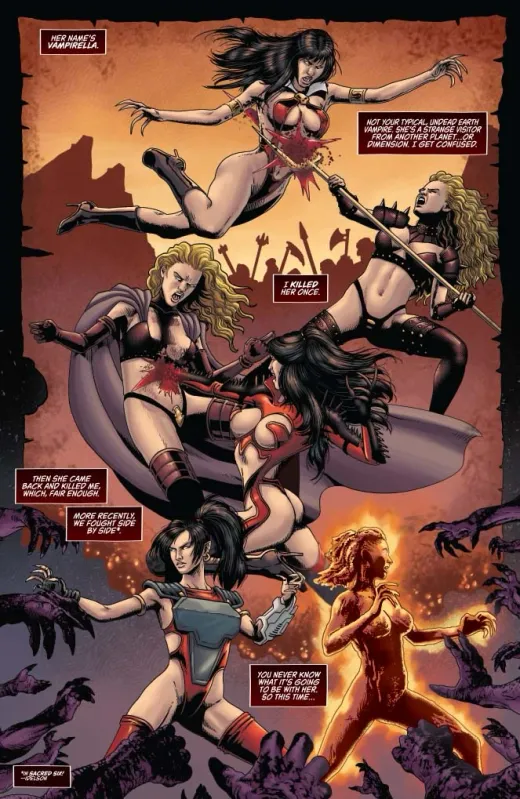
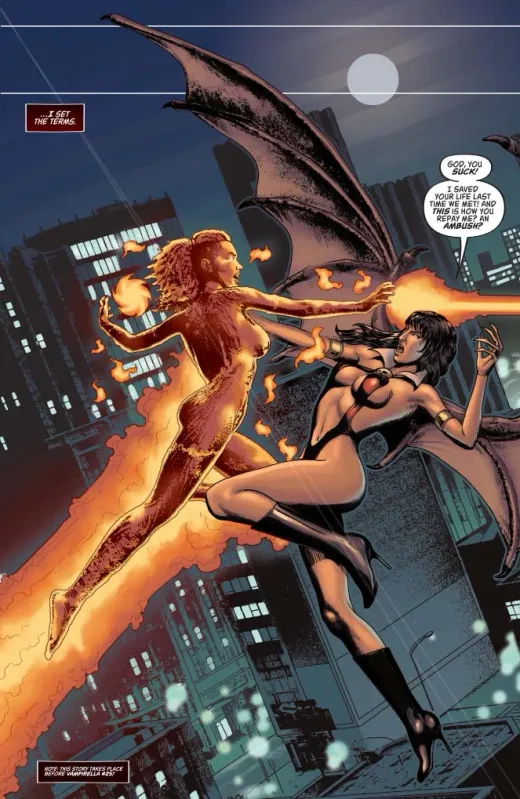
Promotional pages from Dynamite Entertainment. Dynamite Entertainment.
Issue 4. Deranged Tales
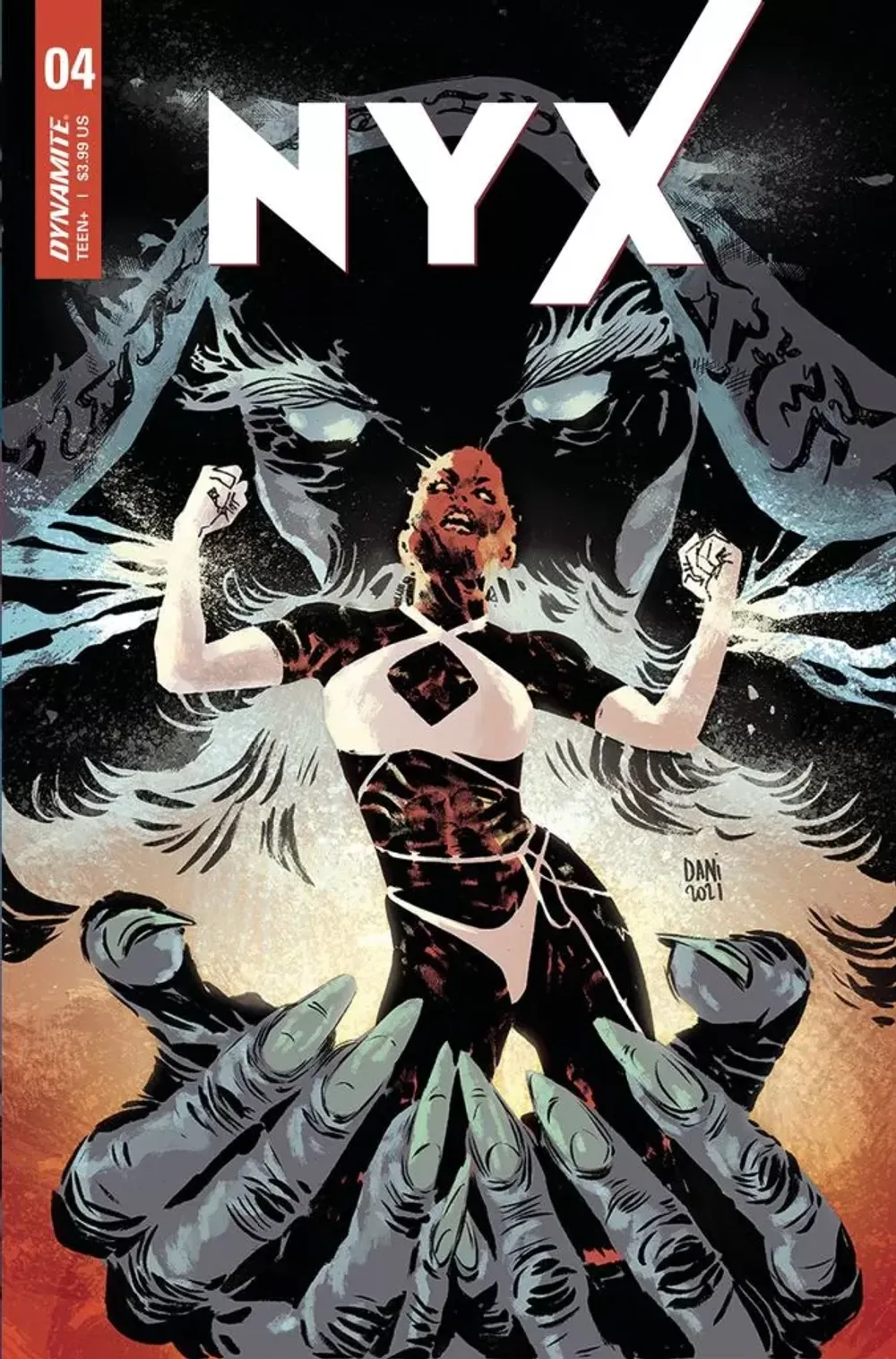
Who can be sacrificed?
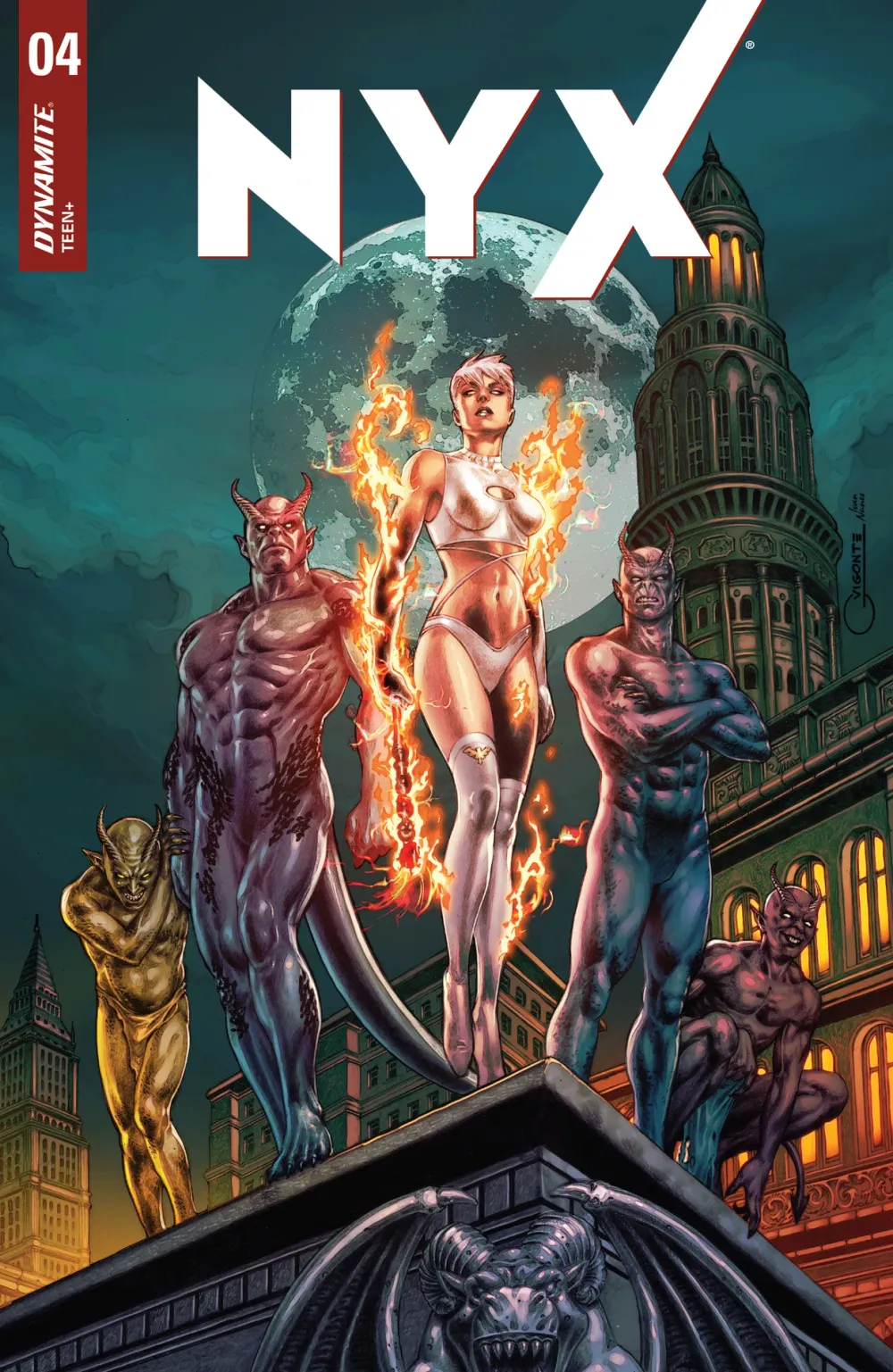
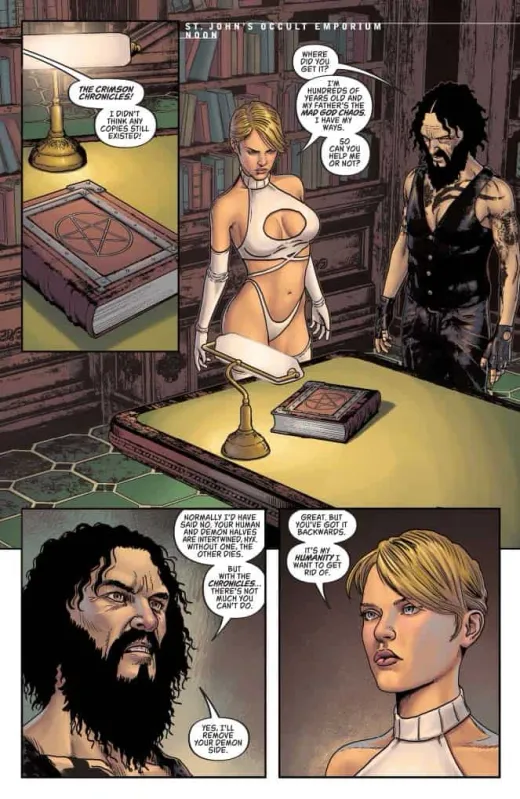
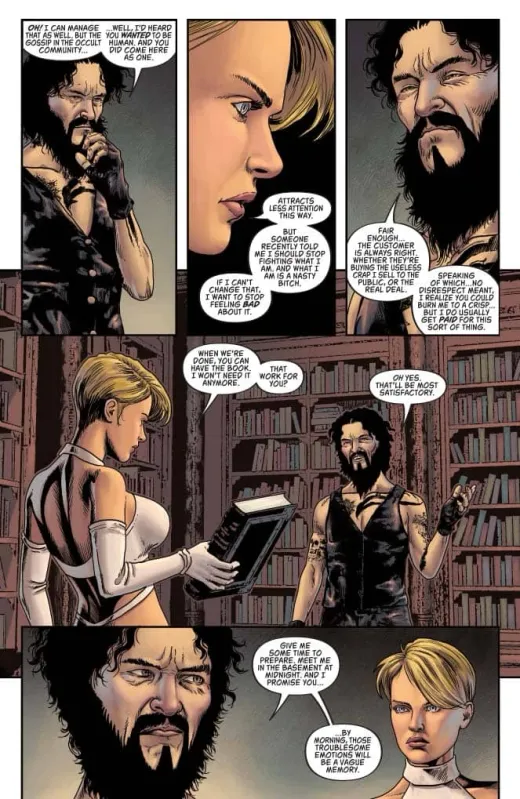
Nyx wants to use the Crimson Chronicles to rid herself of her humanity. After her conversations with her father and Vampirella, she has evidently decided that the simplest thing would be to return to a life in which pity, attachment and guilt did not complicate her hunts. It is hardly surprising that she sees these feelings as the problem. As long as Scott and Anna were strangers to her, she couldn’t let them down. As long as she didn’t stop after a meal to think about whom she had killed, she could get on with the rest of her evening. Once her human half is cut away, all of this seems easy to deal with again.
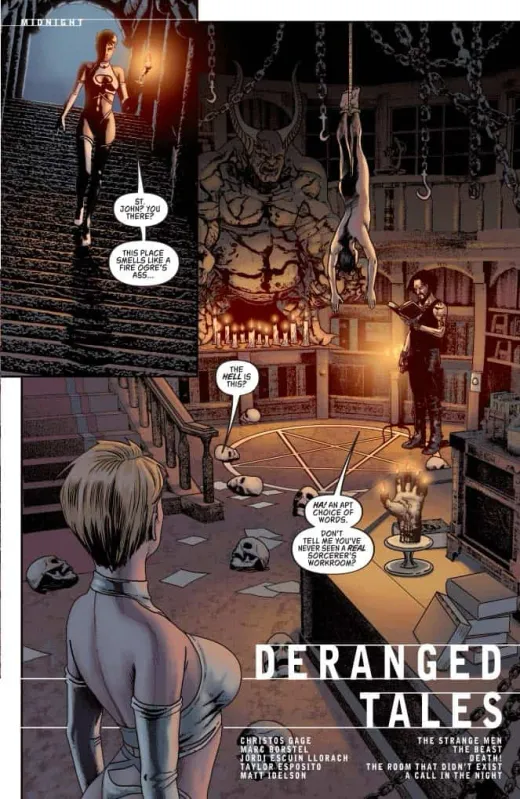
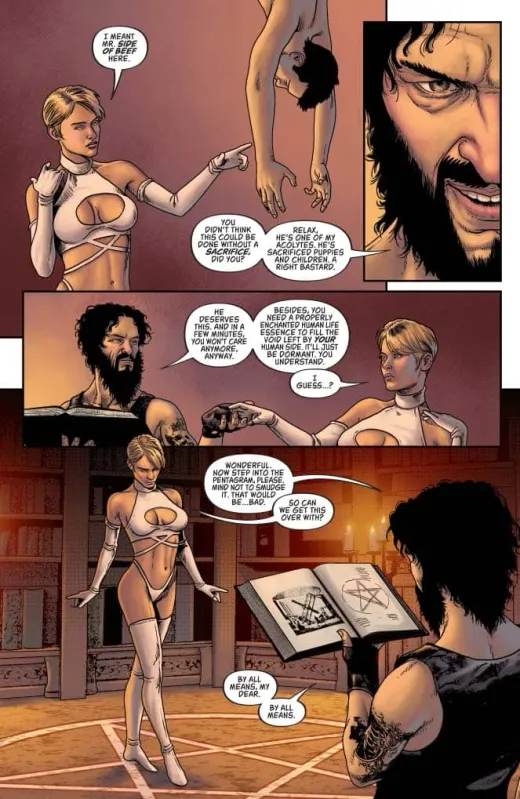
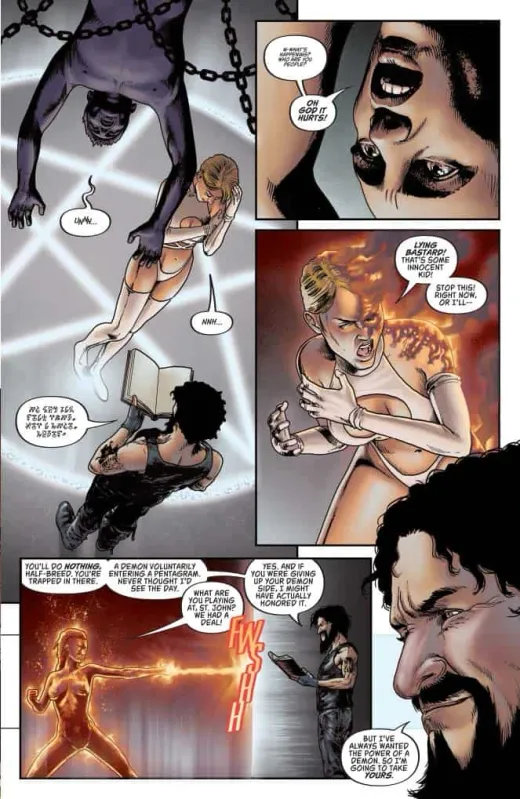
She needs the help of an occultist, St. John, who demands a human sacrifice. He presents her with a bound man whom he describes as exceptionally cruel, so Nyx agrees to the ritual. When the victim cries out that he is innocent, however, she tells St. John to stop. It then emerges that he meant to strip Nyx of her demonic power and take it for himself. The occultist turns out fairly quickly to be just the sort of person one would expect to recruit someone for a ritual killing, but the reversal works quite well. It is also worth noting that Nyx escapes with her life thanks to the very instinct she wanted to get rid of.
Victoria Pendragon and anger
Victoria Pendragon, a hunter of supernatural beings, gets involved. To her, the flaming half-demon looks like another job at first. Eventually the two find time to talk in a pub. Nyx tries to explain how she distinguishes the two sides of herself. She puts compassion, guilt and love on the human side and attributes her mounting anger to the demon. To Victoria, however, both sides look human. She herself gets angry and can be spiteful and aggressive, yet she is also capable of caring about others. Gage challenges the stereotypical distinction between anger and love, which are often portrayed as entirely incompatible. Nyx can be one person and still hold all these emotions without assigning each one to a different parent.
Victoria goes a step further and says that a woman cannot stay polite and gentle regardless of what happens to her. On the contrary, if a woman isn’t furious with the world, she probably hasn’t looked at it closely enough. The remark applies to the fiery Nyx, whose very body betrays the intensity of her feelings, and to women in general, reaching beyond the world of the comic. Why should Nyx regard her own fury as a sign of her demonic nature when every woman has more than enough human reasons to be furious?
This is surely the most important conversation in the first five issues, although Gage spells it out a little too plainly. It also suggests that a person’s origins do not determine their place in the world. People shouldn’t let themselves be forced into roles assigned to them from above. This idea connects with Nyx’s troubles and suggests that there are other possibilities besides the two the Mad God Chaos laid out for her. There may be a third way.
It is worth recalling that Victoria is the great-granddaughter of Mordecai Pendragon, Vampirella’s former companion. Her father is Patrick Granville, Mordecai’s grandson, who already appeared in Kurt Busiek’s ‘Magic Tricks’ in Harris’s Vampirella’s Summer Nights in 19927. There he saved his grandfather from men acting on his mother’s orders to kill Mordecai. In Nyx, we learn that he tried to break with the family vendetta while preparing Victoria to defend herself against the dangers he knew. In the Pendragon family, too, one can inherit the wrongs done to others and their reasons for seeking revenge. Patrick already refuses to take part in the revenge in Busiek’s story, and Gage gives his daughter a similar choice when he lets her befriend the being she was hunting a moment earlier.
From Strange Tales to Buffy
Like the previous issue titles, this one too refers to Marvel comics. Deranged Tales recalls the anthology Strange Tales, and the titles around it – ‘The Strange Men’, ‘The Beast’, ‘Death!’, ‘The Room That Didn’t Exist’ and ‘A Call in the Night’ – reproduce the contents of its first issue from 1951. After Tales to Astonish and the Iron Man story, Gage reaches back to older pulp from the Atlas era. Nyx also jokes about her own reading habits. When the man she rescued flees in a panic, the half-demon jokes about his lack of gratitude to his rescuer, saying, ‘Pulp fiction lied to me rather cruelly.’ Victoria, meanwhile, remarks that the role of the blonde vampire hunter is already taken, most likely a reference to the once popular television series Buffy the Vampire Slayer.
Borstel opens the issue with a pentagram, a book and a bound man, moves through a brawl in the city and finally allows himself a few quieter panels in the pub. The change serves the story well, especially since this is the second time in two issues that Nyx has a drink with someone who knows about monsters, which risks becoming monotonous. The first time, she heard why getting close to others was risky. This time, she hears that she can be furious, love people and care for them while remaining the same person. Towards the end she compares the two parts of her nature to the brain and the heart. Since she needs both to live, trying to get rid of either begins to look equally absurd.
Promotional pages from Dynamite Entertainment. Comical Opinions.
Issue 5. Family Meeting
Time with Dad
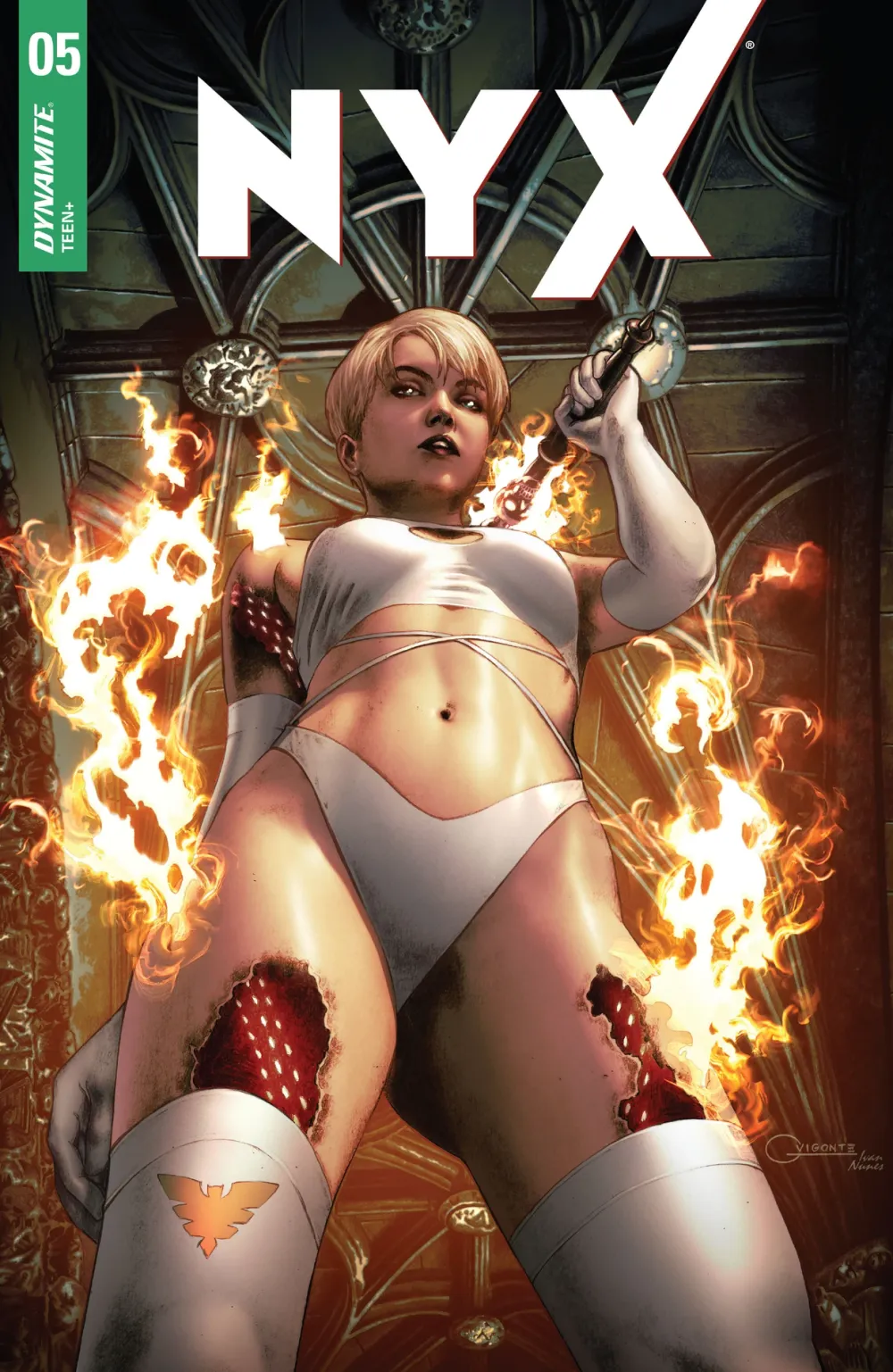
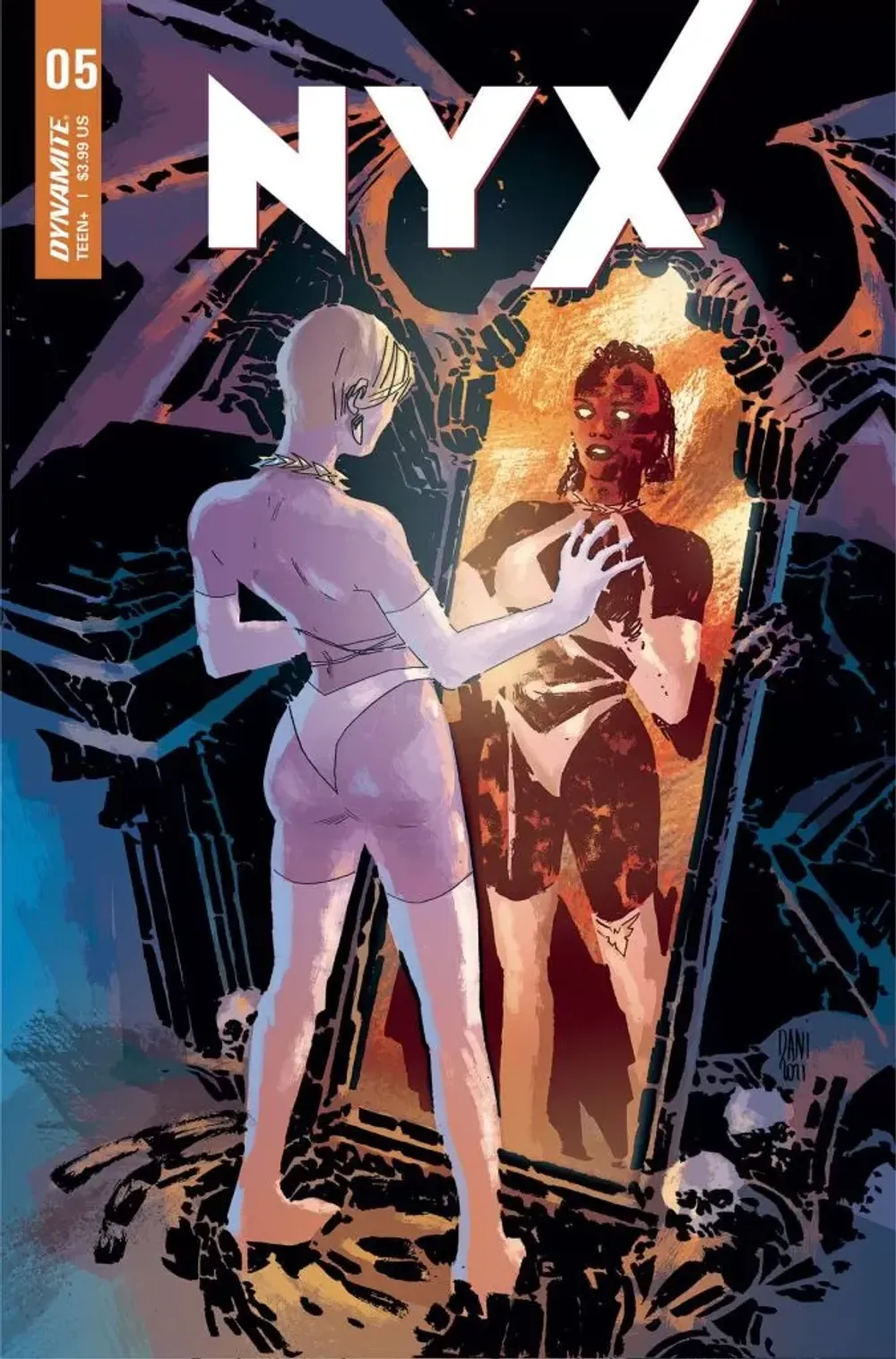
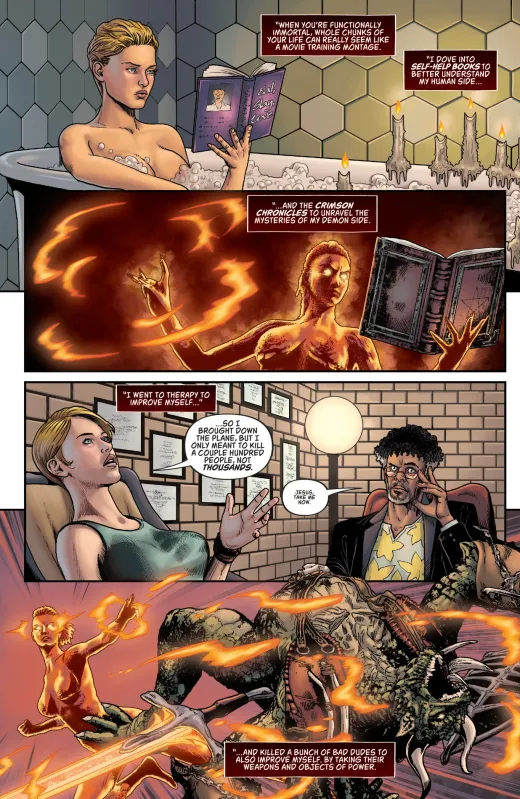
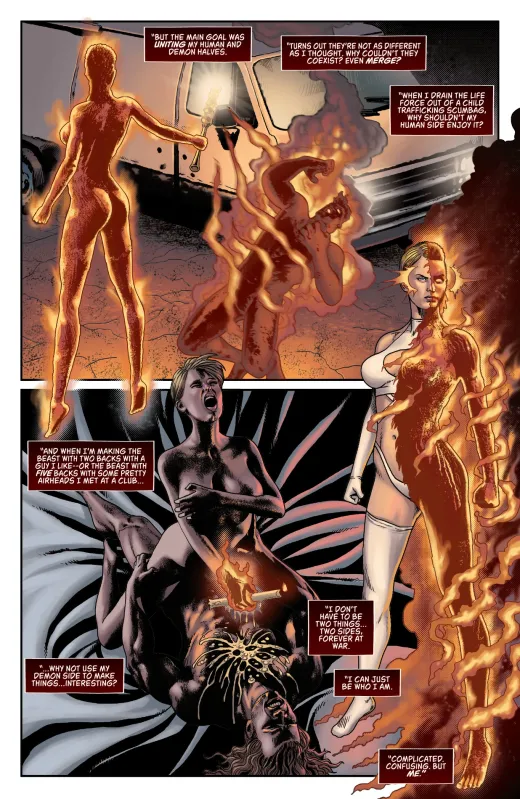
Into the opening montage Gage fits work with the Crimson Chronicles, visits to a therapist, fights with demons and sadomasochistic sex, as well as Nyx’s attempts to sort out her life after the conversation with Victoria. In the course of all this, Nyx discovers how much pleasure she can take in using her demonic abilities on her own terms. When it comes to sex, the beast with two backs from Othello acquires three more8, and Eat, Pray, Love becomes Eat, Slay, Love. In Nyx’s case, there really isn’t much separating killing from eating.
Inventive as the sequence is, the comic could really do with more space to show Nyx’s transformation. In the previous issue she understood why she had misread her own emotions, and here she manages in just a few scenes to put that knowledge into practice and change the course of her life. Setting therapy alongside a magic book is such a good idea that leaving out everything Nyx had to confront in her sessions feels like a waste of its potential. Gage only makes room for a longer conversation that gives us a clearer sense of how she is doing when her father comes crashing down to Earth, kills a few people on the way and announces that it’s time for a family meeting.
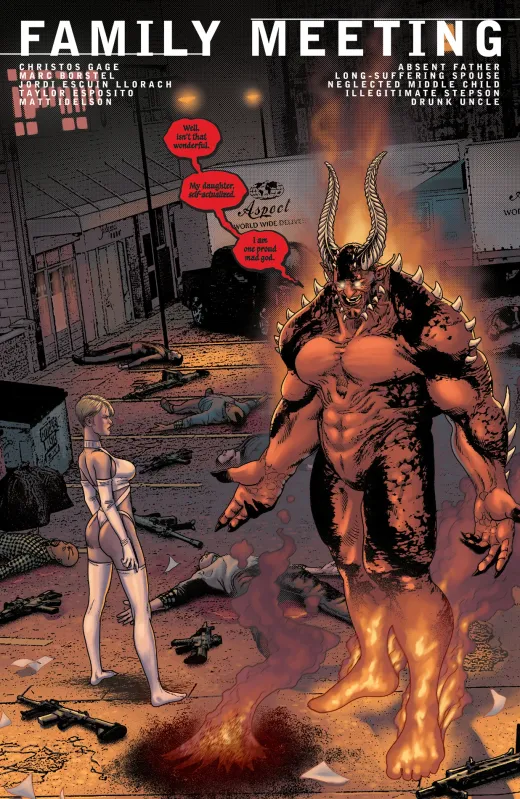
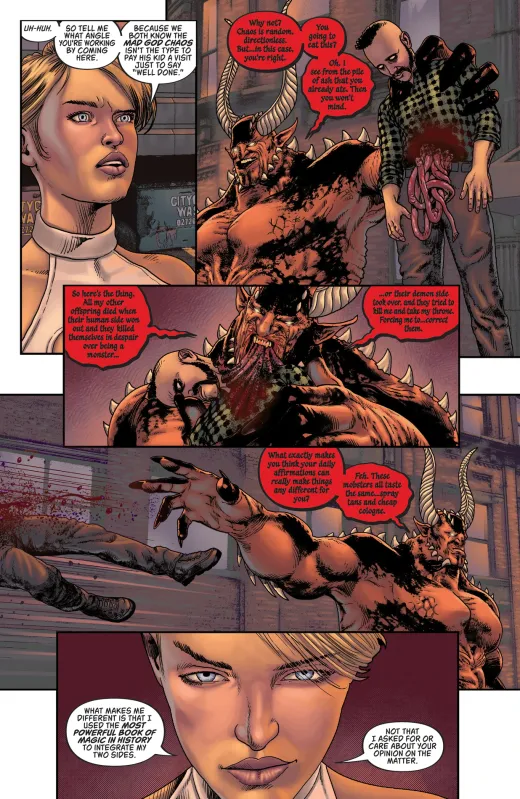
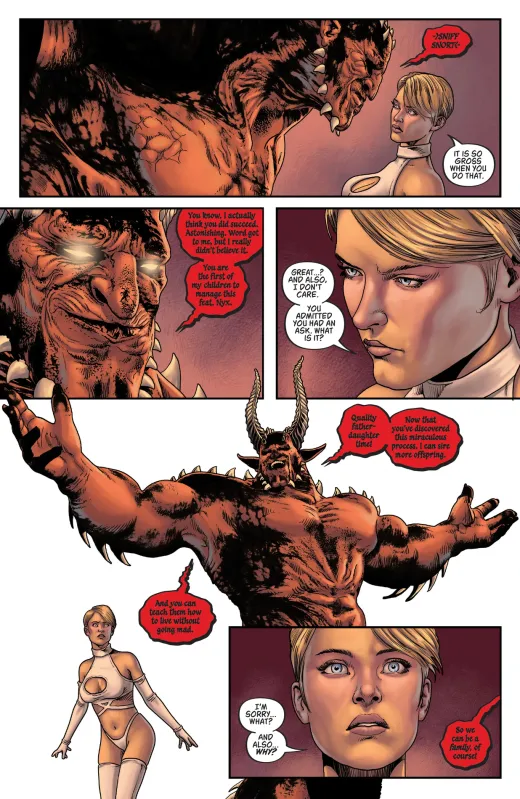
Chaos already knows the outcome of her search and knows that Nyx has escaped the trap of the binary. That changes what he wants. He now wants his daughter to teach her half-siblings how to do the same. His intentions are of course selfish. Once his children stop taking their own lives and coming after him, he can make them commanders in his army. Gage writes the scene in the tone of a conversation with a parent awkwardly trying to catch up on their child’s life. The title page already assigns the characters roles familiar from ordinary dysfunctional families on Earth, including the absent father and the drunken uncle.
Chaos tries to get Nyx to agree by reminding her that her power comes from him and he can take it away. When they fight, their kinship also comes through in the colours and flames. The way Nyx uses fire already shows how much she has done with the ability she inherited. She manipulates temperature, absorbs her own fire and can shape it into a blade. Borstel draws her constantly in motion and gives her father a huge body that takes up almost all the available space. The fight is brief, but the difference in scale alone tells the reader how slim Nyx’s chances of winning are. On top of that, reality needs someone to serve as the Mad God Chaos. The rule is that whoever kills the God takes over his role, and that is precisely the role the half-demon is trying to avoid.
Who pays for peace on Earth?
Nyx chooses to negotiate. She agrees to teach her siblings and wants to leave each of them to decide what to do with what they learn. Her condition is that her father must leave Earth alone. That leaves the question of the people and other beings beyond Earth. Chaos has other places to conquer, and Nyx agrees to help him do so. Gage pays surprisingly little attention to this part of the agreement, given how much space he gave earlier to the fate of even a single one of St. John’s victims. At the altar, Nyx had to acknowledge a stranger’s right to live even if his death would solve her problem. In her conversation with her father, she agrees to a deal that may leave whole worlds paying a similar price. Unfortunately, the writer seems unaware of the contradiction between these decisions.
After five issues
The fifth issue is where Nyx changes course. It is here that a clearer storyline begins to emerge, drawing all five issues together. After her conversation with Victoria, Nyx can finally decide for herself how to use what she inherited, and she would like to give her siblings the same chance. There is an interesting parallel with Hell Sonja. In that miniseries, Hell Sonja’s decisions determine whose souls will satisfy Hell’s hunger. Nyx makes a similar selection on her own, though on a much smaller scale. When the finale gives her the chance to protect certain people from Chaos, the question returns of all those who will be left without that protection. Gage has good material for a continuation here, especially since Nyx’s first adventure ends in a psychological victory for her.
Gage also makes skilful use of the older comics. These issues give us enough to understand why Nyx is afraid of growing attached to Scott’s daughter or seeks advice from Vampirella, but knowing the Warren and Harris comics adds to the pleasure. Gage’s sense of humour is also one of the series’ strengths, especially when the joke comes naturally from how the characters behave after a few drinks or how a demon imagines a successful family gathering.
Taken as a whole, the five issues are interesting, though they lack real punch and the storytelling often feels cursory. Nyx is ultimately a pleasant, undemanding read. Fairly significant for the character’s development, though it doesn’t linger in the memory. It is still worth picking up, especially for fans of the Vampirella universe.
Notes
1. For the character’s origins and the announcement of the series, see ‘Christos Gage and Marc Borstel Launch New Nyx Series From Dynamite’.
2. 2 Kings 17:31 and Jacques Collin de Plancy, Dictionnaire infernal, 6th ed., entry for ‘Adramelech’.
3. See Daniel J. Kevles, ‘A History of Poison’, and the account of Diana Ghirardo’s research on Lucrezia Borgia in USC Today.
4. Nyx #1 in the Grand Comics Database. Cover A and cover B.
5. Hesiod, Theogony, line 116 onwards.
6. Λεξικό της κοινής νεοελληνικής, entry for χειμώνας.
7. ‘Magic Tricks’ in Vampirella’s Summer Nights in the Grand Comics Database. Victoria’s relationship to Mordecai is given by Dynamite in its description of Nyx #4.
8. William Shakespeare, Othello, Act I, Scene 1. Iago uses the phrase.