Script: Christopher Priest
Art: Donny Hadiwidjaja
Colours: Mohan
Letters: Willie Schubert
Publisher: Dynamite Entertainment
Published: 15 December 2021–1 June 2022
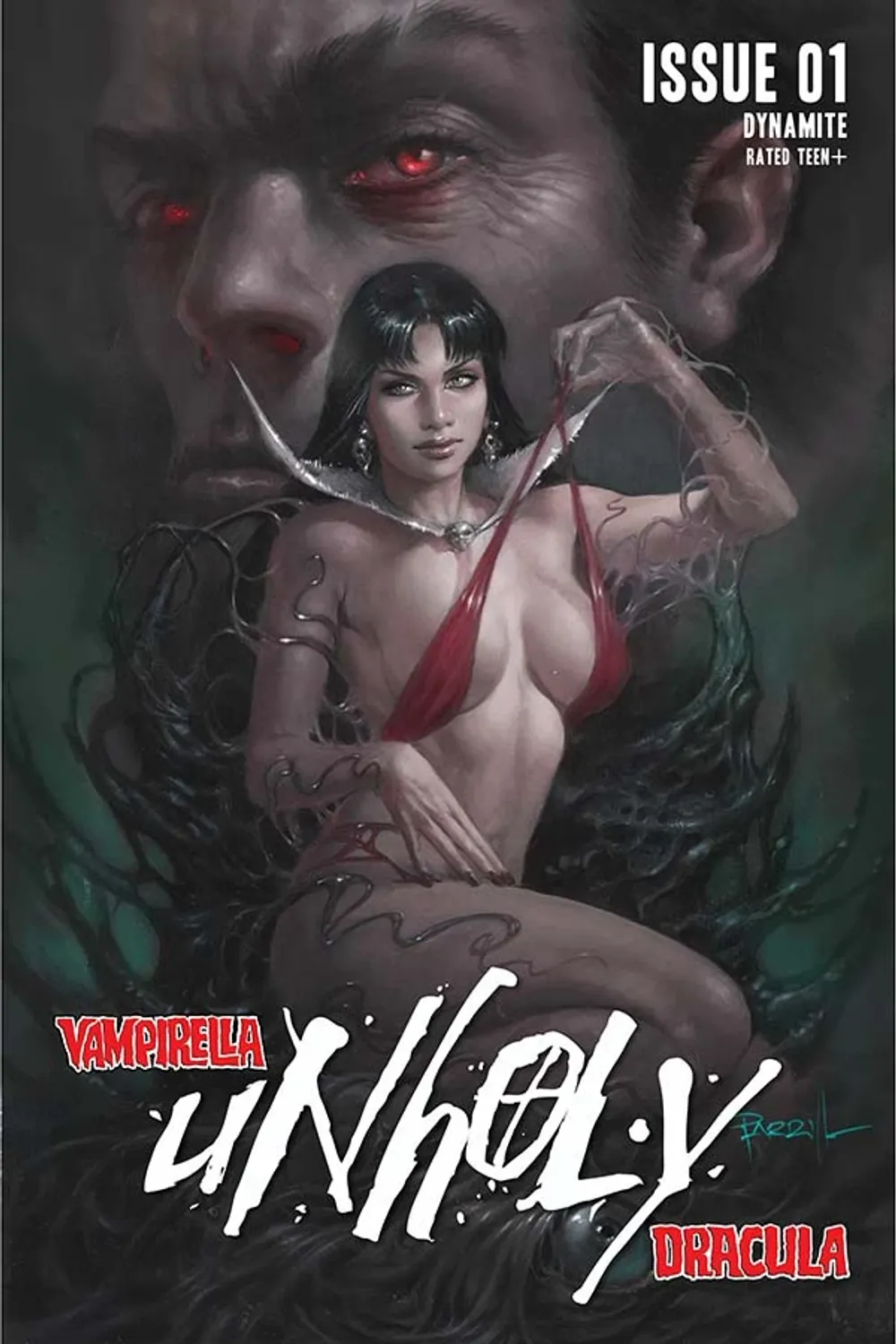
I admit that when I picked up this miniseries, I expected a typical crossover featuring two characters trading blows in a fairly unambitious story with little bearing on their respective histories. I was completely wrong. Vampirella and Dracula have been battling each other since 1972, and Vampirella/Dracula: Unholy is a direct continuation of Priest’s earlier Vampi series published by Dynamite. Moreover, the events of this miniseries were later developed further in Vampirella: Year One.
Nor is this comic a simple brawl between two vampiric beings – the extraterrestrial Vampirella and the undead Dracula – but a surprisingly serious and dark story. The Transylvanian bloodsucker stays in the shadows for almost the entire miniseries, emerging as a master manipulator rather than a handsome man in a cape trying to suck the blood of virgins he encounters more or less at random.
To my mind, the series’ greatest flaw is the way it is promoted as a standalone work. In reality, it can be treated as issues #26–31 of the Vampi ongoing series that ended in 2021. Readers unfamiliar with that run begin the story feeling lost: they do not know who is who or why Dracula differs so much from his classic image.
Let us therefore look at each issue individually and analyse its ideas. For the sake of clarity, I should add that the text below is less a review of the miniseries than an analysis that makes no attempt to avoid spoilers, combined with a subjective assessment of the comic.
Issue 1. A Fistful of Dirt
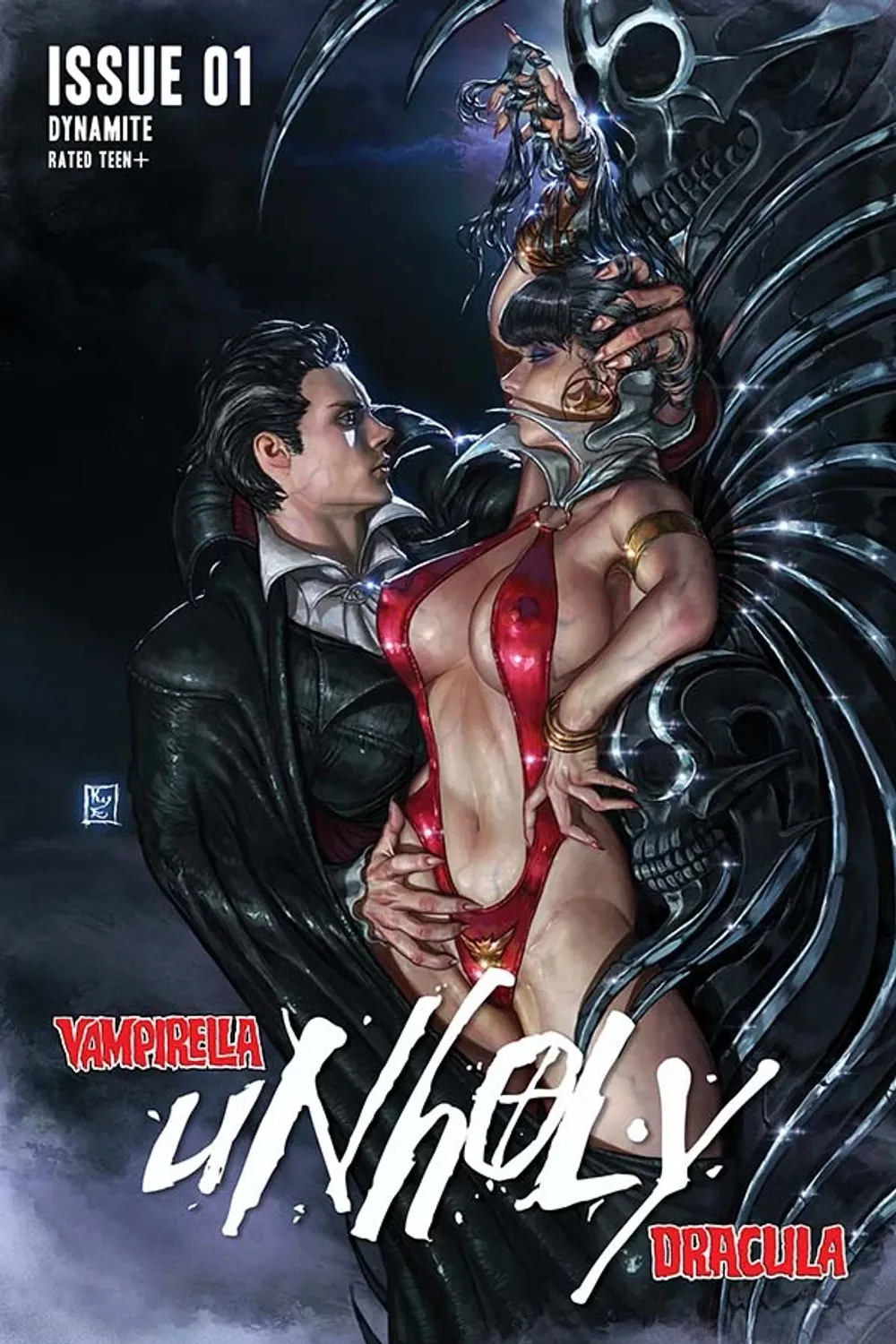
Who is Dracula?
The most important idea developed from the outset of Unholy is the Dracula virus. Matt Ecsed – one of the comic’s protagonists – has carried a virus linked to Dracula’s genetic material since childhood; it passes between people and also has a metaphysical dimension. The miniseries continues the idea of science and magic coexisting, familiar from Vampirella stories, stressing that both science and mysticism are needed to fight the infection. The CDC, an organisation known from earlier comics, studies the biological mechanisms of infection, while the blood ritual and Transylvanian soil act on its occult aspect. The treatment Ecsed received as a child suppressed the virus, but a magical element is required to eliminate it completely.
An intriguing portrait of the legendary vampire begins to emerge in the very first issue. Dracula – as a virus – infects not only bodies but also culture. He is present in Matt’s DNA, his nightmares, the beliefs of cultists, Transylvanian tourism, shows and advertisements. Although he himself remains almost physically absent, his legend permeates successive areas of the fictional world. In the fifth issue, this interpretation finds clearer support in Dracula’s own words, as he regards his status as a fictional icon as a form of camouflage.
Who is Matt Ecsed?
Although the series’ title foregrounds Vampirella and Dracula, Matt is the psychological centre of the story. He has gaps in his memory, nightmares, an illness whose nature he does not understand, and doubts about the woman who introduces herself as his wife. He is someone entirely different to each institution and person: a patient to the doctors, part of an investigation to the FBI, a potential ruler to the cult, a husband to Vampirella, and Dracula to the castle’s supernatural inhabitants. He himself, however, still insists that he is simply Matt.
The history of Vampirella’s interference with Ecsed’s memory is important and morally ambiguous. As a child, Matt was saved by her and then subjected to a post-hypnotic suggestion that erased his memories of the events surrounding the infection. Vampirella therefore knows more about him than he does himself, and their marriage is burdened by an enormous asymmetry of knowledge and experience. Throughout all six issues, it constitutes a real ethical problem rather than an innocent romantic trick. This is also one of the comic’s strengths, as it allows its characters to make questionable decisions even in pursuit of worthy goals.
It is worth observing that although Priest uses a familiar fantasy motif – the promise that love will conquer evil – he expands it into an entire procedure. The wedding, the blood ritual, the joining of souls and the subsequent consummation of the marriage together form the mystical aspect of Matt’s treatment. Marriage is therefore not the culmination of a developing romance; quite the opposite, it is the starting point and a weapon against Dracula. Matt also knows his new wife far less well than the conventional language of a love story suggests.
To some extent, this also reverses Bram Stoker’s Gothic template. In Stoker, the vampire attacks human bonds and marriages; here, the vampiric being Vampirella attempts to use marriage as a weapon against Dracula. This does not give the comic an emancipatory message, but it certainly opens it up to an interesting conflict between institutions, sexuality and individual autonomy.
Transylvania, Drakulon and other references
The motif of the bag of earth, by contrast, is closer to the literary original. In Stoker, the vampire needs his native soil as a resting place. In Dracula, he transports boxes of earth to England, which the protagonists then try to locate. Matt jokes about these vampiric needs, but Vampirella explains that the Vampiri of Drakulon and the Earth’s undead are entirely different beings despite their superficial similarities. Priest thus directly brings together the science fiction ideas of the Warren era (Vampirella as a member of the alien Vampiri race) and late nineteenth-century Gothic (Dracula’s occult, metaphysical dimension). This makes for an interesting contrast, one that Vampirella comics were already using in the 1970s, though rarely with such conviction. The title of the first issue itself – A Fistful of Dirt – is a reference to Sergio Leone’s film A Fistful of Dollars, further emphasising the duel between the title characters.
During the issue, the protagonists arrive at Bran Castle, a place now marketed to tourists as ‘Dracula’s Castle’, although its connections to the literary fortress and the historical Vlad III are tenuous at best. Priest exaggerates the actual commercialisation of the legend, turning the castle into the grotesque attraction ‘Drac’s Digs’: coffin races, Elvis Dracula, advertising slogans, a wedding chapel and absurd tourist attractions. His mechanism of horror rests on the collision between simulation and a genuine supernatural threat. The actual bearers of vampire mythology arrive at an artificial ‘Dracula’s castle’, with comic results. After the comic scenes of souvenirs and shows, however, voices suddenly call out, recognising Matt as their master. The Romanian invocation that appears here – Domn al tuturor veacurilor – means, in the context of the comic, ‘Lord of All Ages’.
One of the more readily apparent associations is Mathias Kronqveist, a name linked in the comic to the castle and Dracula’s identity. It recalls Mathias Cronqvist from the game Castlevania: Lament of Innocence (2003), who later becomes Dracula. A less certain lead is the surname Petulengro, mentioned in the issue and also borne by Jasper Petulengro in George Borrow’s nineteenth-century works Lavengro and The Romany Rye. One might look for a Romani literary context here, but the similarity of the names alone is insufficient to establish a deliberate reference. Priest also tells the story through fragmentary emails, files, flashbacks and accounts by different narrators, recalling the epistolary structure of Dracula, a novel composed of diaries, letters, notes and documents. I did not initially read this as a reference to Stoker – after all, Priest uses similar devices in other comics too – but the fourth issue provides much stronger grounds for the association.
Art and assessment
Hadiwidjaja offers rough, uneven, at times sketchy linework. His faces and anatomy can be highly inconsistent, but the night-time spaces, bats, castle and final eruption of horror benefit from the texture of his art. Mohan, meanwhile, works primarily with cool blues, turquoises and greys, against which Vampirella’s red stands out sharply; the tourist setting of Bran Castle introduces harsher, brighter colours that emphasise its kitsch. This creates a contrast between the combination of horror, mystery and disorientation in the main sections of the issue and the brief respite afforded by the arrival at the tourist attractions.
As in many other Vampirella comics, or so-called bad girl comics in general, the heroine is heavily sexualised. Some of the erotic scenes have a narrative justification, since the story is about newlyweds and intimacy, but numerous pin-up panels objectify Vampi regardless of context, coming across as unnatural, intrusive and childish.
The first issue therefore offers a promising, multilayered conception of Dracula, but refers too frequently to the earlier run, disorientating readers unfamiliar with it. A brief recap of previous events at the beginning of the comic would have been very welcome and should not have presented a problem. Unfortunately, Dynamite rarely helps its readers in this way. The emotional dimension of the reading experience suffers too: a new reader understands most of the facts but does not yet know why they should care about all the relationships.
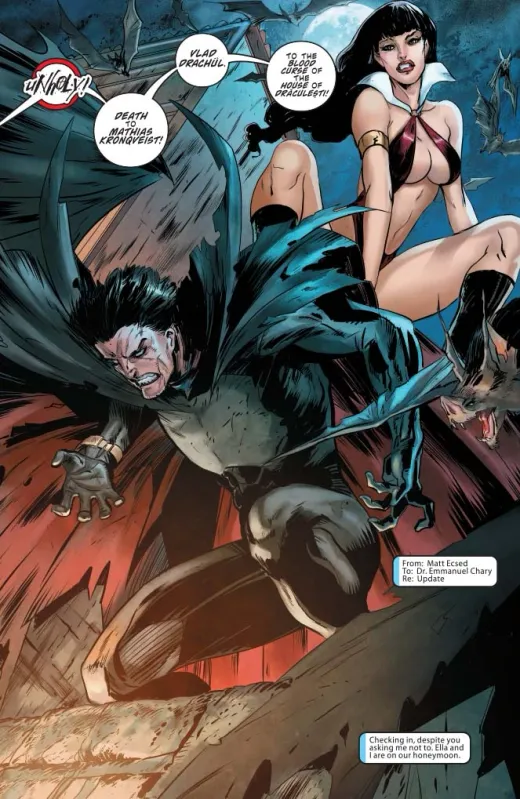

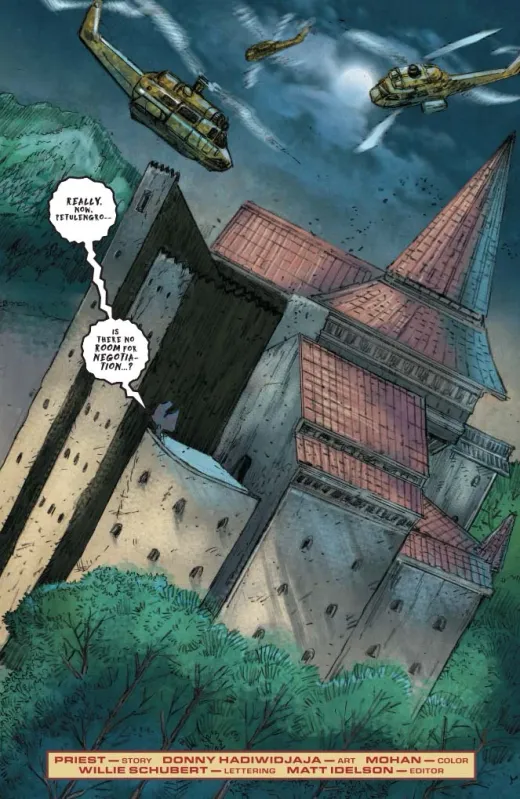
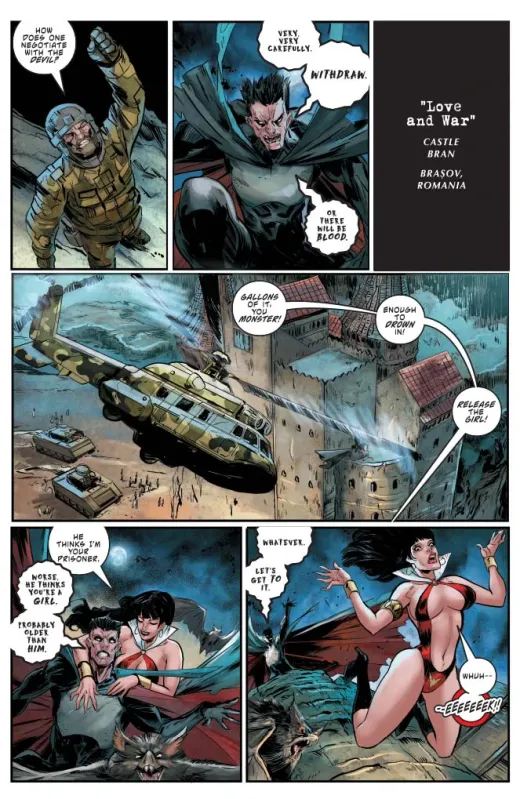
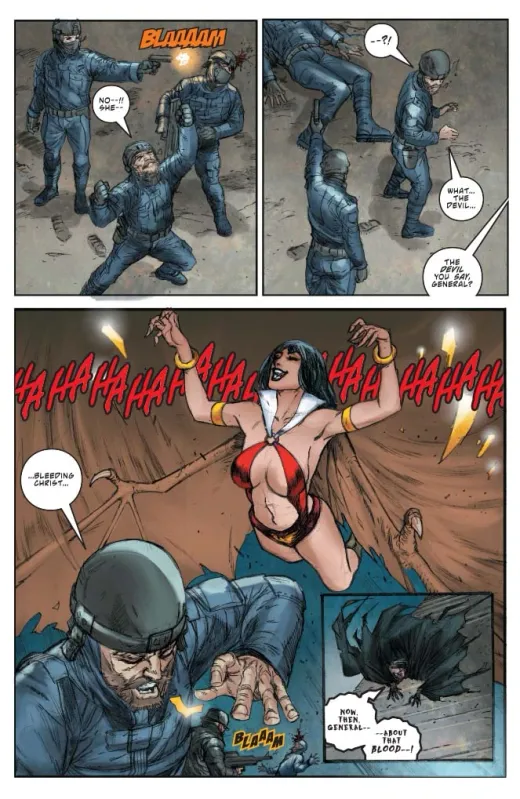
Promotional pages from Dynamite Entertainment. Dynamite Entertainment.
Issue 2. Communion – Better Call Saul – Song of Songs
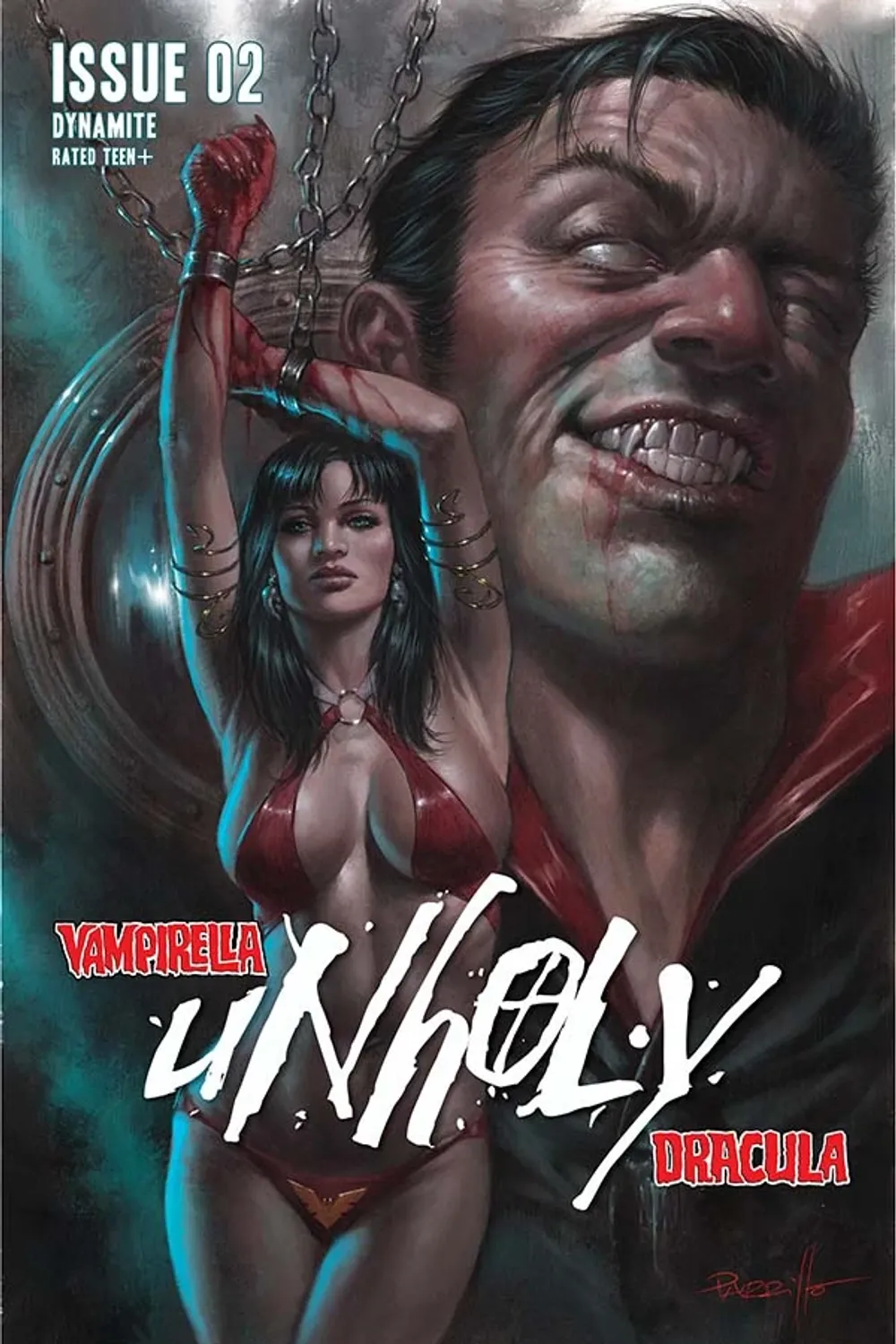
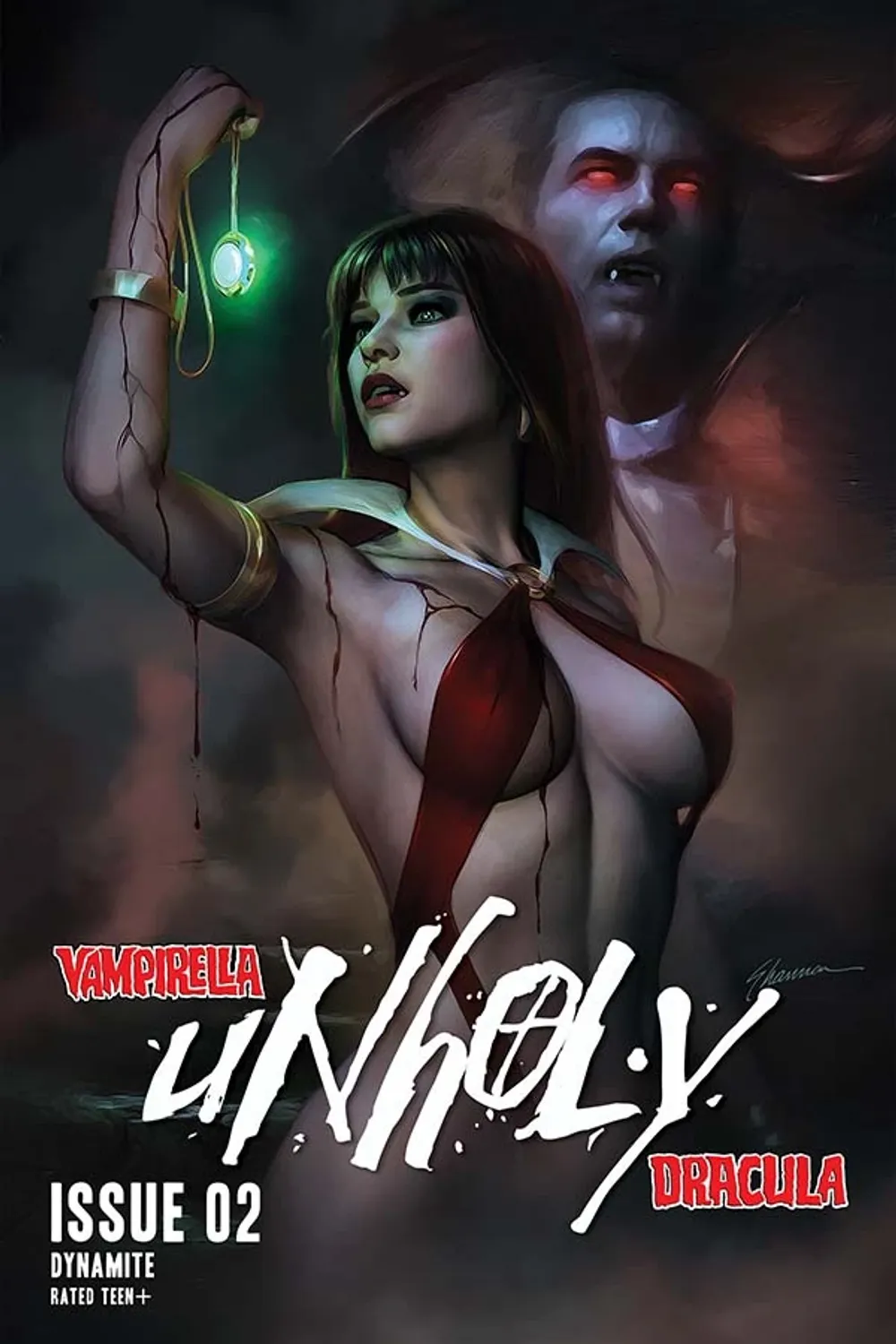
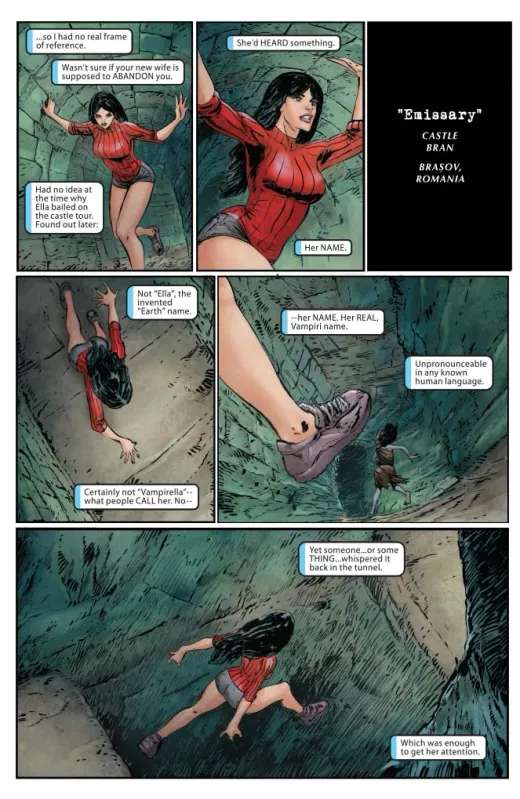
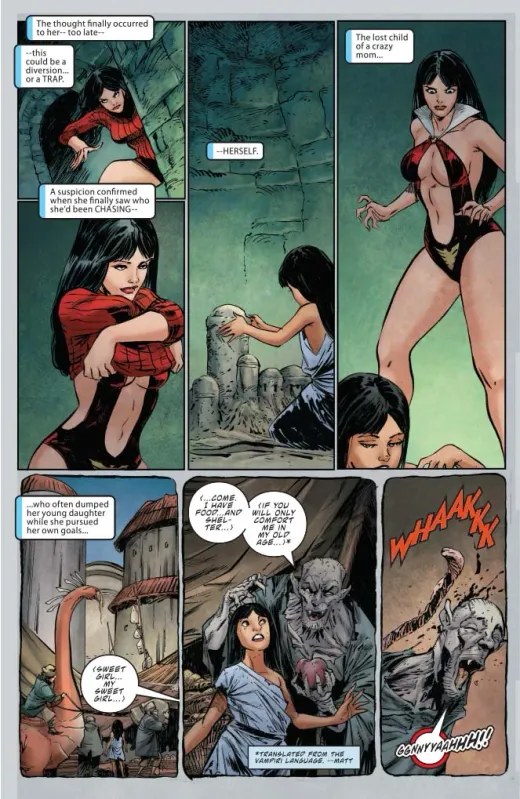
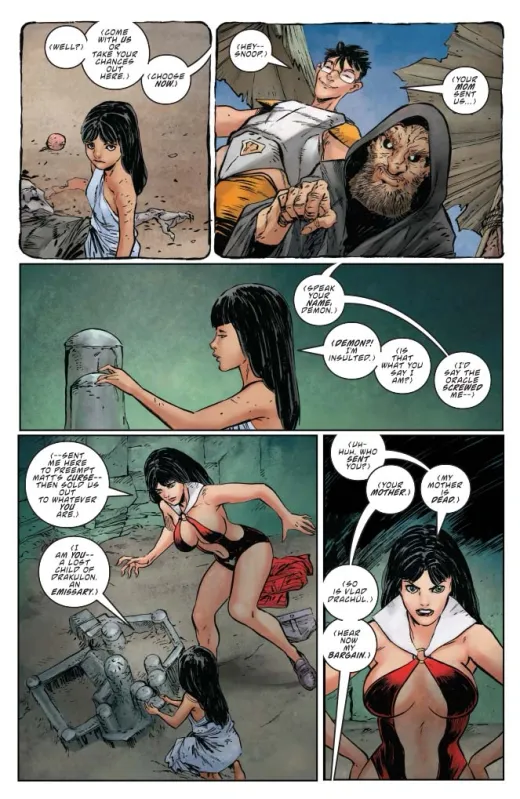
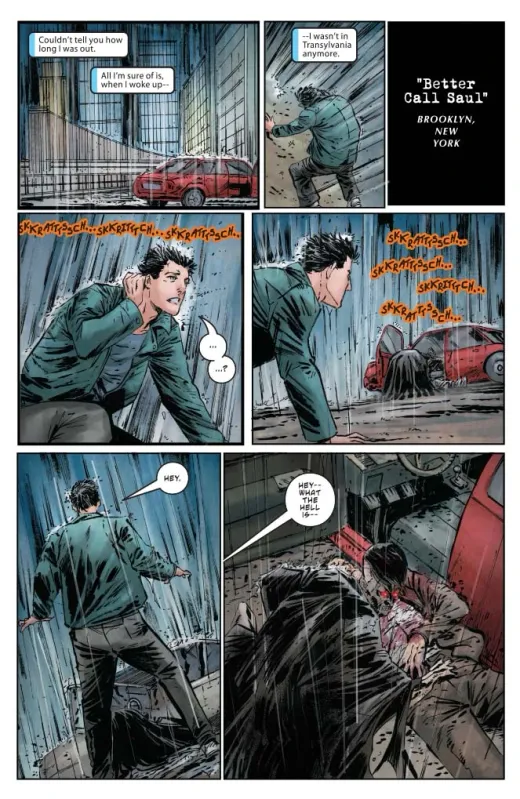
The second issue has no single title; instead, we are given three chapter titles. Priest separates Matt and Vampirella, then confronts them with visions. Vampi meets her childhood self, who invokes her Drakulonian origins, her mother Lilith, and her past and future life choices. Matt, meanwhile, meets Dracula himself, who tries to convince him that they are one being and that he should abandon his existing identity.
This follows a familiar pattern of psychological attack: ‘I know who you really are; stop pretending you belong among humans.’ Vampirella is accused of betraying the Vampiri community by siding with humanity, and Matt of pointlessly resisting his ‘true’ destiny as Dracula. Both, however – as the reader expects – refuse to accept biological and metaphysical determinism.
The idea itself is not particularly original, but a greater problem lies in the way the child Vampirella tempts the heroine with visions of recovering her mother, her world and her bonds with others. These visions refer to earlier events, particularly Sacred Six, but readers starting with Unholy cannot feel the full weight of the temptation. Once again, any recap of earlier events would have helped considerably, especially since the miniseries was promoted as a good entry point for new readers.
A TV series, the Acts of the Apostles, ritual and homosexuality
The title of the second chapter is both a reference to the popular television series Better Call Saul and an allusion to Saul’s conversion in Acts 9:4. The biblical voice asks: ‘Saul, Saul, why do you persecute me?’ In the comic, Dracula addresses Matt as a supernatural authority, attempting a kind of anti-conversion: rather than leading him to a new faith, he urges him to accept himself as Dracula. He even adds that he himself is a god. This, too, is a recurring method in Priest’s work: a pop-cultural joke in a chapter title connects with a much older religious source.
The most important revelation here, however, is that Matt is still in a relationship with his existing partner, Eriq. His marriage to Vampirella is an exceptional procedure forced by circumstances, rather than the culmination of mutual affection. Matt even objects to the sexual completion of the ritual; Vampirella, meanwhile, presents sex as an essential part of the treatment, comparing it to a medical examination. She stresses that she is not asking Matt to fall in love with her, since what matters is her love for him and the magical mechanism of their bond.
Priest therefore depicts neither a crisis concerning Matt’s homosexuality nor an attempt to ‘fix’ his orientation. Instead, he presents a conflict between an existing relationship with a man and a supernatural injunction to marry a woman. At the same time, he does not conceal the moral ambiguity of the pressure placed on Matt. Ecsed can theoretically refuse to participate in the ritual, but when the alternative is the destruction of his identity and Dracula’s rebirth, it is difficult to speak of a free decision. The asymmetry is deepened by the fact that Vampirella knows about events from his childhood that he himself cannot remember. From this issue onwards, autonomy, informed consent and the manipulation of knowledge are among the miniseries’ most important themes.
The Bible, the Eucharist and Bram Stoker
The chapter Song of Songs alludes to the biblical Song of Songs, whose love poetry and sensuality have also inspired a rich tradition of allegorical interpretations relating it to the relationship between God and Israel or Christ and the Church. The ritual in Unholy likewise combines physical intimacy with religious and metaphysical action.
Communion, in turn, opens up the possibility of interpreting the ritual as a blasphemous or alternative communion. Vampirella gives Matt a chalice of her own blood; Matt drinks it during their sexual union. We thus have blood, a chalice, fellowship, marriage, corporeality, sacramental language and the threat of Dracula taking over a human being. The drama can be read as a rivalry between two communions: Matt’s union with Vampirella and his union with Dracula. The word communion also means intimacy and fellowship. In this context, a question arises: with whom is Matt really being united, and will he remain himself at all?
The consummation sequence is visually more subdued than the talkative first half of the issue. There is less dialogue, and greater importance is given to bodies, the chalice, gestures, blood and the supernatural signs distributed across the pages. Dracula seems to intrude into marital intimacy itself, almost between the partners. His Romanian invocation, Domn al tuturor veacurilor, serves as a blasphemous counterpart to a prayer to a king or god.
The issue’s ending therefore leaves an unsettling doubt: has completing the ritual saved Matt, or, on the contrary, supplied Dracula with the missing condition for his resurrection? Vampirella acts in accordance with the prophecy, but the horror arises from the suspicion that the attempt to avert the foretold future is precisely what brings it about. A motif known since antiquity, but one that can still be effective.
Art and assessment
The parallel scenes featuring Vampirella and Matt take place in distinct, cold spaces of illusion. The hotel interior appears to warm the palette, although it soon proves to be another area of Dracula’s influence. Willie Schubert’s lettering distinguishes the supernatural voices and makes the Romanian invocation seem to force its way into the artwork. This is an effective way of maintaining visual uncertainty and showing how Dracula interferes with the protagonists’ reality.
Unfortunately, the problem of Vampirella’s excessive sexualisation remains. The eroticism has a narrative justification here, but the framing still too often serves primarily to display her body. The second issue is, however, much clearer than the first, with an excellent symmetry between the two temptations and distinct religious references. The accumulation of names and references to earlier comics remains an obstacle: Lumea Următoare, Drakulon, Lilith, Scarlet Legion, Sacred Six. Even when some receive a brief explanation, their sheer number makes it difficult for a newcomer to read with ease.
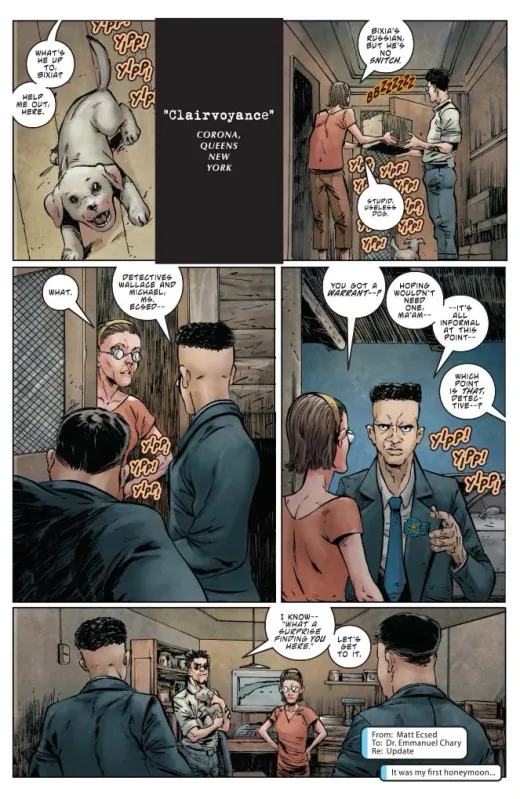
Promotional pages from Dynamite Entertainment. Dynamite Entertainment.
Issue 3. Homeland
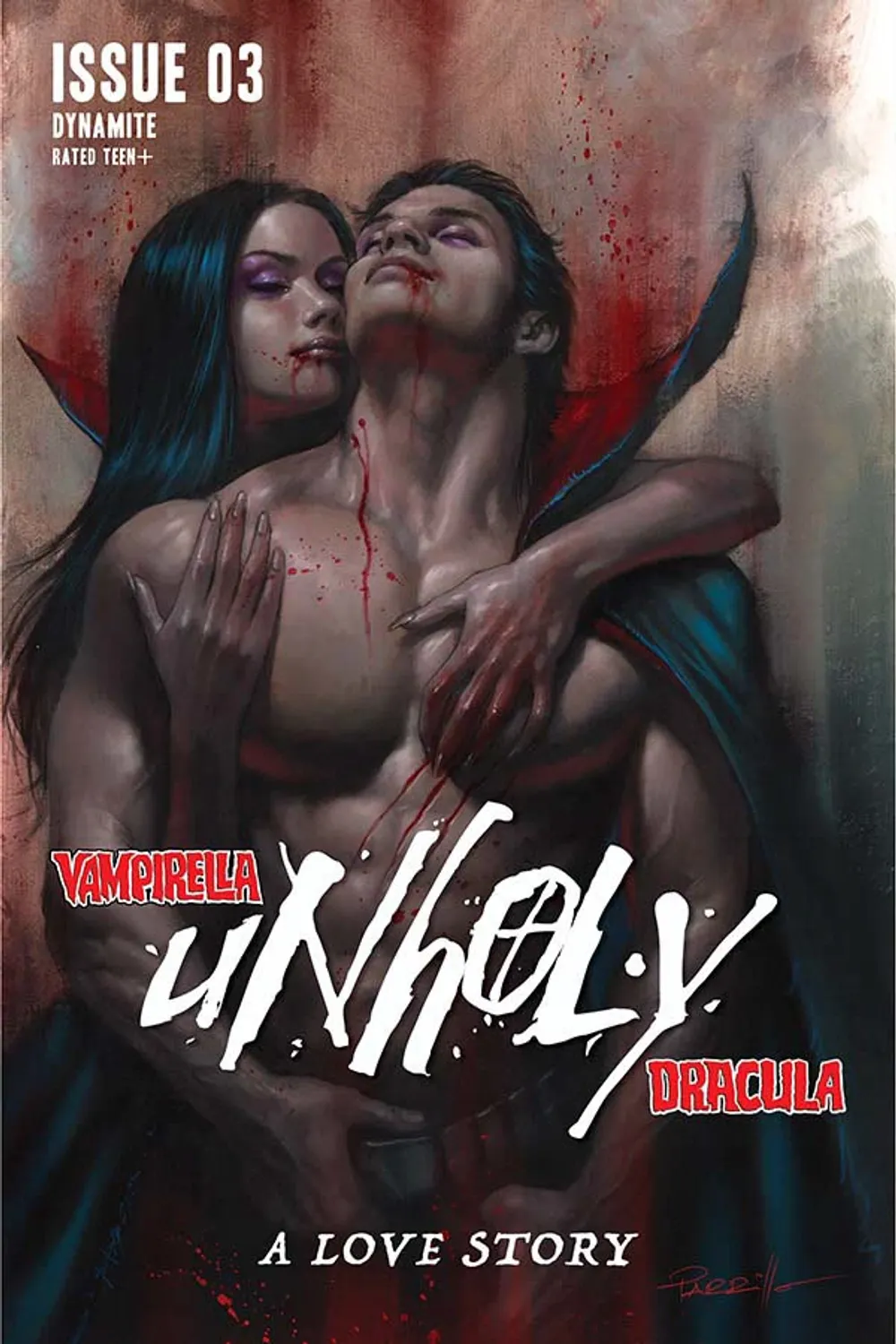
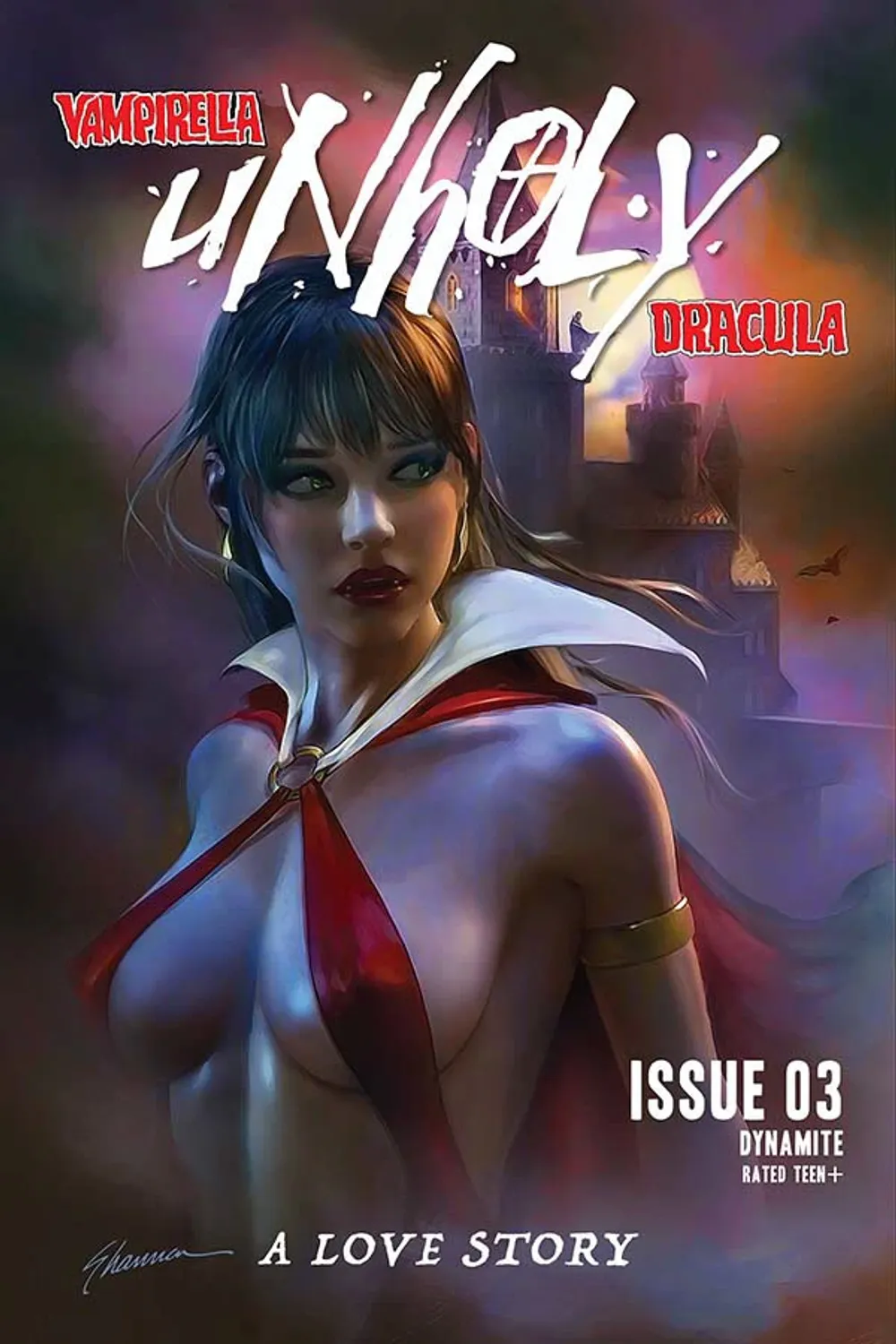
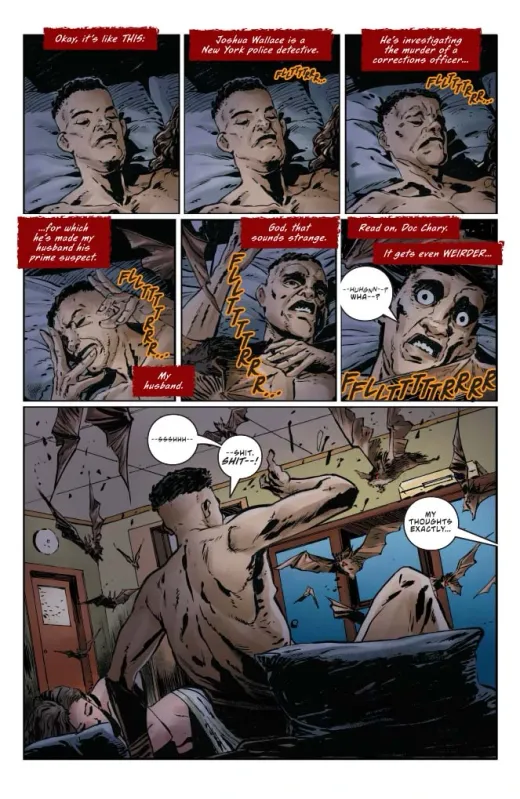
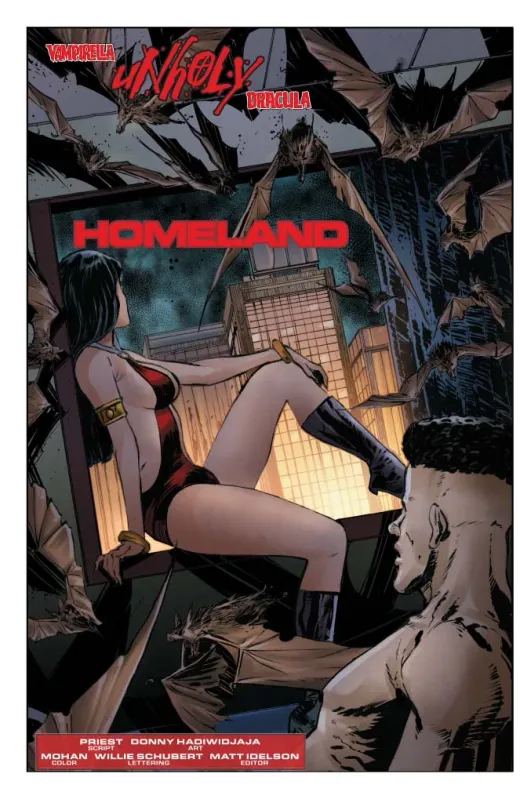
The title Homeland can be read both literally, as the protagonists’ return to the United States, and ironically. The earlier ‘Welcome home’ at the castle located Matt’s home in Transylvania, but since Dracula exists as an infection carried by the human body, each new body can become his home. The return to New York also transforms what has so far been a Gothic tale into domestic horror, a crime story and a police procedural. The crypt gives way to a flat, while laboratory results and investigative records appear alongside the mysterious curse.
One can also invoke the reading of Stoker’s Dracula as a novel about reverse colonisation: a foreign force invades the imperial world and threatens its biological and cultural boundaries. In Priest, the threat no longer needs to sail over from Transylvania; it is now inherited, cultivated within Western society and concealed in the body of a citizen. Geographical colonisation gives way here – whether the writer intended it or not – to the colonisation of personality itself.
The stay in the United States also reveals the emotional consequences of Matt’s decision for his relationship with Eriq. In the first two issues, the mystical marriage was treated as a procedure required to save the world. Matt’s conversation with Eriq in the third issue dismantles this convenient explanation. For Eriq, Matt has not merely taken part in a ritual: he has married someone else, withheld important information from him and had sex with her. Within the protagonists’ supernatural logic this may have been necessary, but within the logic of an actual relationship it is a betrayal of trust.
Particularly telling is Eriq’s paradoxical response, which can be rendered as: ‘You could at least have lied to me.’ It sounds like a desperate plea for anything that would allow him to retain the belief that they shared something special. This scene gives the story human stakes more effectively than the earlier lectures about the virus. The threat to Matt’s identity therefore turns out to be not only Dracula but also his imposed role as Vampirella’s husband, which conflicts with his orientation and hurts his existing partner.
Vampiric and family motifs
In this issue, Matt increasingly encounters classic Stokerian vampire motifs: a wolf, a monstrous winged figure and, finally, the absence of a reflection in the mirror. On the one hand, these are Dracula’s traditional attributes; on the other, they are another manifestation of the ‘cultural virus’. Matt’s body and perception begin to reproduce Dracula’s culturally established image. This is no longer merely a genetic infection, but the imposition of a role.
It is worth adding that the mirror scene is among the simplest yet strongest moments of pure horror in the series. For Matt, the real nightmare of having no reflection is psychological rather than physical. In a story about the annihilation of identity, the missing reflection becomes a metaphor for Matt’s personality disappearing and another being taking its place.
Matt’s mother and Vampirella’s mother, Lilith, also arrive at his home. The comic briefly shifts towards a sitcom about mothers-in-law, but unease grows out of the comedy: the newlyweds cannot build their own relationship because they are immediately surrounded by family claims and obligations. Matt’s mother represents his human roots, and Lilith Vampirella’s Drakulonian heritage. Moreover, Dracula also asserts a quasi-familial, metaphysical claim of ownership over Matt.
Lilith is particularly suspect in this group, especially since Vampirella was convinced she had witnessed her death. It is therefore unclear whether the visitor is the real Lilith, a projection, an impostor or someone else from the earlier mythology. Priest thus consistently shows that recognising a face and a voice does not guarantee recognising a person.
He also continues to refer to earlier characters and events. This time, he brings in Brittany, a character connected with the mythology of the Scarlet Legion and Church structures. Vampirella asks her whether Dracula can really return. Her answer is a grim counterpart to the promise that ‘love will conquer evil’. According to Brittany, the surest way to stop Dracula is to kill Matt before he loses his humanity.
After Vampirella leaves, however, a suspicious figure appears beside Brittany and speaks to her, while her behaviour casts doubt on the sincerity of her advice. Priest thus never allows the reader to feel certain about any character or anything they say. We do not know whether the woman is really trying to save Matt or whether her advice was one of Dracula’s tools. The doubts are all the greater because Dracula/the virus is now infecting not only bodies but also minds and the information on which others base their decisions.
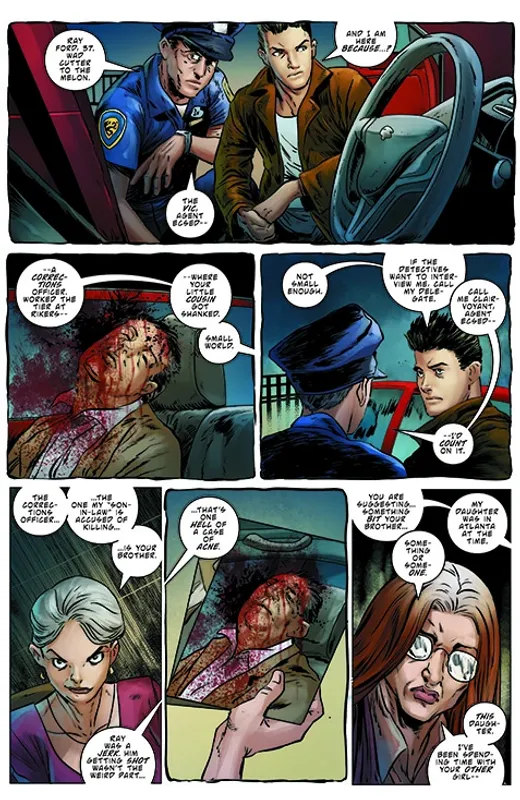
This is complemented by the police investigation into Ray Ford’s death, which stems from events in the previous series. It combines ordinary wounds with signs of a vampire attack: a gunshot wound and fang marks, injuries and blood loss. Once again, Priest shows that the magical and scientific orders coexist in his work. The problem is that the officers are trying to fit the findings into a narrative that does not account for Dracula, who hides behind a web of lies and manipulation.
References, art and assessment
Matt’s surname, Ecsed, may have been conceived as a reference to the Báthory de Ecsed family and the historical Erzsébet Báthory, who became the ‘Blood Countess’ in later popular culture, conventionally associated with vampire iconography. Combined with the previously mentioned resemblance between Mathias Kronqveist and the character from Castlevania, this allows us to see Matt as a convergence of several genealogies of legendary and fictional vampires.
The heading ‘The Devil and Mrs. Ecsed’, meanwhile, recalls the title of the film The Devil and Miss Jones (1941). The slang expression ‘going viral’ is used in a triple sense: it refers to biological infection, the spread of suspicion and a myth circulating through culture as information. There is also the cry ‘Hail Brittany’, which may allude to the religious ‘Hail Mary’, especially given the character’s Church connections, though this may be no more than a chance association.
The strongest visual elements are the wolf, the huge winged silhouette and the empty mirror. Hadiwidjaja handles bodily horror, night and shadow well; unfortunately, inconsistent faces and eroticising panels remain his weaknesses. The warm domestic interiors, however, contrast effectively with the dark visions, the purple scene of the conversation with Brittany and the sterility of the hospital.
This issue develops the protagonists’ personal drama most effectively. Eriq gives Matt’s crisis a dimension beyond the abstract threat of the virus. Dracula, meanwhile, begins to infect the very possibility of establishing the truth.
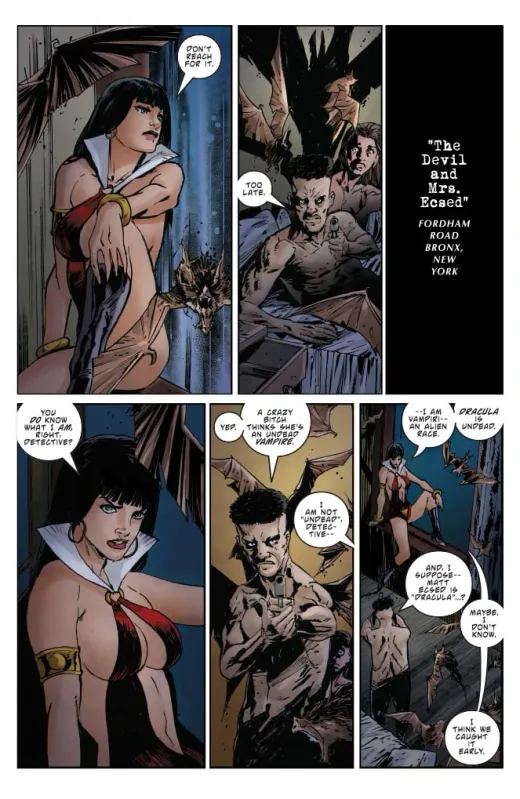
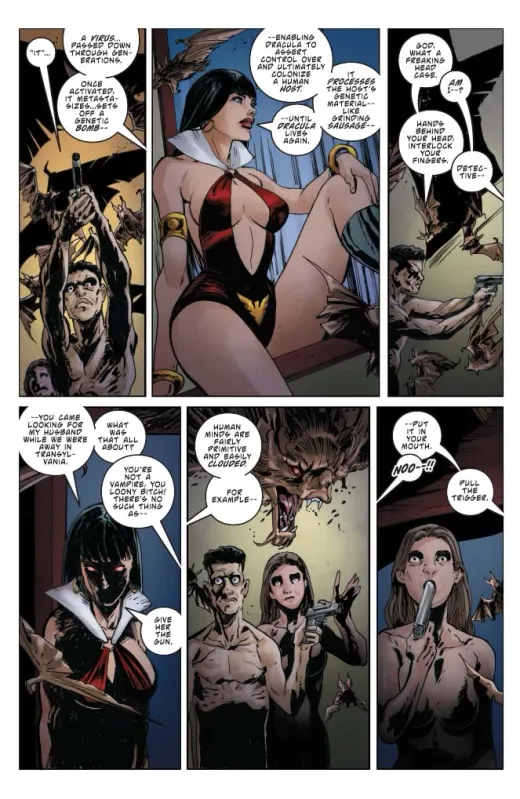
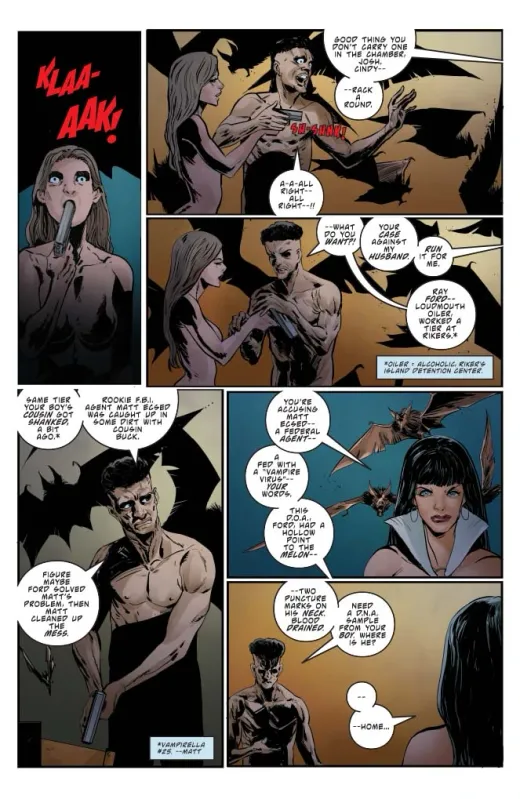
Promotional pages from Dynamite Entertainment. Comics for Sinners.
Issue 4. Maternity
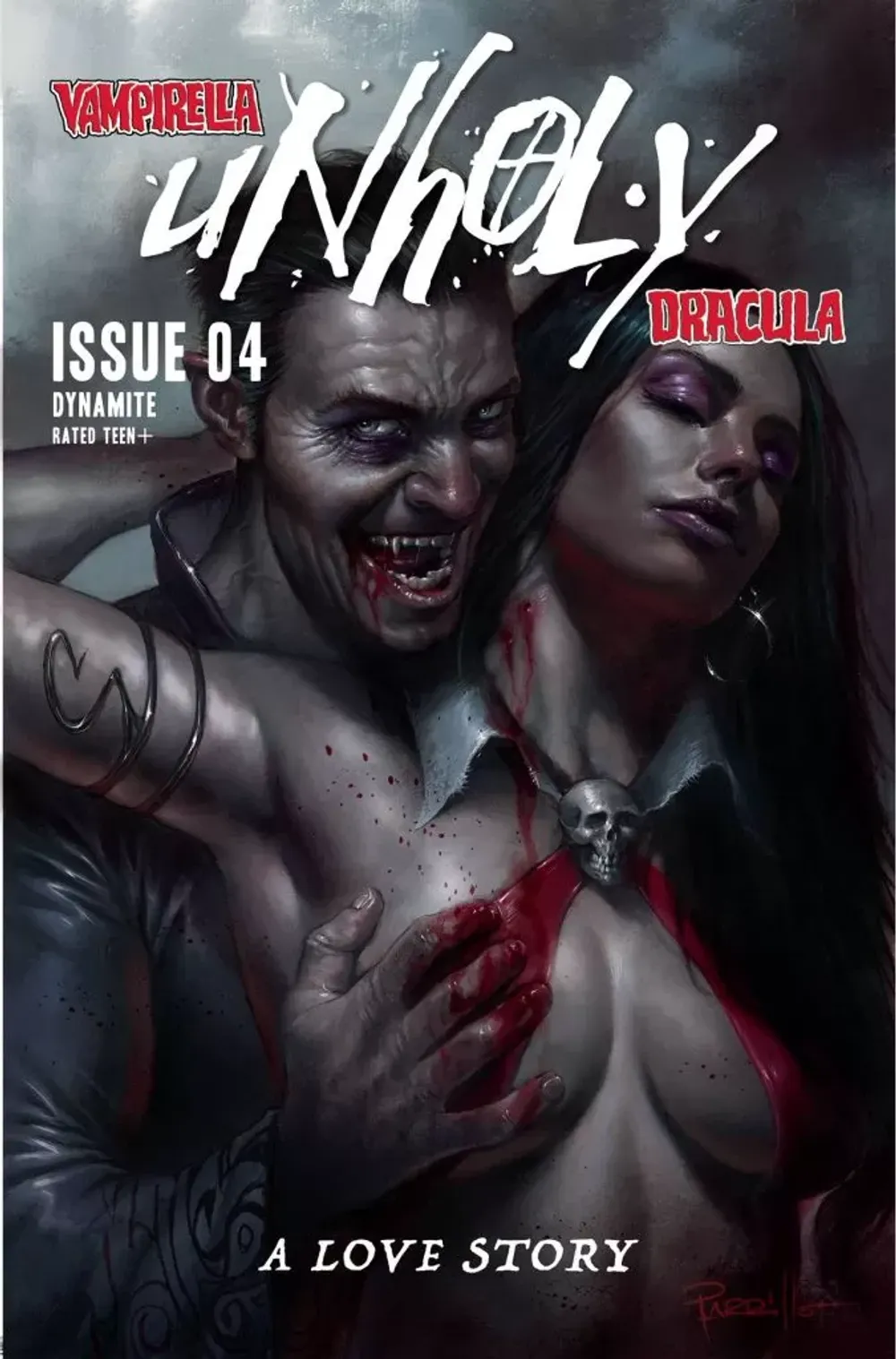
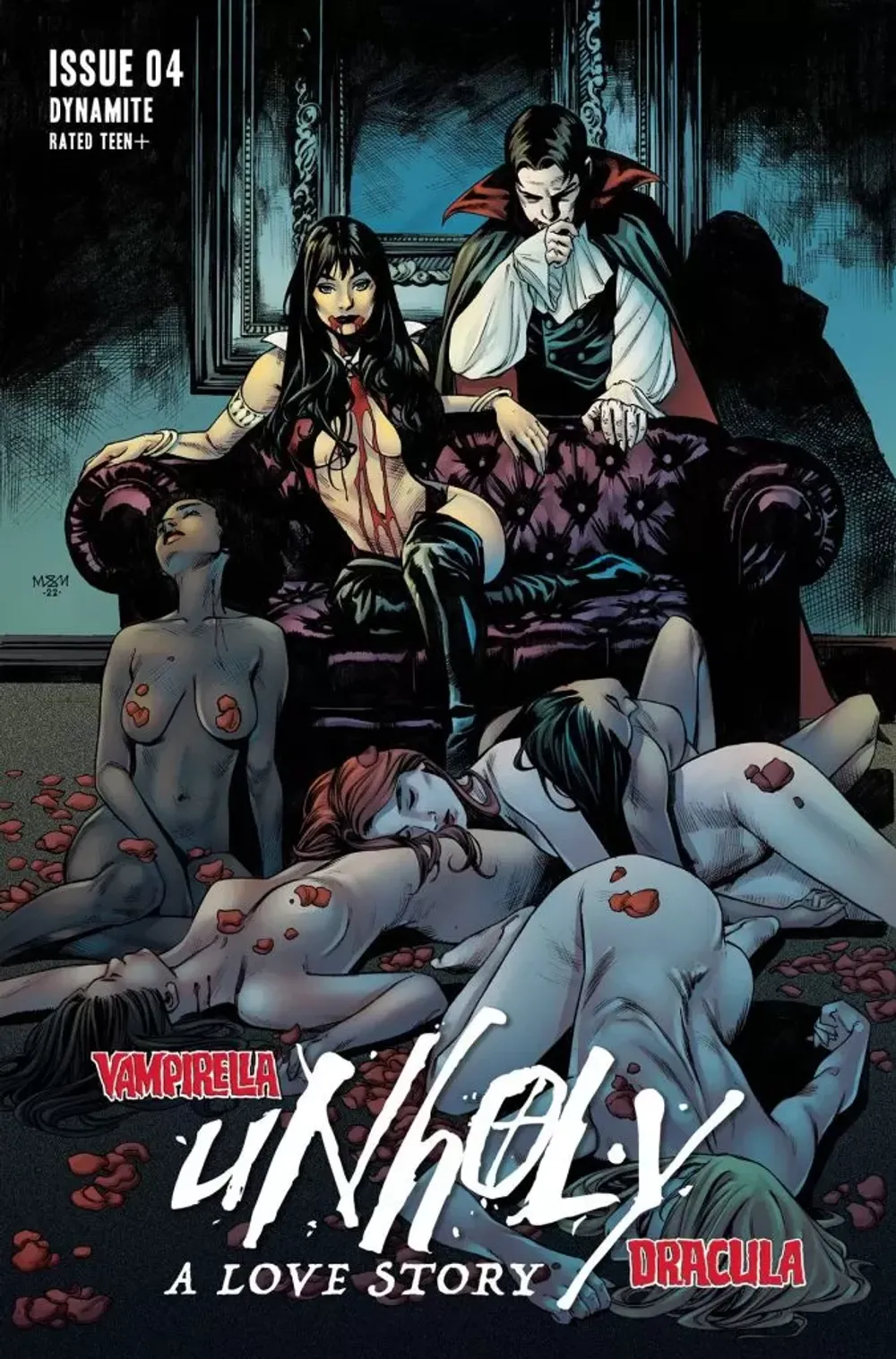
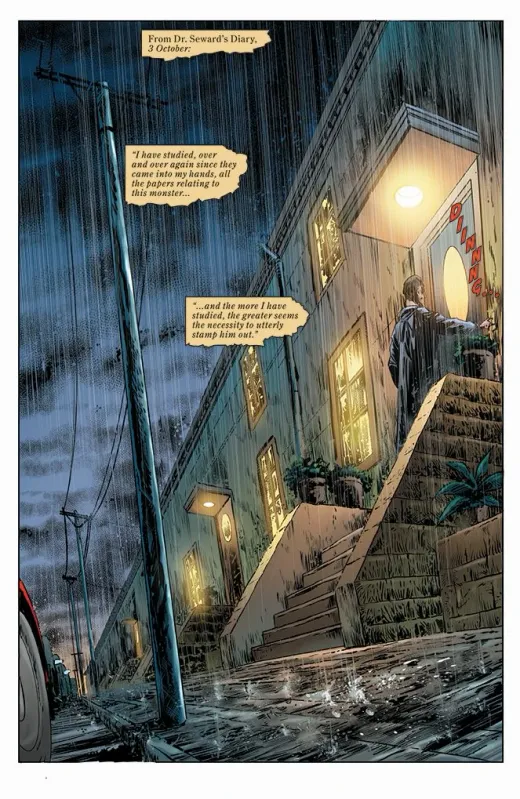
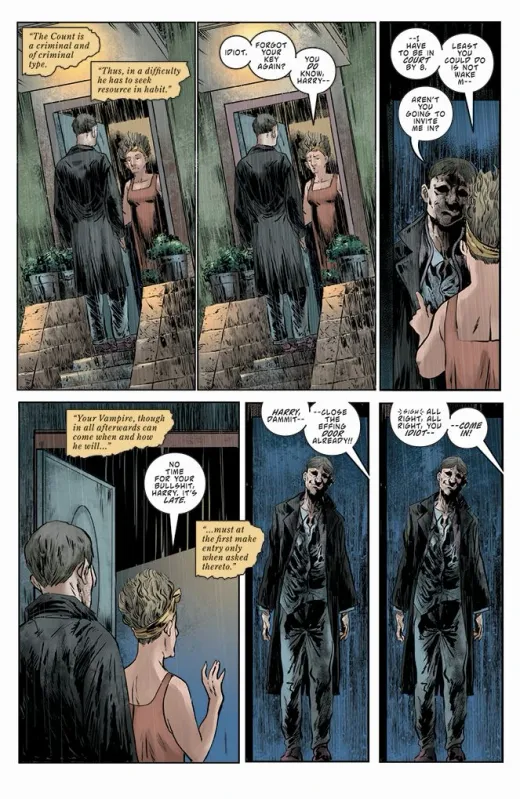
The fourth issue of the miniseries attempts to make Bram Stoker himself a commentator on its contemporary plot. Calling the issue a formal turning point for the series hardly seems an exaggeration. It contains yellowed caption boxes with genuine passages from Bram Stoker’s Dracula. These include Van Helsing’s statements recorded by Seward, the rules governing a vampire’s entry into a home, reflections on the Count’s growing intelligence and his centuries-long patience, and Van Helsing’s later memoranda.
Van Helsing describes Dracula as a being who, despite his enormous abilities, is only beginning to learn how to make use of new circumstances, conducting experiments and testing the limits of what he can do. He even calls him the potential father or promoter of a new order. Priest places these words above scenes in which the contemporary Dracula – one who has already learnt the modern world’s ways – employs similar manipulations. The original novel is therefore not merely a storehouse of Easter eggs, but a parallel commentary, almost a second narrator for the entire issue. This is a highly successful development of the epistolarity foreshadowed in earlier issues. Priest stops merely imitating Stoker’s documents and inserts them directly into his own story.
Ambiguities of words
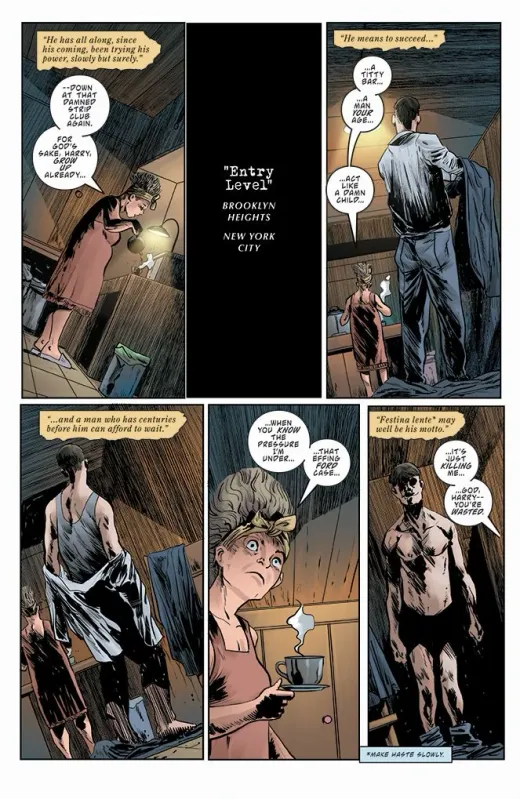
The issue begins with the prologue Entry Level, whose title can be read in two ways. Entry evokes entering a flat, whose threshold the classic vampire cannot cross without an invitation. Entry level, meanwhile, means a beginner’s level, corresponding to the quoted description of Dracula learning to use his powers. In the prologue, someone lets in a person they recognise as familiar, although they are actually dealing with someone else.
This brings back the question of the validity of consent obtained through impersonation. Formally, an invitation has been given; in substance, it may have rested on a lie. A similar problem concerned the wedding, the ritual and Matt’s erased memories. Dracula does not so much circumvent the world’s rules as exploit their weaknesses, particularly where the system demands a gesture of consent but does not guarantee truthful knowledge.
The title of the issue as a whole, Maternity, evokes motherhood: Matt’s mother, Lilith and the family relationships that make the protagonists vulnerable to manipulation all appear. At the same time, Stoker calls Dracula the potential father of a new kind of being. Dracula is reborn by infecting and taking over bodies, thus offering his own parasitic equivalent of genealogy.
An interesting paradox emerges: the feelings that may help Matt retain his humanity also make him predictable and vulnerable to manipulation. He will come to save his mother because he loves her, so Dracula can set a trap based on that certainty. Love can be a weapon against evil, but also proves to be a weakness that evil can exploit. This further complicates the reading of the prophecy from the first issue as a simple promise.
Finally, there is also the Latin ‘Festina lente’, or ‘make haste slowly’, invoked by Van Helsing. Dracula operates on a timescale of centuries, so he does not need to behave like an ordinary villain planning a single attack. He manipulates Matt, Vampirella, the family, the cult, supposed witnesses, memories and bodies. He is not simply a man in a cape who wants to bite someone. He is a patient strategist whose real battlefield is control over the perception of reality and the minds of those he infects.
It is in this issue that the interpretation of the reader’s disorientation as often serving a narrative purpose becomes justified. Priest wants us, alongside the protagonists, to be unsure whether we can trust a face, a name, testimony or a memory. This does not mean, however, that every unclear transition is a successful device. The writer is known for the excessive disorder of his comics, and although Unholy fares better in this respect – and connects his style with the plot – it still proves confusing at times, making us question the rationale behind certain narrative jumps.
The crucifix, the graveyard and the coffin
Vampirella does not trust the Lilith who appears and tests her reaction to a crucifix. In the comic’s world, such a test resembles a laboratory procedure: a classic terrestrial vampire should react in a specific way. If a being can hold the cross, the suspicion that it is Dracula weakens. The limitation of this method becomes immediately apparent, however: ‘this is not Dracula’ does not automatically mean ‘this is the real Lilith’. The test does not rule out other beings or methods of deception, and Dracula can infect minds, which may allow him to circumvent the limitations of a physical, undead body.
This scene successfully combines science with mysticism. The cross is a diagnostic tool, much like the CDC’s tests. Unfortunately, neither test provides complete knowledge of the complex threat it is meant to detect. Moreover, the Vampiri of Drakulon are subject to different rules from terrestrial (Stokerian) vampires, making simple classifications even less reliable.
The scene in the chapter Family Reunion, meanwhile, takes place in a ship graveyard in Rossville on Staten Island, corresponding to the real New York location on the Arthur Kill known as Witte Marine. The location is naturally Gothic: decaying ships, rust, night, water and the remains of structures. The choice of setting suggests the ambiguity of the word vessel, which can mean both a ship and a container or – in the appropriate context – a host. Matt is a vessel for Dracula, and a confrontation about the takeover of human bodies unfolds in a graveyard of ships. The decomposing wrecks visually resemble bodies that have already died but have not yet completely fallen apart. As such, the setting is an excellent reflection of the events depicted.
The issue also contains a splendid idea combining pulp with the Gothic: Dracula’s earth is hidden in a pool table. Instead of a mysterious crypt, we have a furnishing in a modern New York flat. Priest juxtaposes the discovery with a genuine quotation from Stoker about a tomb bearing the name ‘Dracula’. The new world does not invalidate archaic horror, but transforms the crypt into a piece of furniture, further developing the sense that everything surrounding the protagonists is uncertain and false.
The final discovery of the empty resting place likewise corresponds to an earlier passage from Stoker. Both the use of the earth itself and the absence of the person being sought are significant: Vampirella finds material traces of the undead, but again not where she expects to encounter her opponent. Instead, she reaches the suffering Matt and tries to elicit a declaration of his own identity. He says: ‘I am not Dracula.’ In the context of earlier issues, this sounds like a refusal to accept a fate written in blood, genes and someone else’s legend. But the next issue changes this interpretation: the statement turns out to be less a symbolic declaration than a literal clue.
From this point onwards, the comic’s central question is no longer solely: ‘Will Matt become Dracula?’ It is accompanied by another: ‘How do we know the person standing before us is Matt?’ After all, any identity may prove to be a mask or a record of someone else’s memory.
Art and assessment
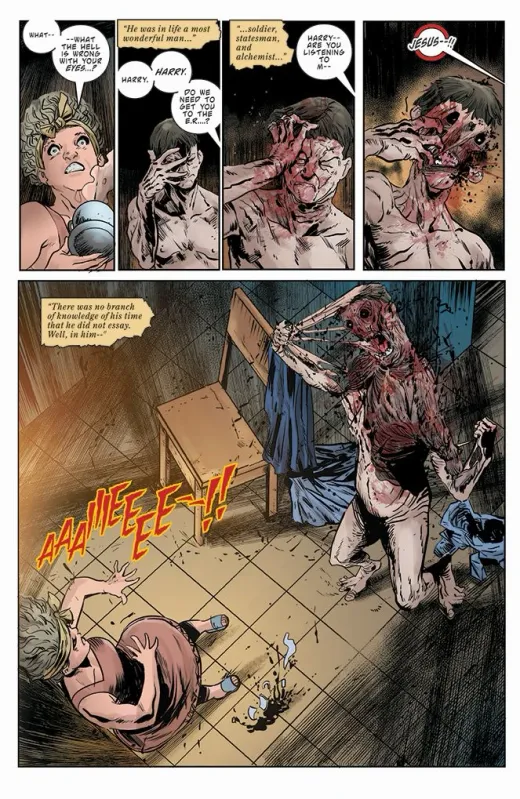
Hadiwidjaja has more opportunities here to use body horror, which is a major visual strength of the comic. Disintegrating skin, desiccated tissue, a cadaverous face and the grotesque transformation of a person taken over by a monster intensify the horror and give Dracula’s presence an almost surreal quality. The infection finally becomes the visible destruction of the body, rather than merely a term in the doctors’ dialogue. The wide panoramas of the ship graveyard, the moon, the creaking wrecks and the contrast between the crucifix’s light and the darkness are also highly impressive.
The problem of the drawn faces nevertheless returns. It is particularly acute when characters deliberately impersonate others. The uneven, at times unclear linework makes it easy to mistake deliberate paranoia for simple visual or sequential confusion. In a story about uncertain identity, clarity in the depiction of characters is particularly important. Even so, this is the strongest issue so far in formal terms, and an example of a meaningful creative dialogue with Stoker.
Promotional pages from Dynamite Entertainment. Comical Opinions.
Issue 5. Contagion
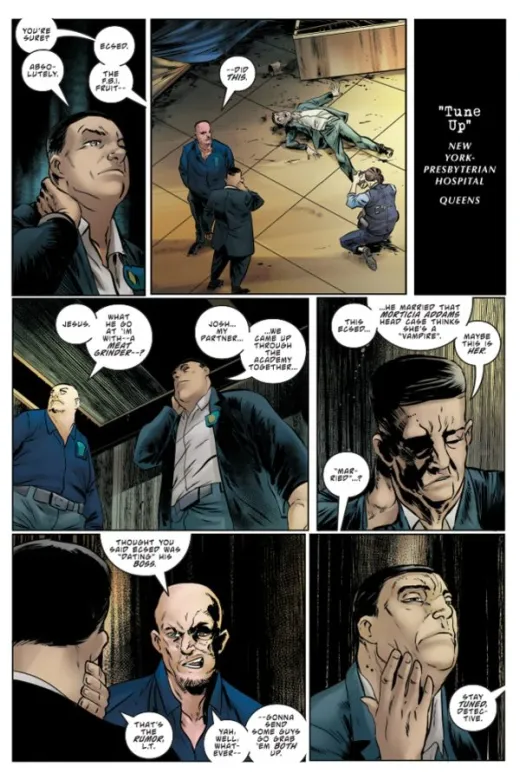
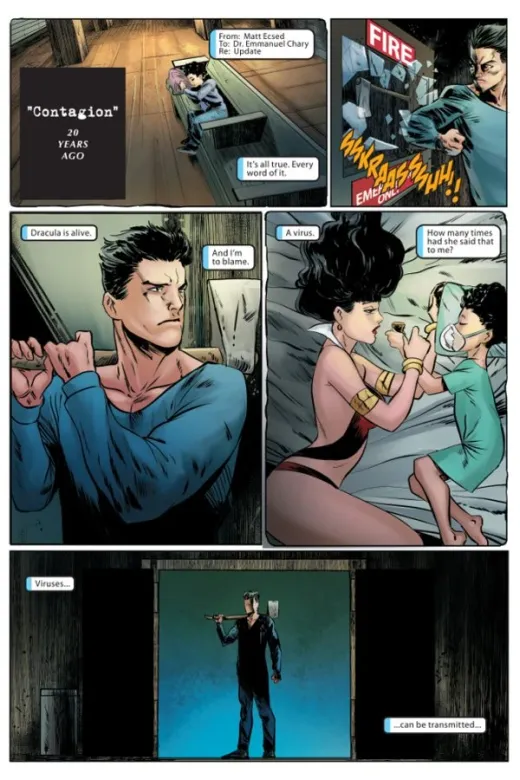
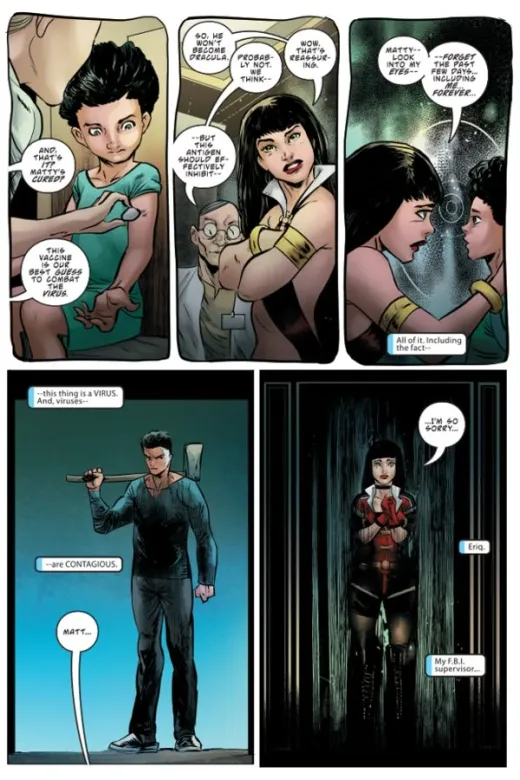
The fifth issue brings a plot twist. Until now, we have been wondering whether Matt will turn into Dracula. It turns out, however, that this question has distracted us from the real threat. Matt carries the virus, but Eriq, infected through sexual contact, has become the host of the reborn Dracula. This explains the literal meaning of Matt’s declaration in the previous issue: ‘I am not Dracula.’
From the very first issue, Priest stressed in the medical storyline that the inhibitor does not remove the infection. The word ‘virus’ therefore needed to be taken literally, even though the threat also had a metaphysical dimension. The way the disease is transmitted proves to be one of the plot’s key concerns. Love, sexuality and infection form an unconventional triangle of transmission: Vampirella loves Matt, Matt loves Eriq, Dracula takes over Eriq and, through his body, desires Matt and power. An ordinary love triangle becomes a web of biological and emotional dependencies.
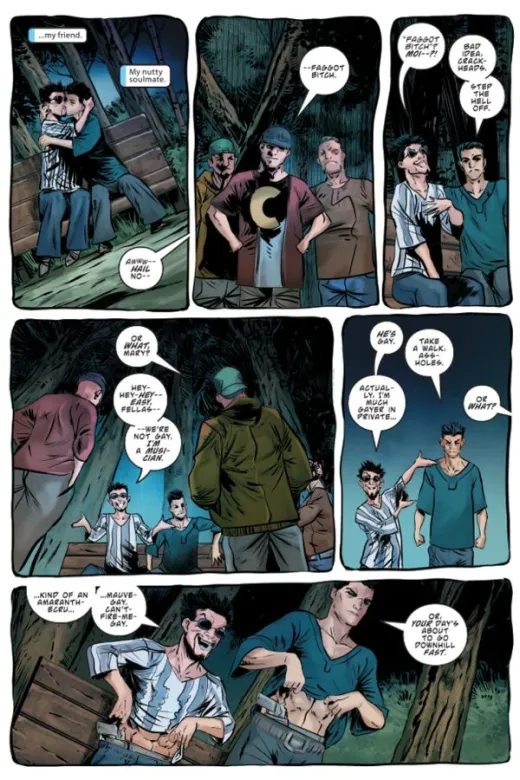
Dracula as an infection sexually transmitted between two men can, of course, evoke the history of the HIV/AIDS epidemic and the homophobia and fear of infection that accompanied it. At the same time, the comic does a great deal to avoid demonising homosexuality. Matt and Eriq’s relationship is real and emotionally rich, while the attackers who use homophobic slurs are presented in an unequivocally negative light. The horror arises from the takeover of body and identity, not from sexual orientation itself. Nevertheless, the intertwining of homosexual intimacy and sexually transmitted disease remains culturally charged. I do not think Priest was trying to draw on the negative aspects of the allegory; he was more likely aiming to reinforce Dracula’s role as a virus, but inevitably prompted other associations too.
The horror of uncertain identity
The chapter Call Me by Your Name refers to Luca Guadagnino’s film of the same name, which Matt and Eriq watched together and found moving. In that story, the exchange of names is a gesture of erotic closeness and a temporary blurring of the boundaries between lovers. Priest perversely reverses this gesture: it is Dracula, not Matt, who possesses Eriq’s memories, experiences and feelings. This allows him to appropriate not only his body but also his life and identity.
This situation raises a question: does preserving memory mean preserving the person? Dracula knows about the two men’s shared experiences, their jokes, their intimacy and the film they watched together. Moreover, he even takes over Eriq’s love for Matt. This does not automatically mean, however, that he is the same subject who loved Matt before. It recalls the questions surrounding digital personalities that I recently discussed in relation to Hell Sonja, but here the problem is far more corporeal and emotional.
Dracula uses the perfection of his forgery to gain intimacy with Matt. But can one give informed consent to intimacy with someone who looks and speaks like one’s lover, yet is also a different, parasitic being? This is another return to the problem of consent depending on knowledge of the other person’s identity. It leads to one of the miniseries’ better sequences, in which Matt kisses Eriq/Dracula and then shoots him repeatedly. Hadiwidjaja gives the kiss ample, almost romantic space, without reducing it to a homophobic joke. A moment later, however, he abruptly shatters the mood with violence. This shows that, for Matt, Eriq’s memories and feelings are not equivalent to Eriq himself.
Another interesting idea is the transformation of the classic iconography of Dracula’s ‘brides’. In the literary original and numerous adaptations, he possesses women who are subject to him, creating an erotic and patriarchal power structure. In Unholy, Dracula addresses an adult man in the language of bridehood and eternal intimacy. We can speak of a queer transformation of the traditional figure, but treating this as a straightforward declaration of Dracula’s bisexuality would probably be a simplification. His feelings for Matt may come from Eriq, whose body, memory and emotions he has infected and taken over. Moreover, the Transylvanian vampire turns intimacy into a claim of ownership. He uses Eriq as a bargaining chip, attempting to offer Matt eternal life through the continuation of his relationship with his lover, even though the latter is already a shell filled with the infection consuming him in the form of Dracula.
It is worth adding here that Matt and Vampirella assess the moral costs of certain decisions differently. For example, when Dracula attacks police officers, Matt does not want to leave them to die, while Vampirella considers escape and survival more important. His impractical refusal to abandon strangers becomes another expression of humanity. This does not, of course, mean that Vampirella is a hypocrite or does not respect other people’s lives. She simply assesses the risk differently and considers the threat of Dracula’s full return more important than the possibility of saving a few people. The comic allows us to understand her calculation without removing its moral cost.
Legends
Over the course of the issue, Dracula fully reveals his idea of absence: popular culture has made him so ubiquitous that no one can recognise the real Dracula any more. If someone finds a body with two fang marks, they assume the murder has been staged in the manner of a B-movie. Dracula is universally known, but it is precisely this that makes him socially implausible. This is a clear continuation of the first issue’s motifs and confirmation that Dracula’s status as a cultural virus is his most perfect camouflage. He does not need to erase the legends about himself, because their dissemination protects him. He can also offer society alternative narratives of crimes: instead of the historical monster, he presents the public with suspect police officers, agents, psychopaths and various ‘rational’ versions of events. Dracula therefore also fights the protagonists by controlling public perceptions of what is happening.
Priest also continues his references to Stoker. Vampirella finds further supplies of Dracula’s native soil, this time in modern premises, and uses consecrated hosts to deprive him of a place to rest. She thus repeats the act of Van Helsing and his companions rendering the boxes of earth unusable in the classic novel. The contemporary apartment and the pool table prove to be an updated version of the old tombs and another of the vampire’s masks. This demonstrates that Dracula has fully adapted his classic repertoire of abilities to contemporary circumstances.
I should also mention the joke that uses the title of Kurt Vonnegut’s Slaughterhouse-Five – Rzeźnia numer pięć in Polish – in connection with the deaths of five police officers. This is more a macabre play on the title than a reference to the novel’s themes. Grinder’s Bar also appears, a name that may recall the app Grindr, especially given the story’s homosexual themes. It could equally well be a coincidence, however.
Art and assessment
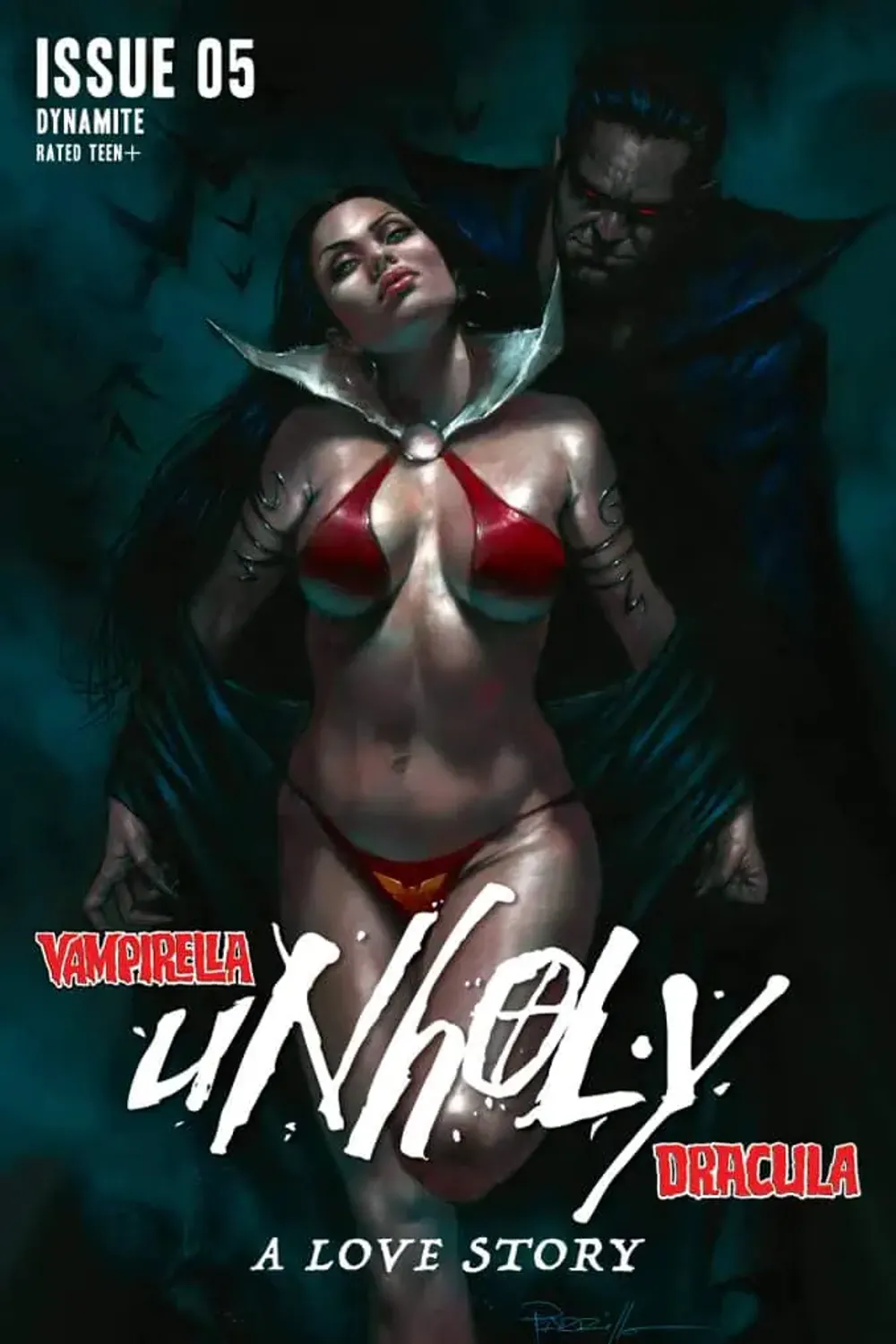
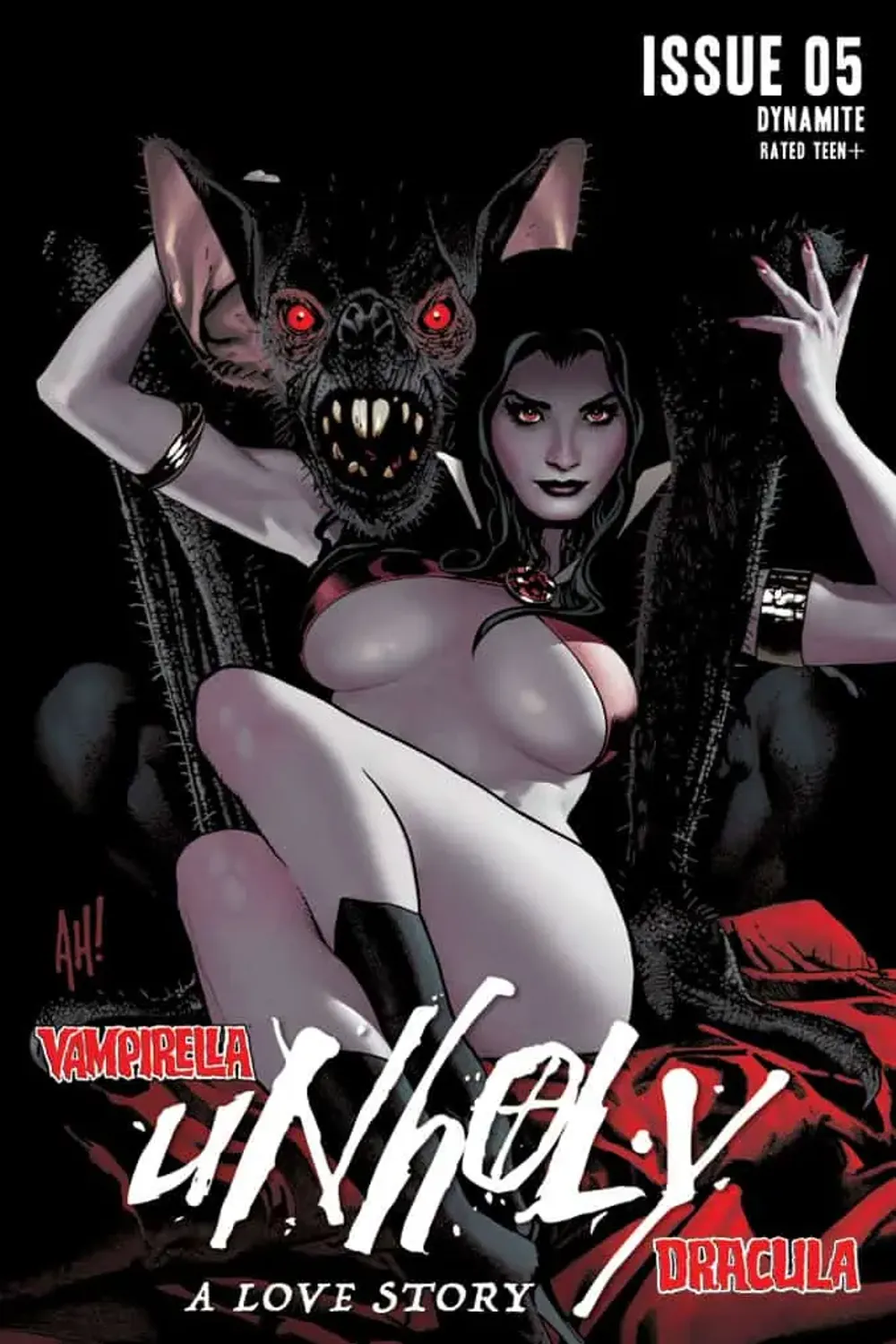
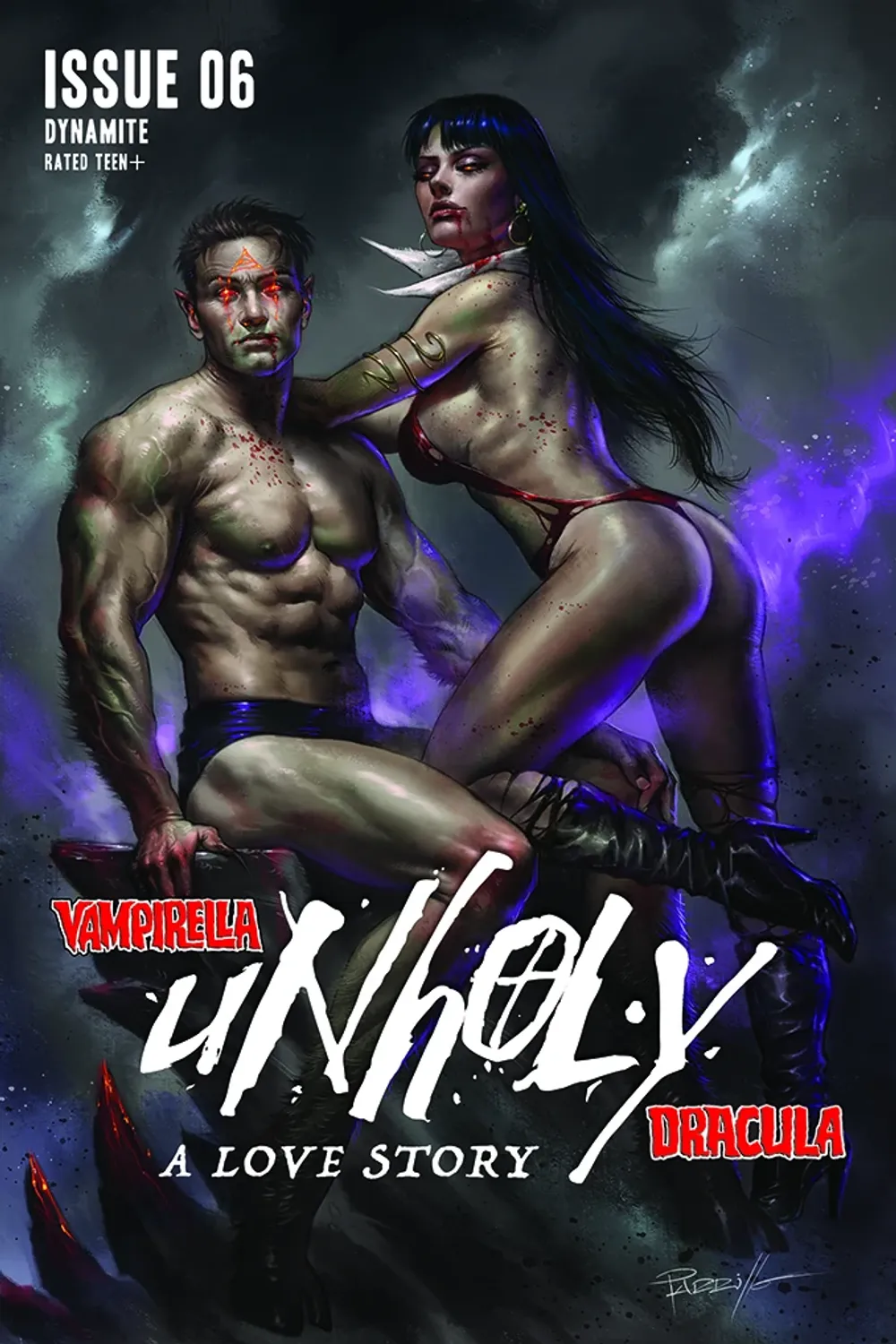
Matt’s kiss with Eriq/Dracula is a surprisingly serious, intimate scene against the backdrop of covers selling the typical heterosexual Gothic eroticism of Vampirella and Dracula. The covers thus promise a different story from the one we find inside the issue. In the comic itself, Dracula takes on the features of a distorted ghoul; his body hides in blackness and becomes increasingly inhuman. His monstrous physiognomy works well with the comic’s dark, uncertain style and agitated linework. Unfortunately, alongside these successful choices, caricatured faces and imprecise anatomy remain.
To my mind, this is the best issue so far, surprising but logically prepared. The queer romance transforms into body horror, and Dracula proves to be a parasite feeding not only on the body but also on other people’s memories and society’s collective imagination. We therefore approach the miniseries’ finale feeling positive.
Promotional pages from Dynamite Entertainment. Flickering Myth.
Issue 6. Misery
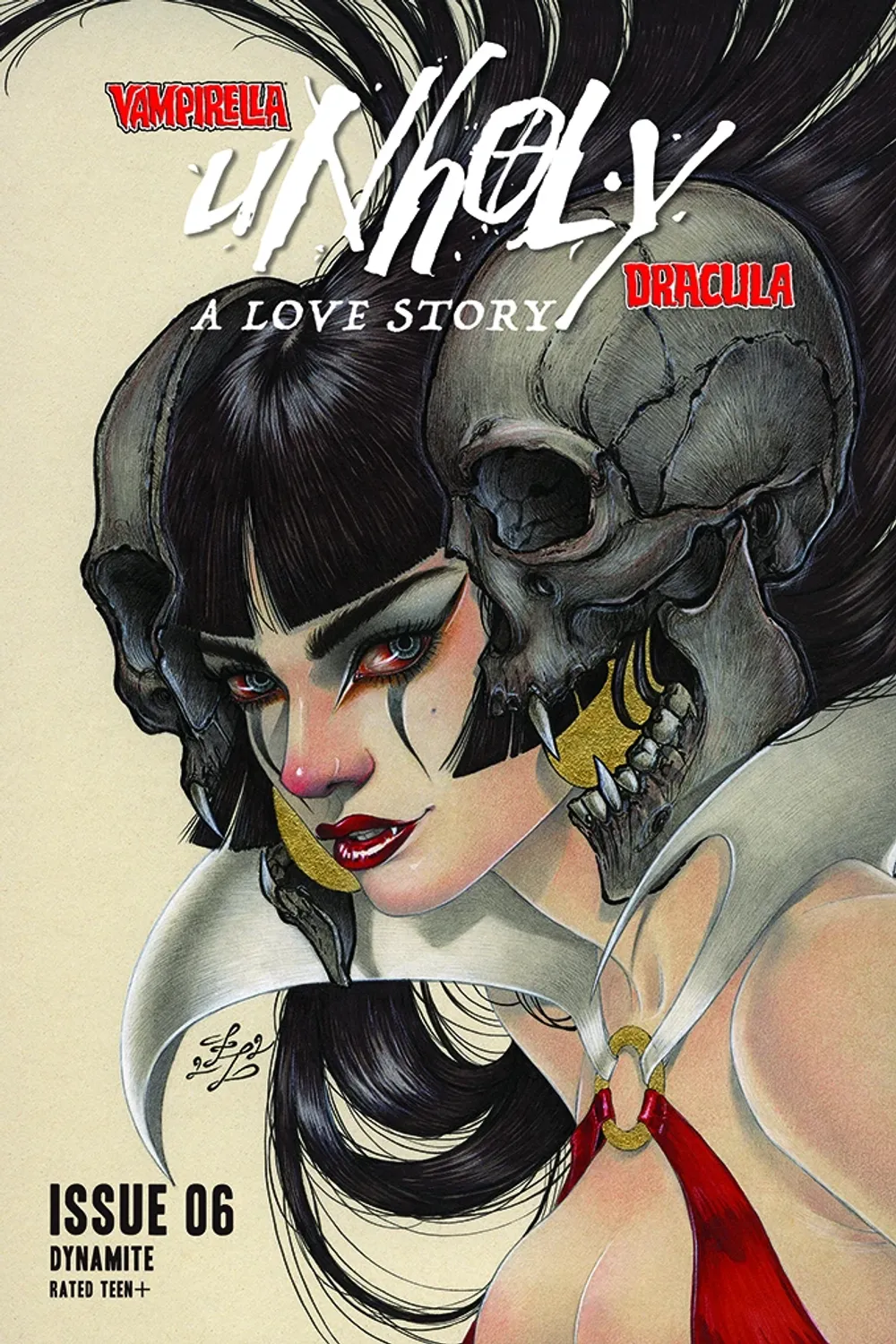
At the beginning of the series, Priest promised that love would conquer evil. Across five issues, however, he repeatedly showed its dark side: love contributed to the transmission of the virus, made it possible to predict families’ reactions, gave Dracula tools for emotional blackmail and made people willing to risk their lives. In the finale, the oracle proves to have told the truth. With the proviso that love is not a morally pure force against evil.
Matt arranges a meeting with Eriq/Dracula because he cannot simply give up on his lover. Dracula exploits this and invokes Eriq’s memories and feelings. Matt then asks him to profess his love in a way he can believe. When the beast draws on the emotions he has appropriated, Matt reveals explosive charges and sacrifices his own life to destroy Dracula’s host. Love allows him to get close enough to his opponent and make a decision that selfish calculation could never justify. This is a rather dark interpretation of the prophecy: love conquers evil, but only through self-sacrifice and violence, rather than through the automatic healing power of feeling.
Perhaps, then, the most important metaphor in the entire miniseries is the statement that poets describe love as a delicate spider’s web, whereas in reality it is far more like nuclear fission. It provides the power both to heal and to kill, to tend wounds and to destroy, to save and to take revenge. This observation finally brings the tensions of the preceding issues into order.
In his final message to his doctor, Matt considers why people seek love despite suffering and the inevitable end of relationships. He argues that sometimes something real comes along that must not be carelessly abandoned. Dracula offers the opposite of this attitude: he takes people over to make relationships eternal, refusing to accept loss. Matt accepts finitude as the price of humanity; Dracula wants to abolish finitude by appropriating other people’s lives.
The question of how much of Eriq actually remains in Dracula stays open. The vampire insists that he has retained his emotions, memories and the entire history of his love for Matt. In some respects, he may be telling the truth. This is precisely what makes the drama so cruel: Matt cannot easily prove that Eriq no longer exists, yet he has no choice but to regard his loved one as lost. In his understanding, memory does not give Dracula the right to be Eriq if the bearer of that memory is a monstrous disease using it for violence and the subjugation of others.
The ‘bride’ motif returns in Dracula’s promise of a shared eternity. He offers Matt a life without separation, but in reality wants to possess him for ever, just as he has taken over Eriq. Once again, this combines Stokerian Gothic with the horror of identity: love is dangerous not because it is inherently evil, but because the monster turns it into a claim of ownership over others. He reveals himself once more as a virus whose imperative is to keep infecting further beings.
References, Vampirella and the wider comics universe
The attempt to kill Dracula introduces an updated version of the traditional weaponry used against a vampire: an explosive charge and ammunition with a wooden component, as well as armour made of bone reinforced with Kevlar. This is almost an emblem of the entire series, which combines Stoker with twenty-first-century technology, and magic with a crime thriller. The idea is consistent with the quotations in the fourth issue, in which Van Helsing stressed that Dracula is learning about his abilities and adapting to his opponents. Fighting him therefore also requires old methods to be adapted to contemporary conditions.
Although the series’ title promises readers a clash between Vampirella and Dracula, Matt remains the drama’s central character. It is he who makes the decisive choice and deals Dracula the greatest blow. Vampirella arrives only to finish the fight against a weakened opponent. She finds him thanks to the ritual from the second issue, which allows her to feel Matt’s suffering. The earlier ‘communion’ was therefore not merely a metaphor – the ritual really did unite them.
Vampirella then tells Dracula that he despises human nature while simultaneously envying it and wanting to draw on human feelings. He is a biological and existential parasite: he needs people in order to be reborn, to remember and to love, yet denies them dignity. In dealing the monster the final blow, however, Vampirella is no longer settling a philosophical dispute. She completes Matt’s sacrifice and confronts its irreversible consequence.
From the perspective of pulp spectacle, the finale can be criticised for making the last confrontation too brief. The preceding five issues built Dracula up as a powerful, almost omnipresent manipulator. This is not a deus ex machina, because the resolution was prepared earlier, but the fight itself could have been given more space. It would probably have made the finale a more satisfying read.
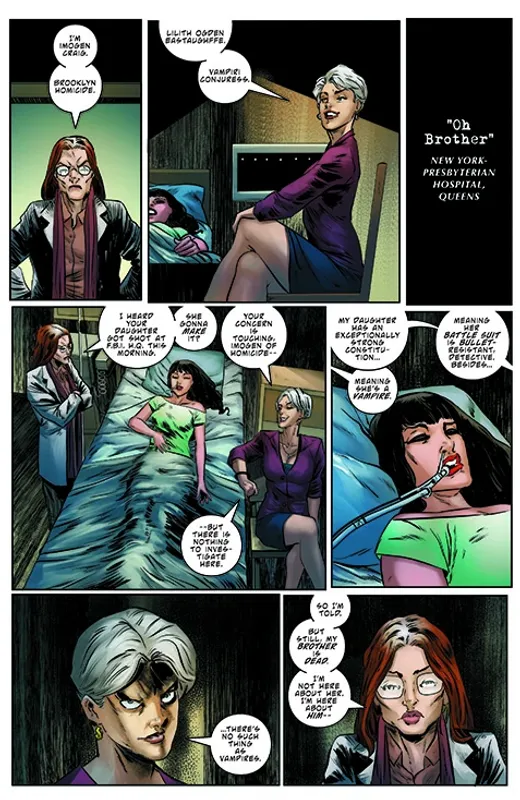
The opening pages of the finale also contain Imogen Craig’s police storyline, a reference to earlier killings and a clear promotional opening towards Draculina, which was being published alongside it at the time. For readers planning to explore the entire mythology, this is a welcome branching out of the universe; for anyone who simply wants to bring a six-part miniseries to a close, it is another test of patience. For the sake of clarity, however, I should add that Draculina will also be coming to Velarium soon.
This is where the weakness of comics universes filled with endless ‘new beginnings’ becomes clearest. Each story being brought to a close immediately becomes a branch leading to others, while the supposedly separate ‘first issues’ in practice require familiarity with previous runs and spin-off titles. As I wrote at the beginning, this does not make the story incomprehensible, but without that knowledge the reader does not receive its full emotional context.
Victory over the Dracula virus is followed by Vampirella’s quiet visit to Matt’s mother. Instead of another fight, we get a look through her son’s belongings, memories, the presence of a dog and a conversation in which it is finally necessary to say aloud that Matt has died. Vampirella does not resurrect him, transform him or attempt to bind his soul. She returns his possessions and lets him go. Her attitude is the opposite of Dracula’s actions: love here takes the form not of eternal possession, but of acceptance of a painful loss.
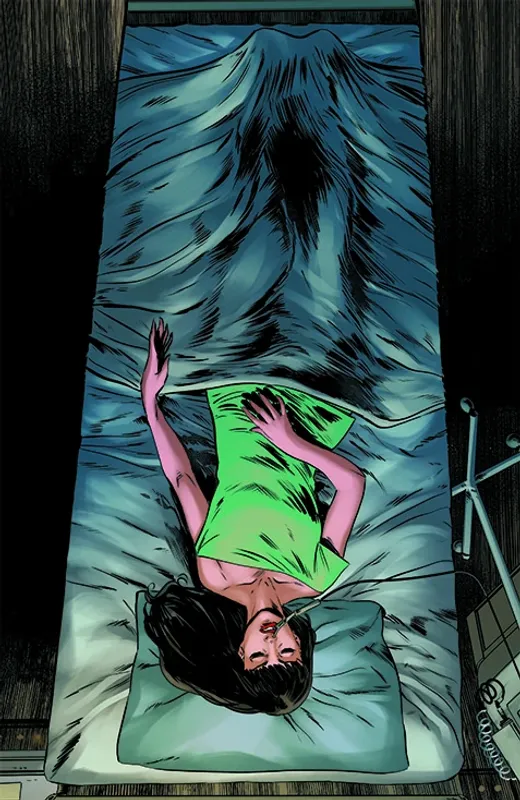
The final page reveals that Vampirella is pregnant with Matt’s child. On the one hand, this ends the story of a marriage with conception and the continuation of the family, and Matt’s story with his remembrance and new life. At the same time, the miniseries has repeatedly reminded us that the Dracula virus is linked to its carrier’s genetic material. The question therefore arises of what the child might inherit. The finale leaves this matter to subsequent series. In other words, it offers us another ‘new beginning’.
Visually, Hadiwidjaja continues to depict Dracula as a deformed, desiccated ghoul rather than a romantic aristocrat in a cape. Grand words about empire and immortality contrast with disintegrating flesh. This is consistent with the idea of the vampire as a biological parasite. Vampirella, meanwhile, remains his visual opposite: she lives, bleeds, regenerates, is physically attractive and capable of bringing new life into the world.
Their duel, however brief, is suitably brutal. The quiet of the family scene that follows consequently strengthens the sense of mourning. Unfortunately, the problem of sexualising panels of Vampirella does not disappear, although it is less prominent in the final issue than before. Ultimately, we get a powerful, tragic conclusion that simultaneously opens the way to the then-current Draculina and the then-forthcoming miniseries Vampirella: Year One.
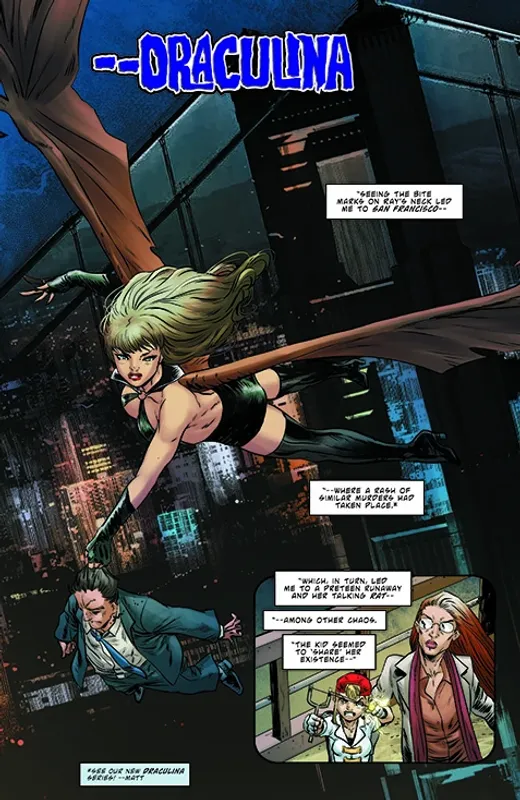
Promotional pages from Dynamite Entertainment. Lotusland Comics.
A few closing observations
1. Dracula exists in the comic on several overlapping levels:
- Biological: virus, DNA, carrier, transmission through intimate contact and bodily transformation.
- Metaphysical: rituals, souls, curses, rules of blood, the need to rest in Transylvanian soil and the effects of sacred objects.
- Psychological: possession, other people’s memories, the imposition of identity and manipulation of perception.
- Social and informational: lies, testimonies, police files and false explanations of crimes.
- Cultural: Stoker, films, Bran Castle, Castlevania and the image of the Count as a fictional monster.
2. It is also worth comparing this idea with older Warren stories. In The Coffin of Dracula!, published in Creepy #8–9 (1966), Archie Goodwin and Reed Crandall continued Dracula’s story after the events of Stoker’s novel and introduced the motif of the vampire’s surviving essence/spirit. It can possess a human who comes close to the Count’s remains, ultimately transforming that person into the reborn Dracula himself.
The Dracula from that story later returned in Vampirella comics in the early 1970s. The contemporary Dracula virus can therefore be read as a substantially updated variation on survival in another host.