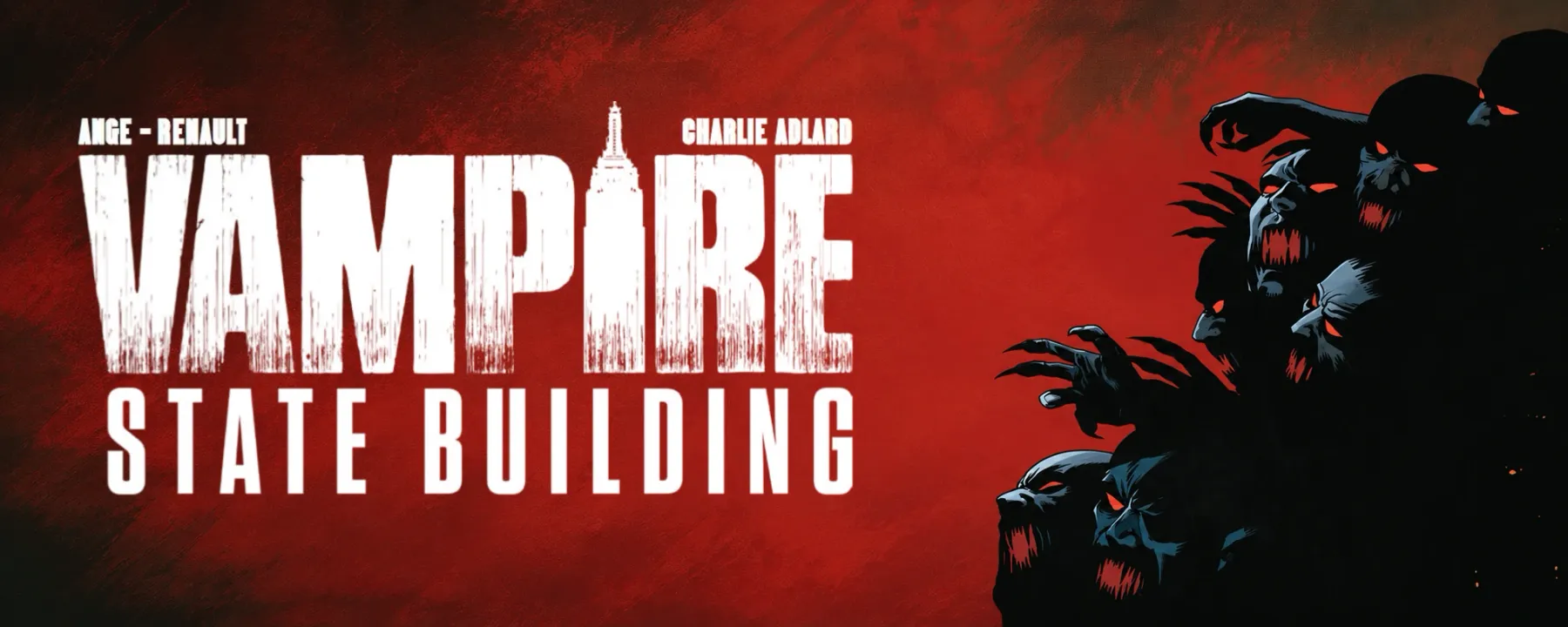
Anyone in the mood for a cross between Die Hard and a vampire horror story? If so, Ange and Patrick Renault, along with Charlie Adlard, have just what you’re looking for. They take readers right to the top of the crowded Empire State Building, where a swarm of bloodsuckers is after more than just human blood.
Script Ange and Patrick Renault
Art Charlie Adlard
Colours Sébastien Gérard
Letters Carlos M. Mangual
Publisher Ablaze Publishing
Issues published 2 October 2019 – 22 January 2020
Issue 1.
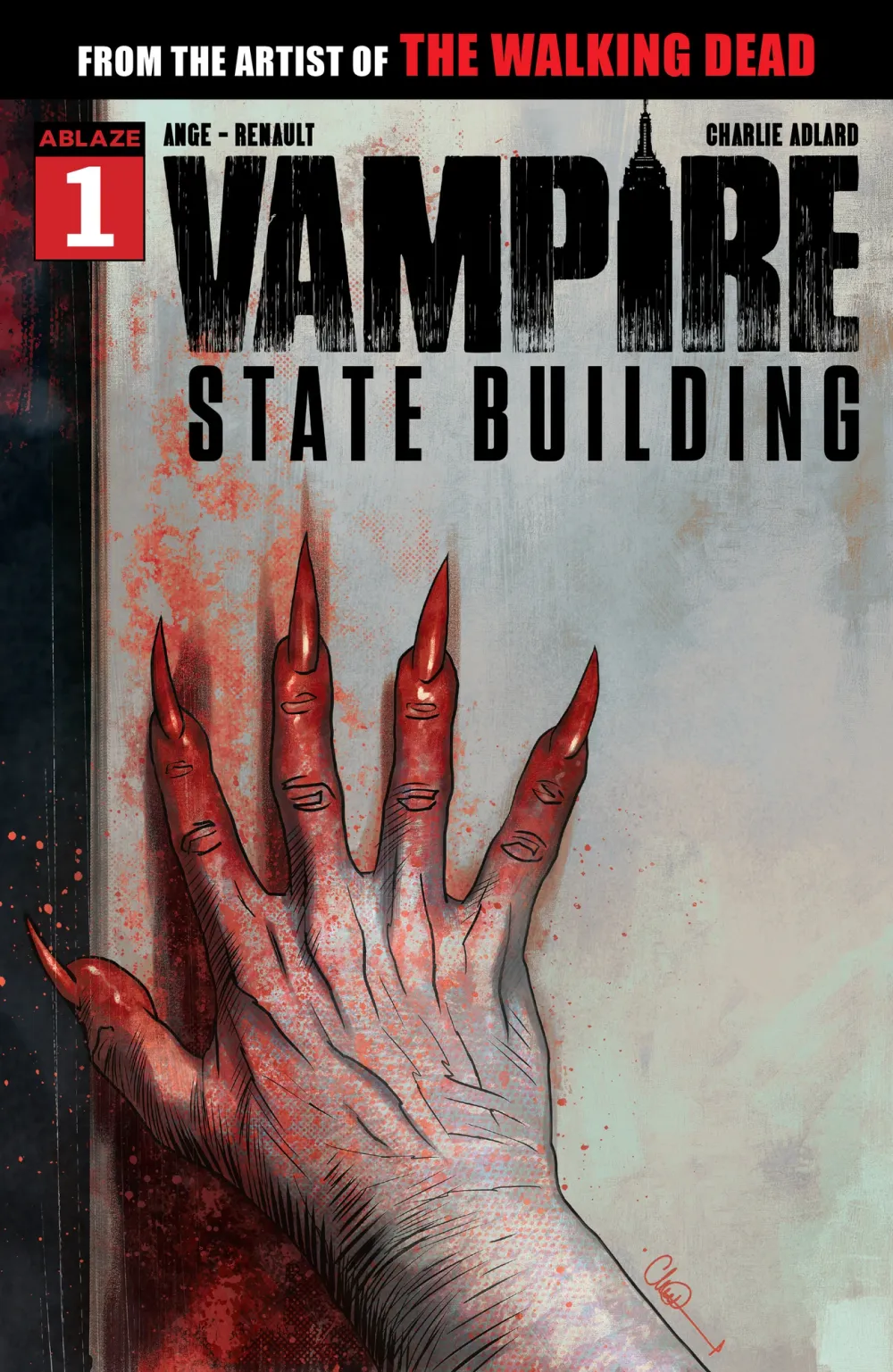
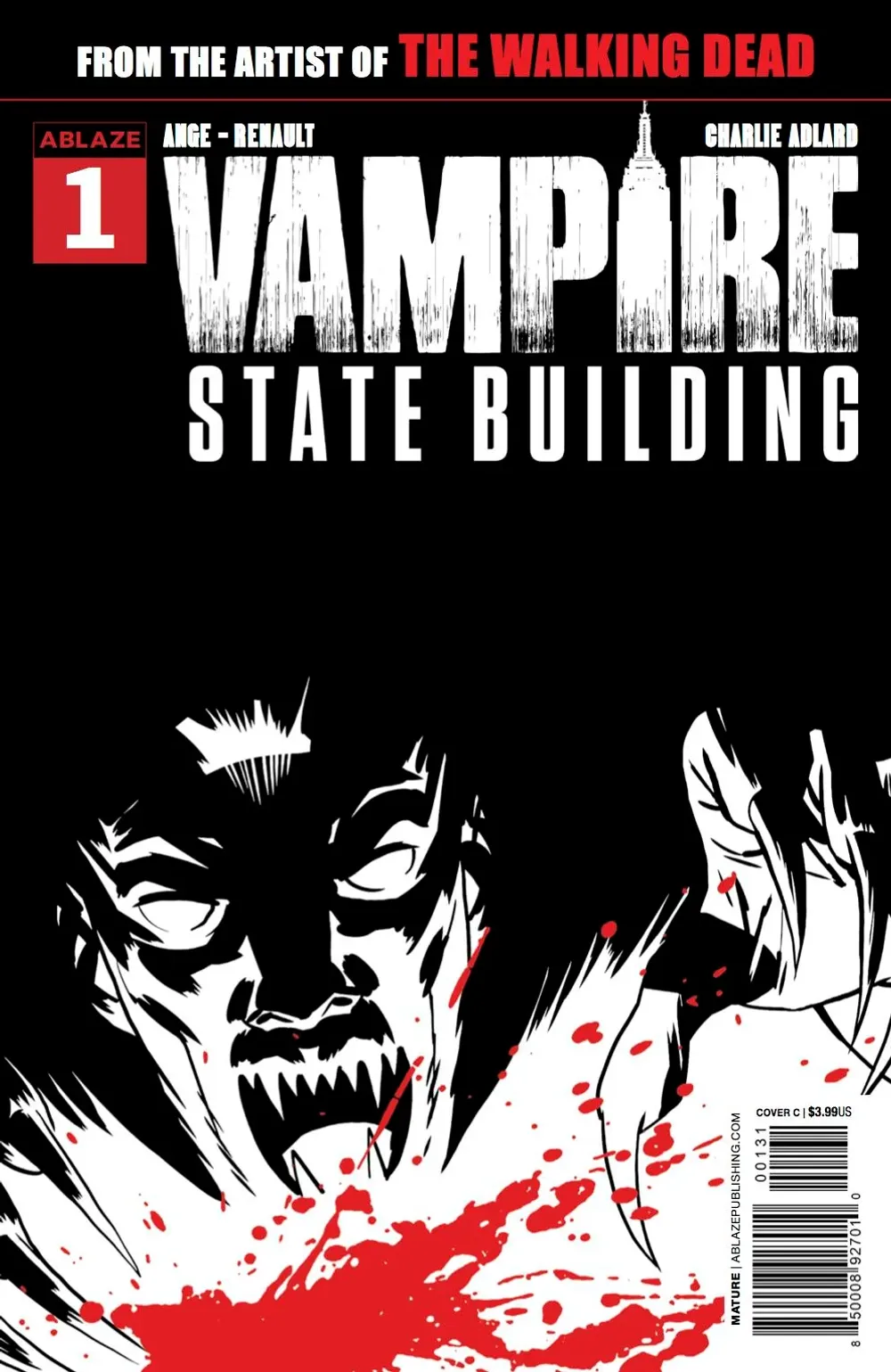
The story begins as a group of friends meet on the skyscraper’s observation deck to say goodbye to Terry, the protagonist, before he leaves for Afghanistan. Meanwhile, on the seventy-fifth floor, a renovation crew uncovers a mysterious iron door in a pillar. That evening, unidentified attackers appear and start taking over one floor after another. It isn’t long before the slaughter begins. The priority for the protagonists then becomes getting down from the observation deck on the eighty-sixth floor.
The resemblance to Die Hard extends beyond the familiar layout of a skyscraper. People are cut off from the exits, and police commanders gather outside to work out what they are up against. The comic turns up the violence, and having vampires as the enemy means that the more people die, the more monsters roam the building’s corridors. In the first issue, though, the creators do more to promise the scale of the threat than to show it.
The observation deck, the window and the pillar
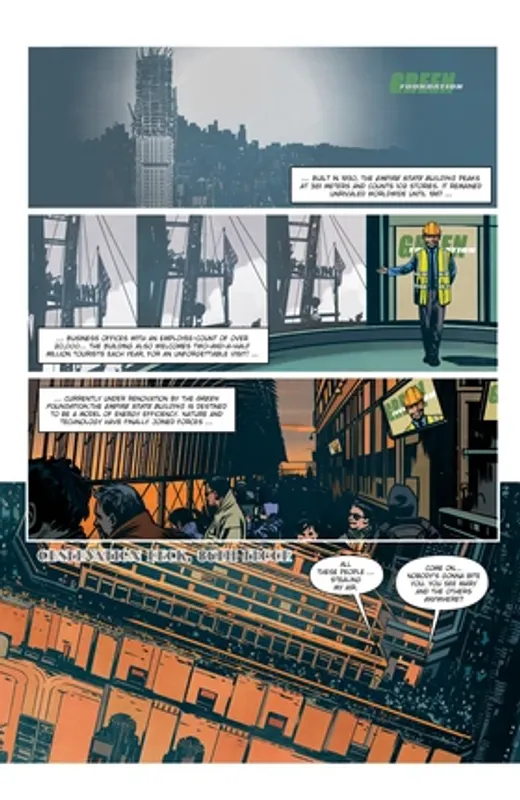
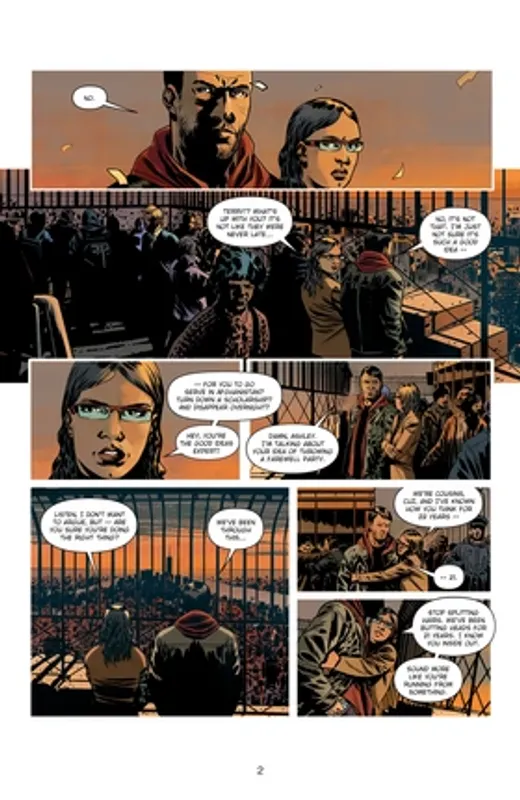
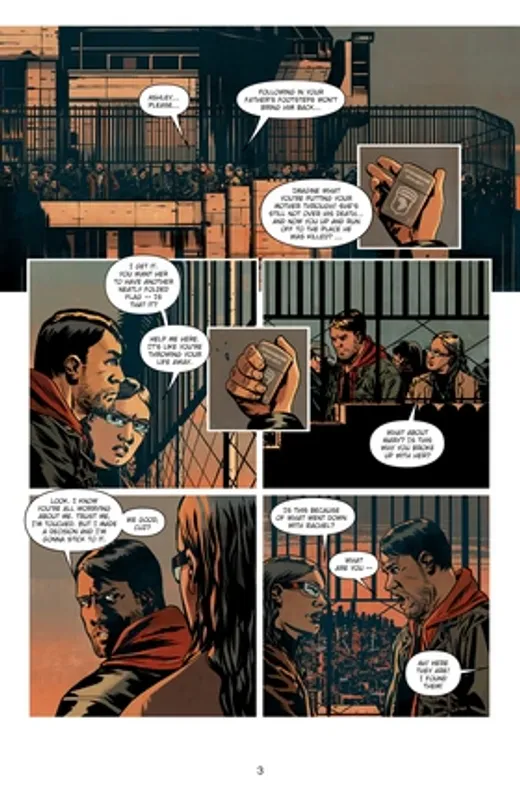
The first page brings together images of the building under construction, an advert for the Green Foundation renovation and a crowded observation deck. The comic thus links the scale of the original construction to the promise of modernisation. At the same time, it emphasises that the Empire State Building is a self-contained environment. A large part of the city is visible from the observation floor, but closely spaced bars separate the people on the deck from it. Adlard shows the fence first from outside, in a shot that takes in the crowd, then so close that the bars cut across the faces of Terry and his friend Ashley. The skyscraper already looks like a cage before the vampires get inside.
The sequence cuts from a panorama of the city to hands, objects and faces. While talking about his father, Terry closes his fingers around a lighter inscribed ‘Afghanistan 2010-2011’, hinting at a family tragedy and a sense of obligation to follow in his father’s footsteps. When the friends pose for a photograph, we briefly see them on a phone screen, framed differently from the way we see them against the city. The image of their farewell will become a point of reference for later panels showing the friends dead or transformed, giving it a clear role in the story. Throughout the sequence, Sébastien Gérard takes us from the rusty warmth of the sunset to the chill of the service areas and corridors. Changes in scale and colour help us recognise whether we are looking at the building as tourists, as people trying to find a way out, or as emergency services trying to make sense of the situation from the street.
The renovation work has a specific purpose here. The iron door and the space hidden behind the plaster undermine the impression of a building whose every corner has been accounted for. The workers start discussing what might be in the mysterious room, but have no chance to check because they are pressed for time by a press conference. These scenes also set up later dangers, for instance by telling the reader that there are no sprinklers on that floor.
Terry’s farewell and the vampire attack
Early on, the creators also try to give their characters depth. We learn that Terry is going to Afghanistan as a military mechanic, that his father’s death has a bearing on his decision, and that for some unknown reason he has broken up with his girlfriend Mary. Ashley and his friends have brought him to the observation deck to show him what he is leaving behind.
The issue thus begins with a lot of talk about parting, friendship and the relationships between the characters. Unfortunately, all this is condensed into a few pages, so it rarely feels natural. The writers also try to cram in romantic relationships and school life, a joke about The Walking Dead and a few other things. It is simply too much. This overload and narrative haste will run through the entire miniseries. To make matters worse, the comic soon proves surprisingly short on energy.
The vampires gain the upper hand almost immediately. They come in through the public areas and appear above people’s heads. Adlard can guide the reader’s eye from a narrow reaction panel to a shot that suddenly reveals the scale of the attack. The encounters themselves have less variety. Several attacks in succession follow a similar progression from surprise to scuffling. The killing visibly accelerates, although the action on the page can be less varied than the body count suggests.
Down on the street, the emergency services start talking about terrorists. They are wrong about the nature of the assailants, of course, but sense correctly that the attack is coordinated. The comic thus creates a distant echo of the tragic events of 11 September. It plays on the instinct to interpret an attack on a New York skyscraper in the light of that history, then links the story to other political issues. In this issue, they are only hinted at in passing through the words ‘Hamaťsa’ and ‘U’tlun’ta’, but they come through more strongly in the second.
Issue 1 – preview on GlobalComix
Issue 2.
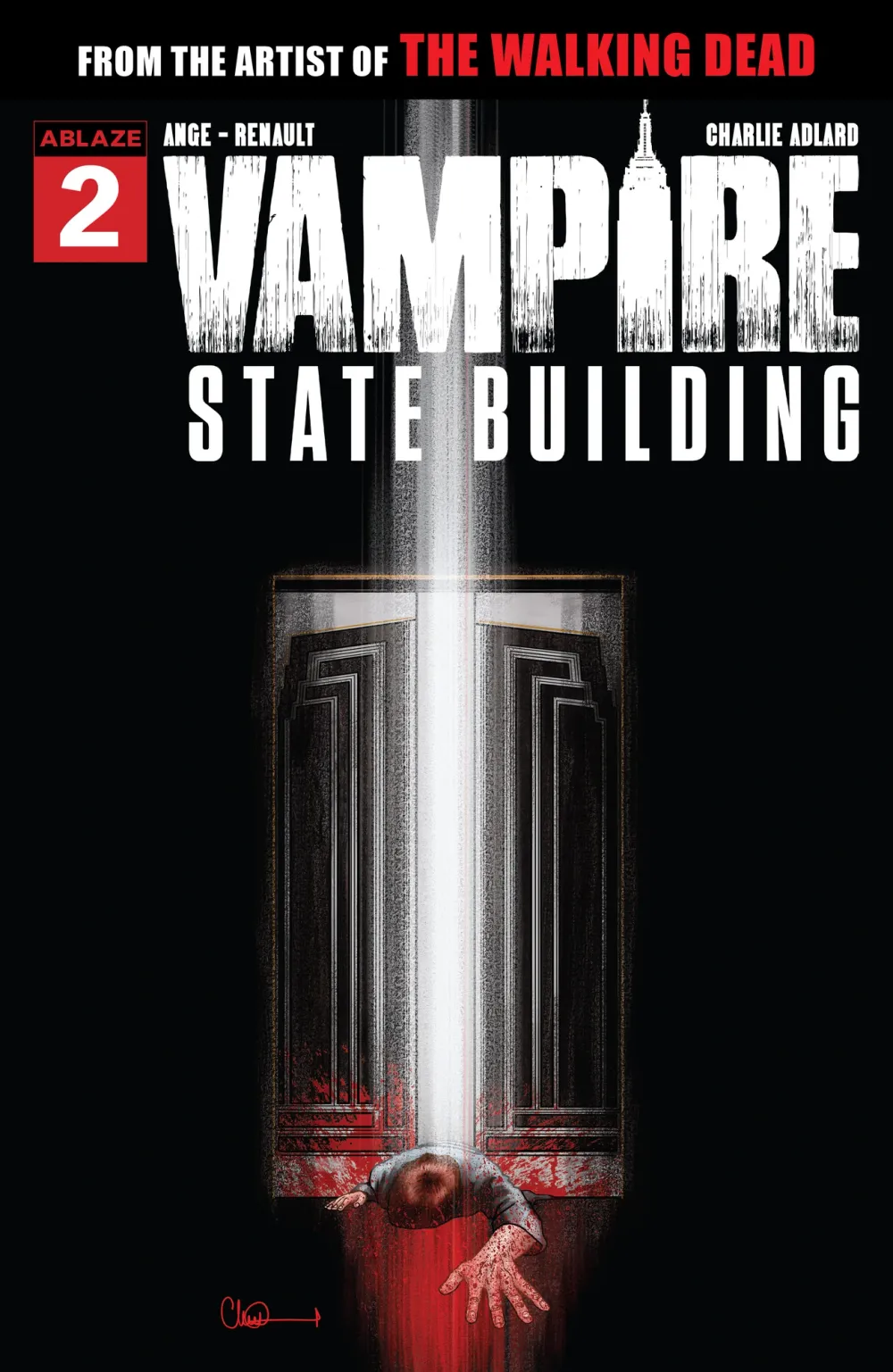
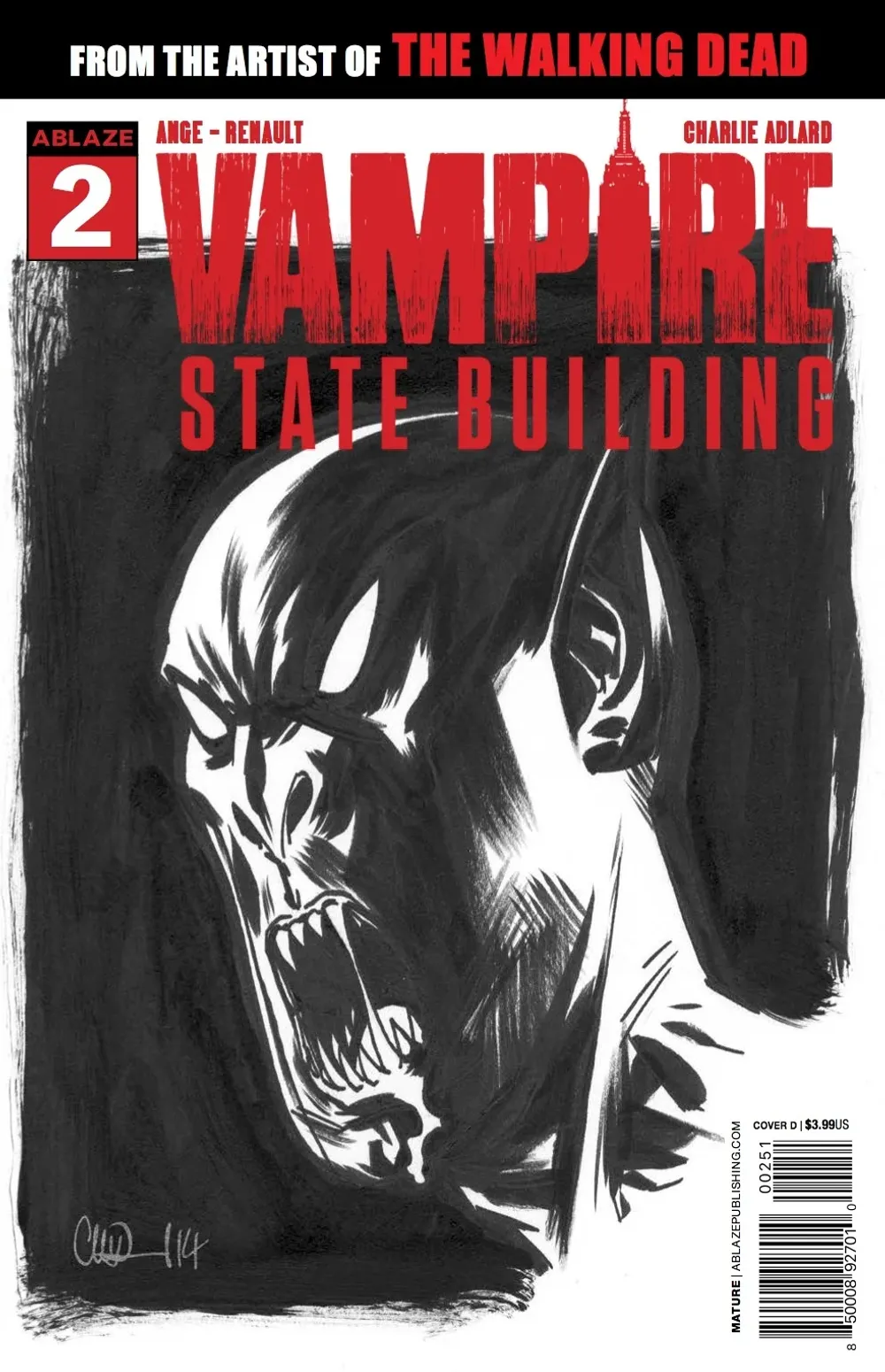
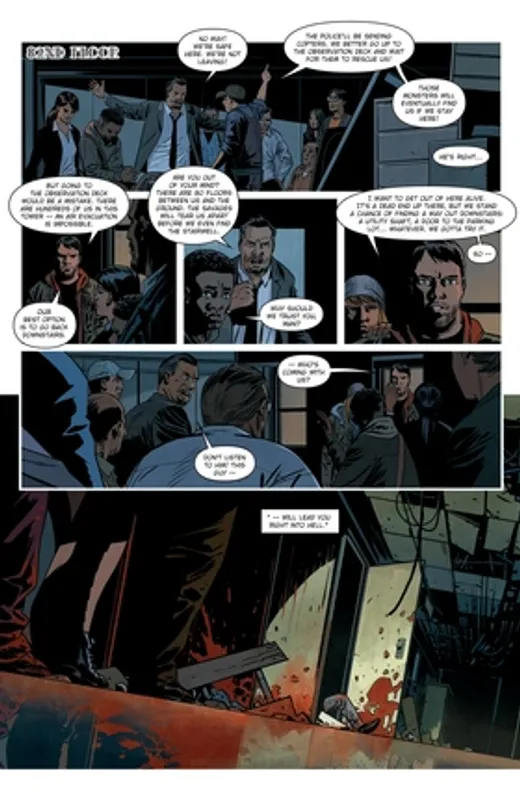
The second issue links movement inside the skyscraper to decisions made outside it more effectively. The friends make use of floor plans, service passages and a ventilation duct, and look for a route between floors around the scaffolding. As a result, the Empire State Building finally begins to dictate the kinds of danger they face and how they might get around them, becoming more than a backdrop for the action. The route under the ceiling, for instance, limits visibility and freedom of movement, while the characters on the exterior platforms expose themselves to gunfire and risk falling.
The escape also ties in with what people are doing outside the building. In the sequence where the characters leap between platforms, the cut from figures on the scaffolding to the circular view through a gunsight takes control of what is happening around them out of their hands. The comic also makes good use of fire in these scenes, both visually and narratively.
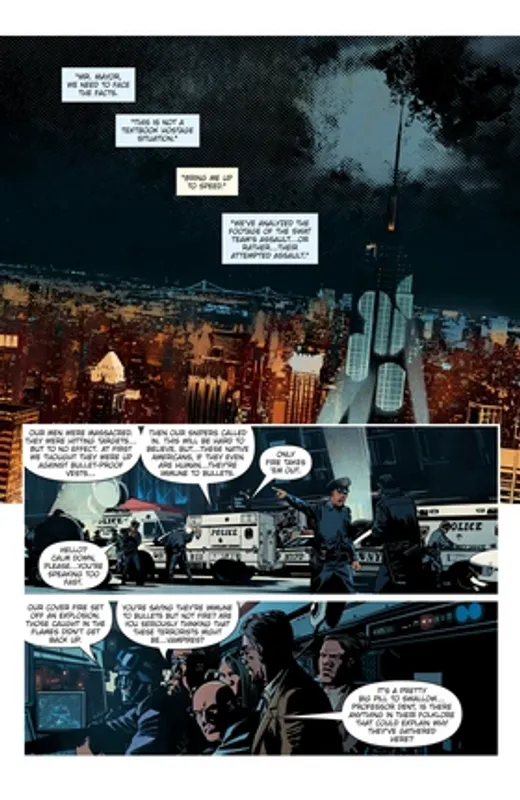
The issue as a whole fares better than the previous one. It contains one of the miniseries’ best sequences, the SWAT raid. Adlard alternates between showing part of an attacker or a police officer and plunging the image into black. At first, the panels fill with gunfire and radio reports. Then communications cut out, and in a broad band of black the sound disappears too. A moment later, a torch reveals vampires stooping over the bodies. The atmospheric, dynamic scene is also watched on monitors whose cool blue light stands apart from the fire motif elsewhere in the comic. The fights with the vampires are well paced and reveal their weaknesses in stages, giving the encounters a clear narrative purpose as well.
The vampires’ Indigenous origins
The issue introduces the idea that the vampire god raises the dead, who return as creatures somewhere between vampires and zombies. The god himself initially recalls Nosferatu, especially in the shape of his head, ears and hands, as well as in some of his gestures. His arrival and the nature of his vampires together make for the miniseries’ best plot idea, one worth a closer look.
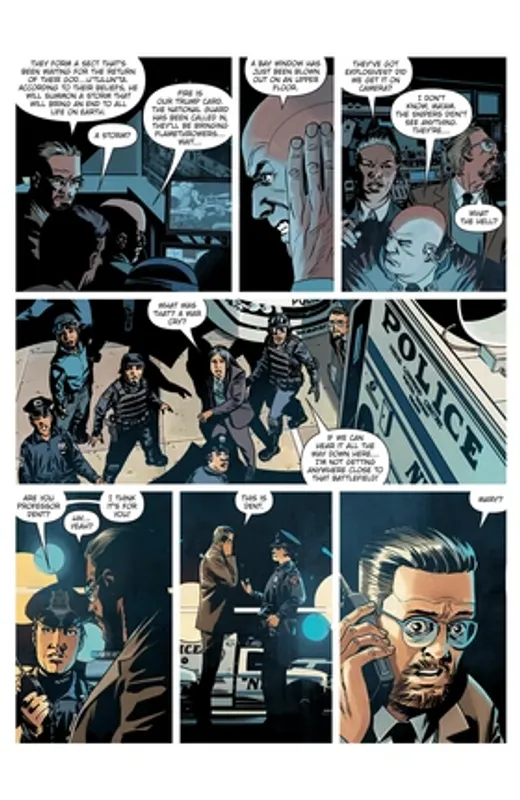
Professor Dent recounts a legend about a tomb that was rebuilt over the centuries as high up as possible. A wide page juxtaposes the older landscape and the tomb with the modern Empire State Building. The height that gave tourists their view in the first issue is thus revealed to have a ritual significance too. Different shades of sky and small panels inset in the panorama bring two eras together on one spread. On the following pages, Dent’s story of rebirth and a cry that heralds a storm begins to create a different sense of threat from the fast, bloody attacks inside the building.
The legend’s connection to the city has a basis in history. Ironworkers from the Kanien’kehá:ka nation, also known as the Mohawk, really did work on the construction of the Empire State Building. Their involvement grew out of a tradition of work in the trade that spanned generations. Dent moves from this fact to a stereotype of warriors unafraid of heights and calls them ‘cannibals’. The workers’ contribution is well documented, although the comic’s claim that they did most of the construction is an exaggeration that takes the weight out of the emerging social and political commentary. The historical material called for sticking to the truth, unpleasant as it already is. Embellishing it risks undermining the comic’s message. Falling back on stereotypes of fearless Indigenous people also greatly simplifies their portrayal and robs it of its seriousness.
The mention of the Mohawk is also linked to a remark about people who barricaded themselves in Canada when a cemetery there was threatened with destruction. The reference is never explained in detail, though it most likely points to the resistance at Kanehsatà:ke in 1990, known as the Oka Crisis. It concerned plans to extend a golf course on disputed land that included a cemetery. Through this web of real and fictional associations, the comic evokes various conflicts and links them to cemeteries and tombs. The touch of horror this gives them works quite well.
The second issue also briefly examines the vampires’ language, identifying elements of Mohawk and of what the comic calls ‘Kwakiutl’ and presents as an archaic dialect. Vampire State Building brings together several distinct traditions here. Historically, the name Kwakiutl, derived from the name of the Kwagu’ł community, was extended to other related groups. Their collective name, which does not appear in the comic, is Kwakwaka’wakw. Their traditions included a dance and initiation rite called Hamaťsa. The term was also used for the dancer undergoing initiation. In the comic, the name is applied to all the beings raised by the vampire god. They generally speak of themselves in the plural – ‘We are Hamaťsa’ – suggesting a collective consciousness. The term is also associated with stories of a being called Baxwbakwalanuksiwe’, who devoured people. The dance was meant to calm the person possessed by this being.
The vampire god himself bears the name U’tlun’ta. That comes from Cherokee tradition and refers to a female figure with stone skin and a long, sharp finger, also known as Spearfinger. The comic’s U’tlun’ta, however, is male, with mouths all over his body, as in the stories of Baxwbakwalanuksiwe’, and the silhouette of Nosferatu. He is thus a composite design that draws on legend and popular culture. Unfortunately, to my mind, the idea behind the design is far more interesting than the way he is depicted. The drawings of the vampire god are too realistic and precise. They never go far enough into horror and the grotesque to convey the weight and dread inherent in his design.
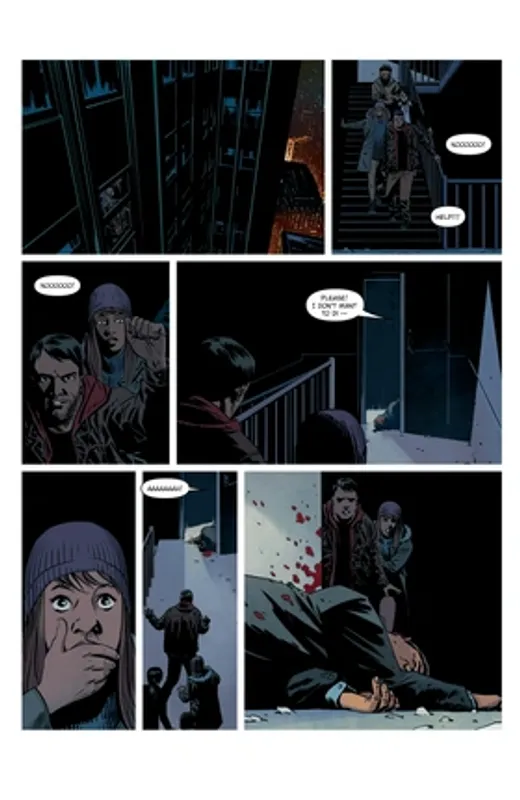
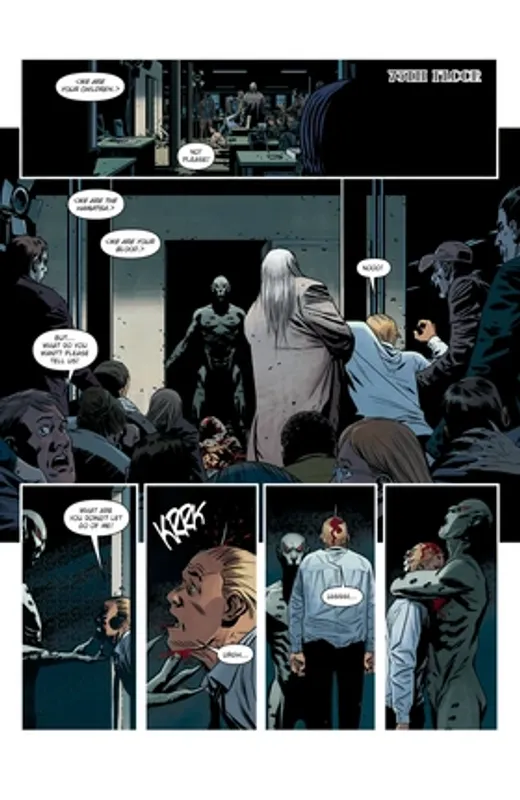
Issue 2 – preview on GlobalComix
Issue 3.
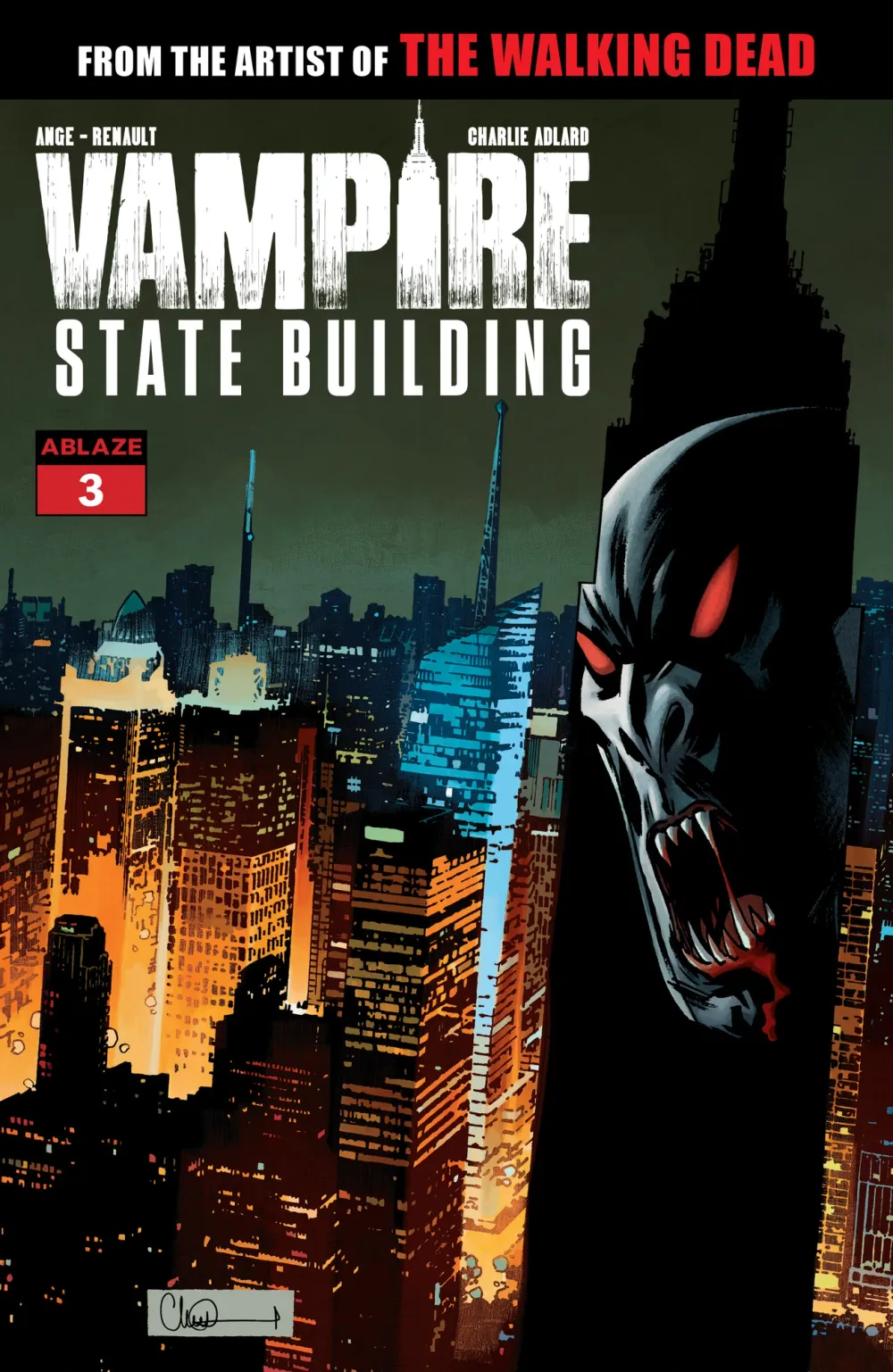
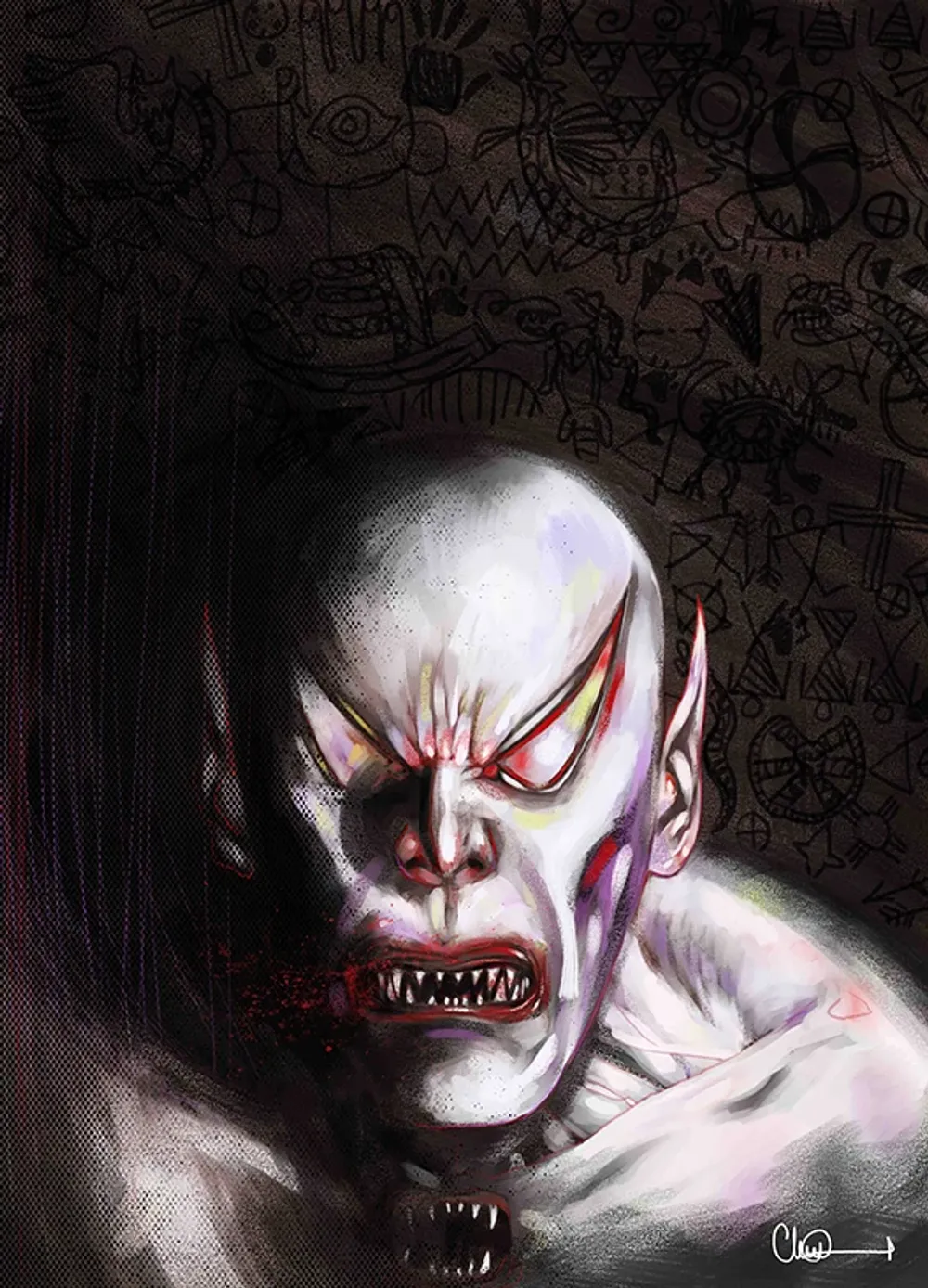
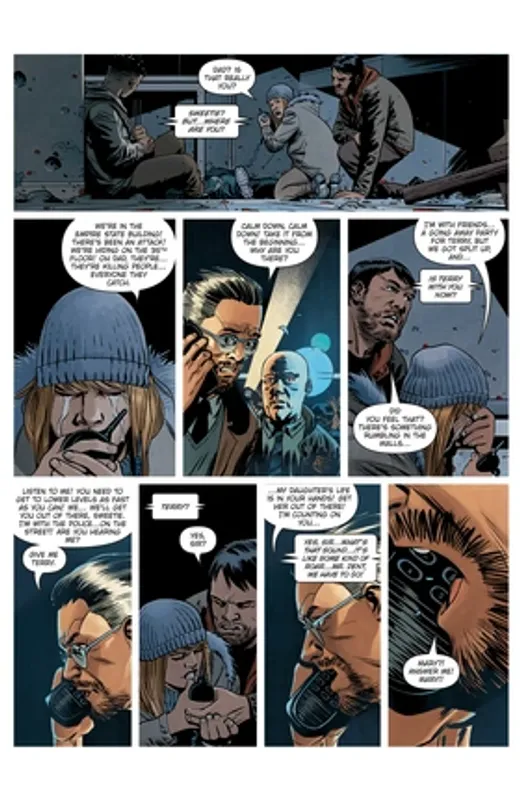
In the third issue, the threat more often takes the form of familiar people who are now under the vampires’ control. The encounter with Ashley is particularly powerful, combining horror, gore and drama. The visuals reflect the change in mood. The framing grows tighter and more claustrophobic. More often, we see hands, teeth or fragments of the surroundings in place of a full view. Outside, the emergency services learn that most of the vampire swarm they are facing consists of people who were staff or tourists in the building only moments earlier.
The approaching storm and the threat of the vampires breaking out into the city steer the comic towards a solution reminiscent of the finale of The Towering Inferno. In that film, blowing up the tanks is meant to flood the interior and put out the fire. Here the fire protection system is used to set up a blaze meant to save the people outside the building. Unfortunately, a technical detail weakens this part of the comic. At a meeting of the emergency services, someone claims that the structure of the Empire State Building contains no metal and that the plan therefore has a chance of working. The actual building, however, has a steel frame. The same scene also refers to 11 September. According to those at the meeting, the fire brigade has not put so many personnel on standby since that date.
Overall, though, the third issue has less to offer than the previous ones. It mostly settles for showing the protagonists trudging through floor after floor, occasionally returning to conversations meant to give the characters more psychological depth, with little success. The vampire god introduced earlier turns out to be surprisingly bland and static. The comic certainly has plenty of potential, but by the time we reach the last issue it is clear that it cannot realise it.
Issue 3 – preview on GlobalComix
Issue 4.
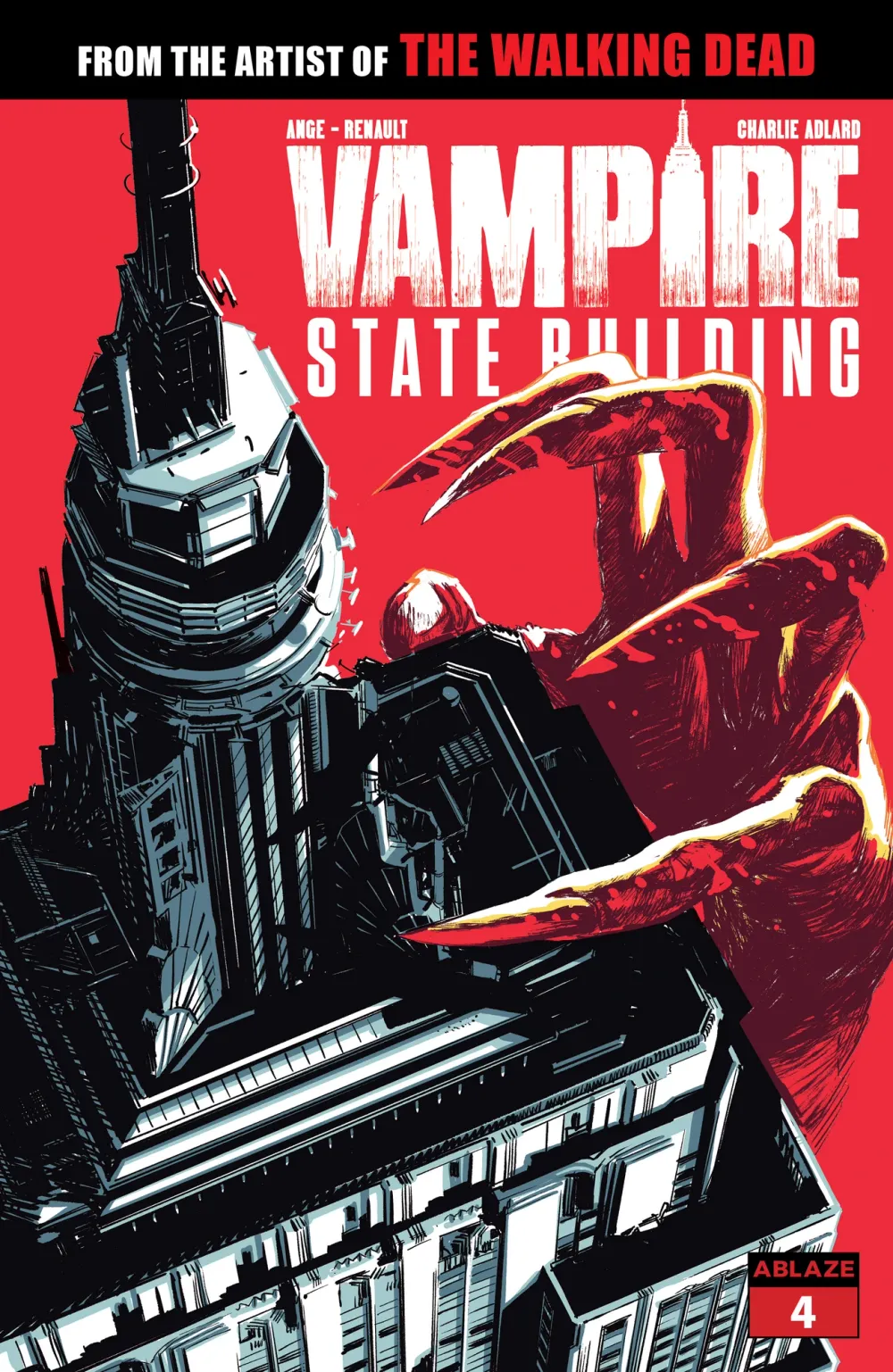
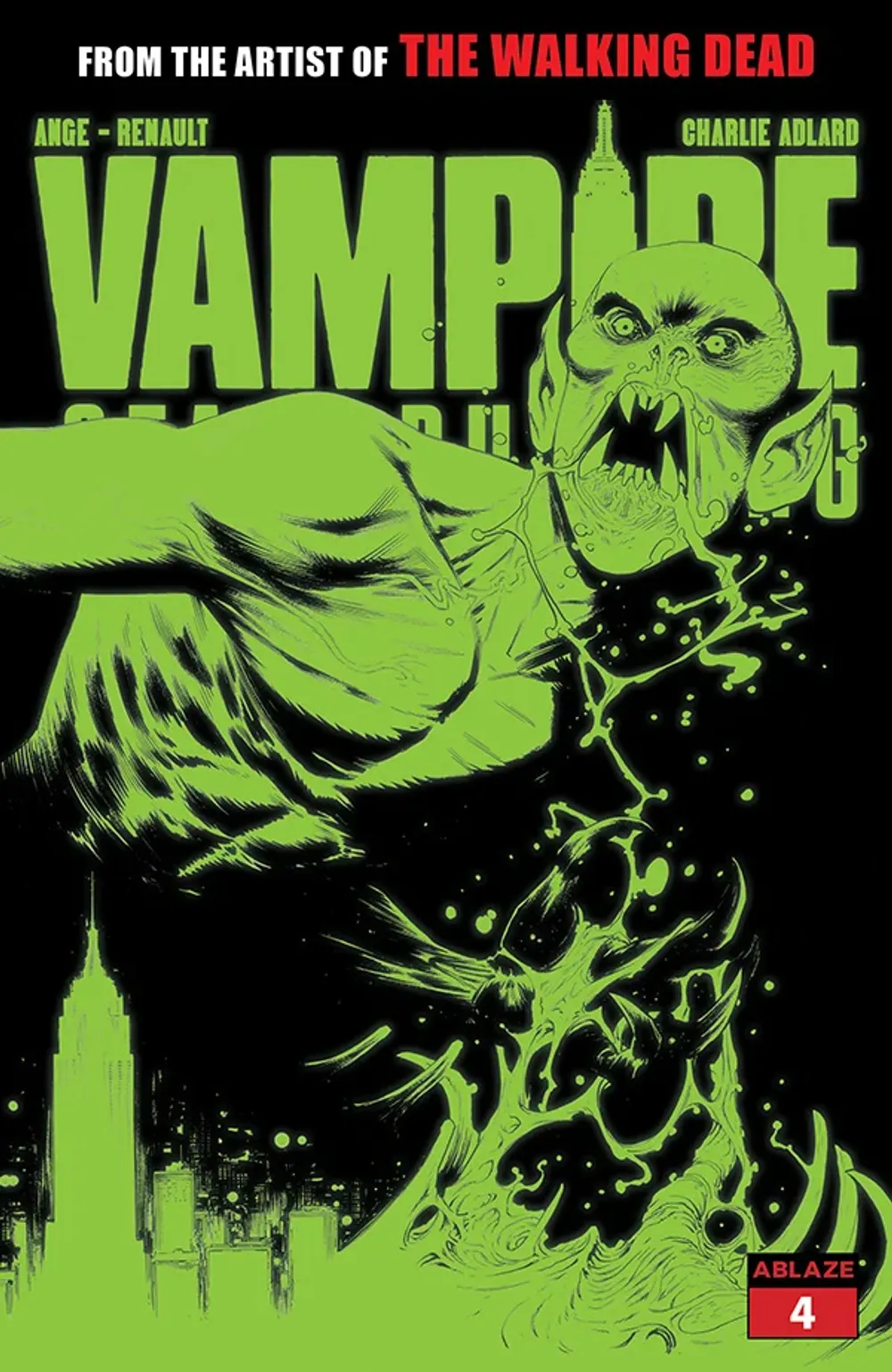
In the last issue, the reader comes full circle with the protagonists. Vampire State Building began on the upper floors and returns to them in the finale. Specifically, it returns to the seventy-fifth floor, where Terry confronts U’tlun’ta with Mary’s help. The fight is short on excitement and essentially comes down to which of them is first to get hold of something that can start a fire. The monster looks striking, especially when the flames reveal the mouths scattered across his body, but face to face with Terry he becomes a fairly ordinary opponent.
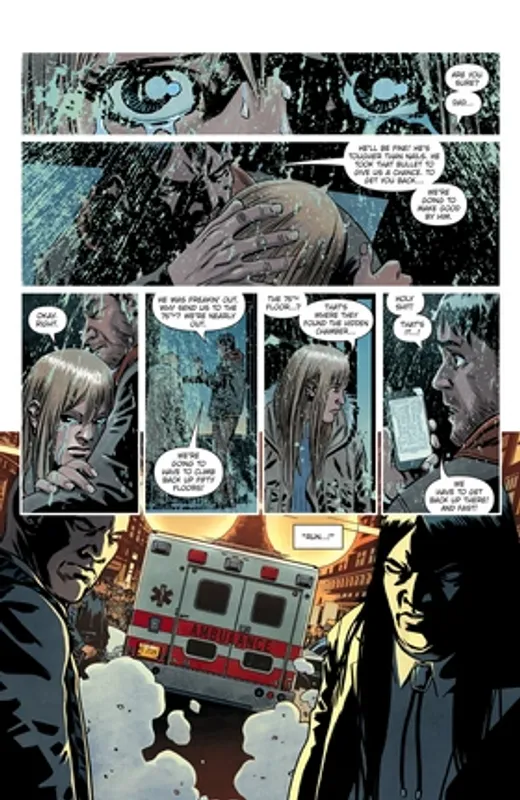
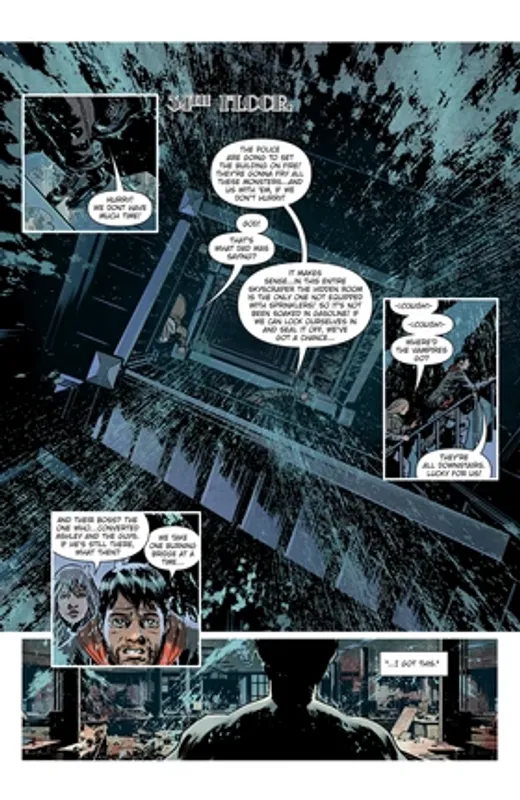
Adlard and Sébastien Gérard handle the fire itself very well, though. After the question of who started the fire is raised, there are three almost identical panels of an empty stairwell. A flame enters from above and moves down a few steps with each panel. Only then do we get a large bird’s-eye view of the skyscraper. The pacing comes from repeating a quiet panel, and we feel the scale of the fire because only a moment earlier it could be measured in stair steps. A page contrasting U’tlun’ta’s hand disintegrating in the flames with Terry burning his hands as he holds a hot door works in a similar way. The same fire solves one problem and immediately creates another.
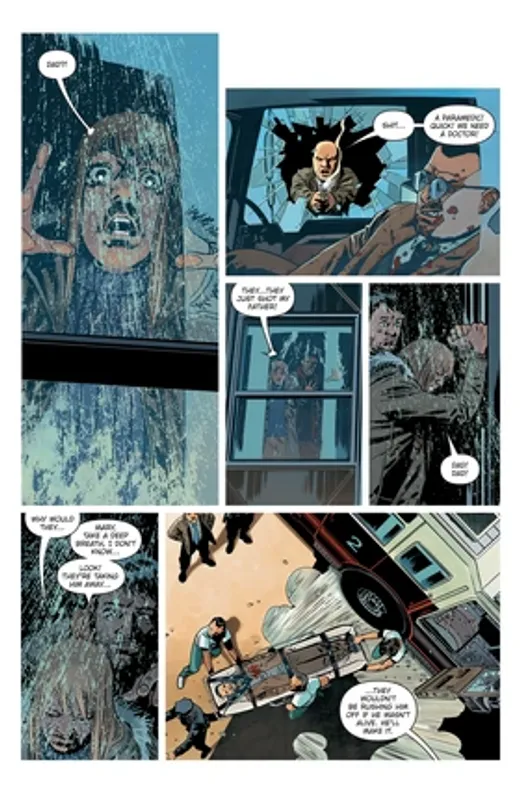
The comic resolves the main conflict without much excitement and is just as cursory about the conflicts that have arisen among the supporting characters. Towards the end it seems to forget them altogether and lets everyone celebrate together, even though some of them were shooting at each other a moment ago. The issue also contains an epilogue that brings the limitations of the earlier issues into sharper focus. It tries to strike a sentimental, nostalgic note, mourning the dead and describing Terry’s deep attachment to his friends. Yet the reader has never felt that attachment. The characters were only roughly sketched, and across four issues none of them stood out enough to be particularly memorable. They mostly served as a backdrop for Terry, who was positioned as the protagonist from the very first panels.
The final page of Vampire State Building includes a panel of workers that recalls Lunch Atop a Skyscraper, the 1932 photograph taken during the construction of Rockefeller Center. The comic draws on a recognisable image of the people who built the New York skyline, then reveals a crypt hidden in another skyscraper, as if to suggest that every architectural marvel conceals a grim past. That ambiguity also weighs on Terry’s words. For him, the belief that the dead can return lets him say goodbye and look to the future with hope. The reader remembers the form in which the dead returned at the beginning of the miniseries.
Issue 4 – preview on GlobalComix
Bonus: builders and vampires
Political tension is already apparent in the way the comic tells the story of the skyscraper’s construction. At first it presents the building as part of New York’s success story. During the siege, it recalls that the Mohawk, who are left out of many historical accounts, worked on it, but within a single conversation it moves from their trade to stereotypes of fearless warriors and cannibals. The historical starting point is solid. Mohawk ironworkers helped build the Empire State Building. They later worked on both World Trade Center towers and took part in the rescue and clean-up efforts after the attack.
The same problem can be seen in the mythology. Hamaťsa is a Kwakwaka’wakw ceremonial tradition associated with stories about a being that devours people. U’tlun’ta is a figure from Cherokee tradition. The comic combines both with the history of the Mohawk workers and presents the results in scenes in which experts explain the nature of the threat to the police. In this context, the vampire god’s throne – made of corpses and the comic’s most memorable image – recalls a ’Namgis story recounted by the U’mista Cultural Centre. In that story, a seat serves as a trap for the man-eater, and biting insects arise from his ashes. The resemblance between the images is striking. It is all the more regrettable that the script blurs the distinctions between the stories it draws on and so readily reduces them to a single tale of a secret cult.
Follow the links below to read more about Indigenous legends and the work of Mohawk ironworkers.
Brooklyn Mohawks: https://www.bklynlibrary.org/blog/2009/11/24/brooklyn-mohawks
How Mohawk ‘Skywalkers’ Helped Build New York City's Tallest Skyscrapers (readers in the European Union need to use a VPN to open the link): https://www.history.com/articles/mohawk-skywalkers-ironworkers-new-york-skyscrapers
The Education section of the Living Tradition website: https://umistapotlatch.ca/enseignants-education-eng
Cherokee Legends: https://visitcherokeenc.com/utlunta/