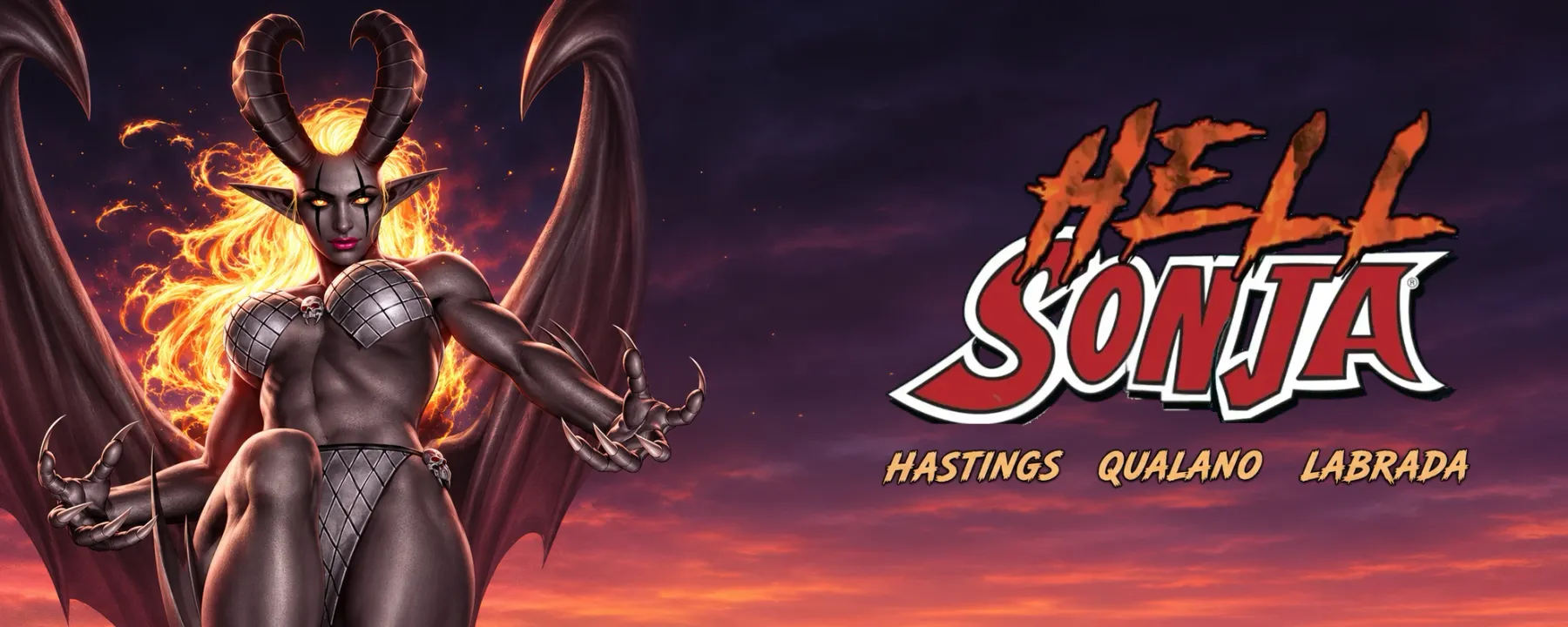

Hell Sonja, #1–5
Writer: Christopher Hastings
Art: Pasquale Qualano (#1–4), Andres Labrada (#5)
Colours: Kike J. Díaz (#1–2, #4), Ellie Wright (#3, #5)
Lettering: Jeff Eckleberry
Publisher: Dynamite Entertainment
Publication: 12 January – 18 May 2022
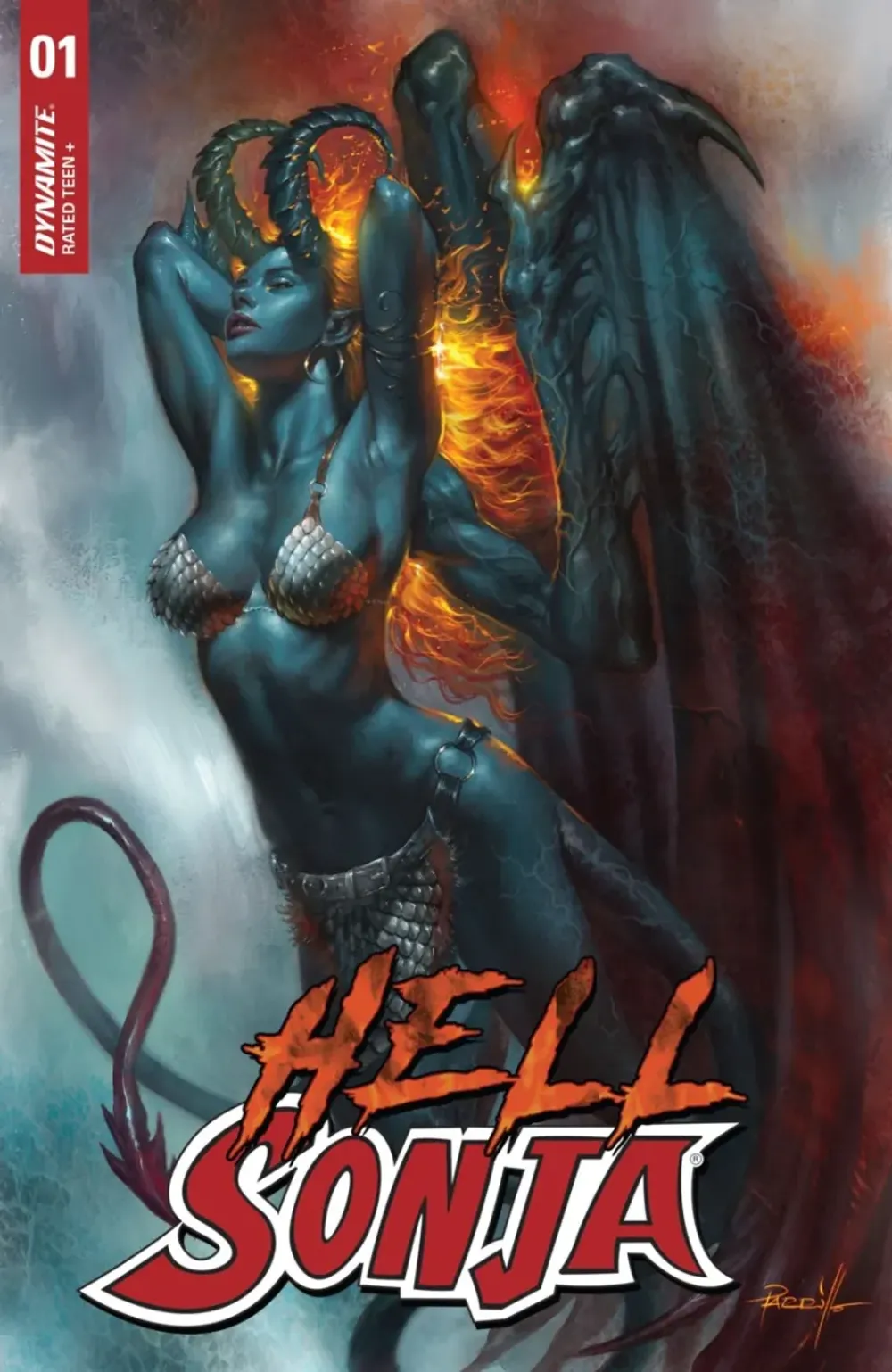
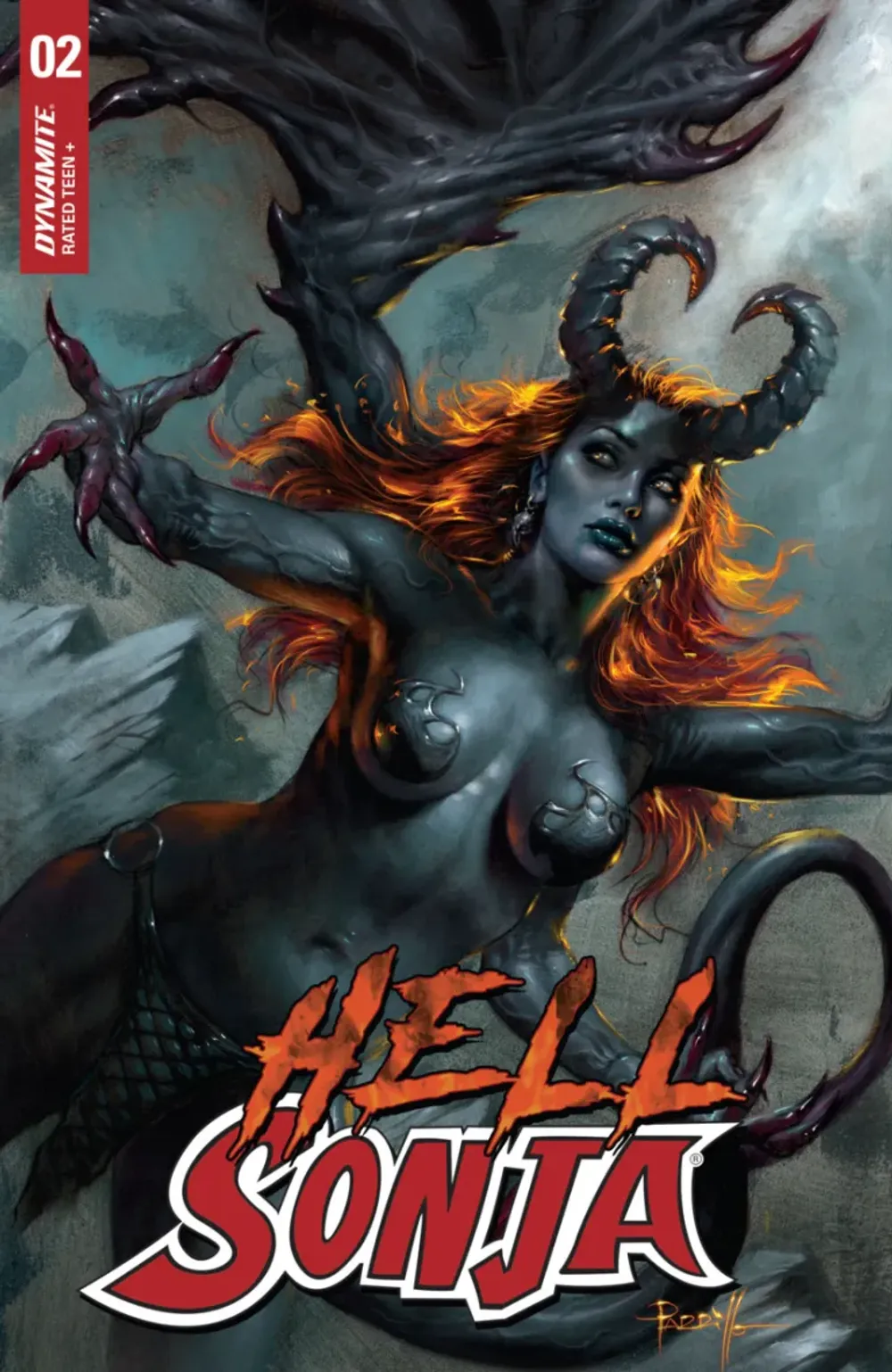
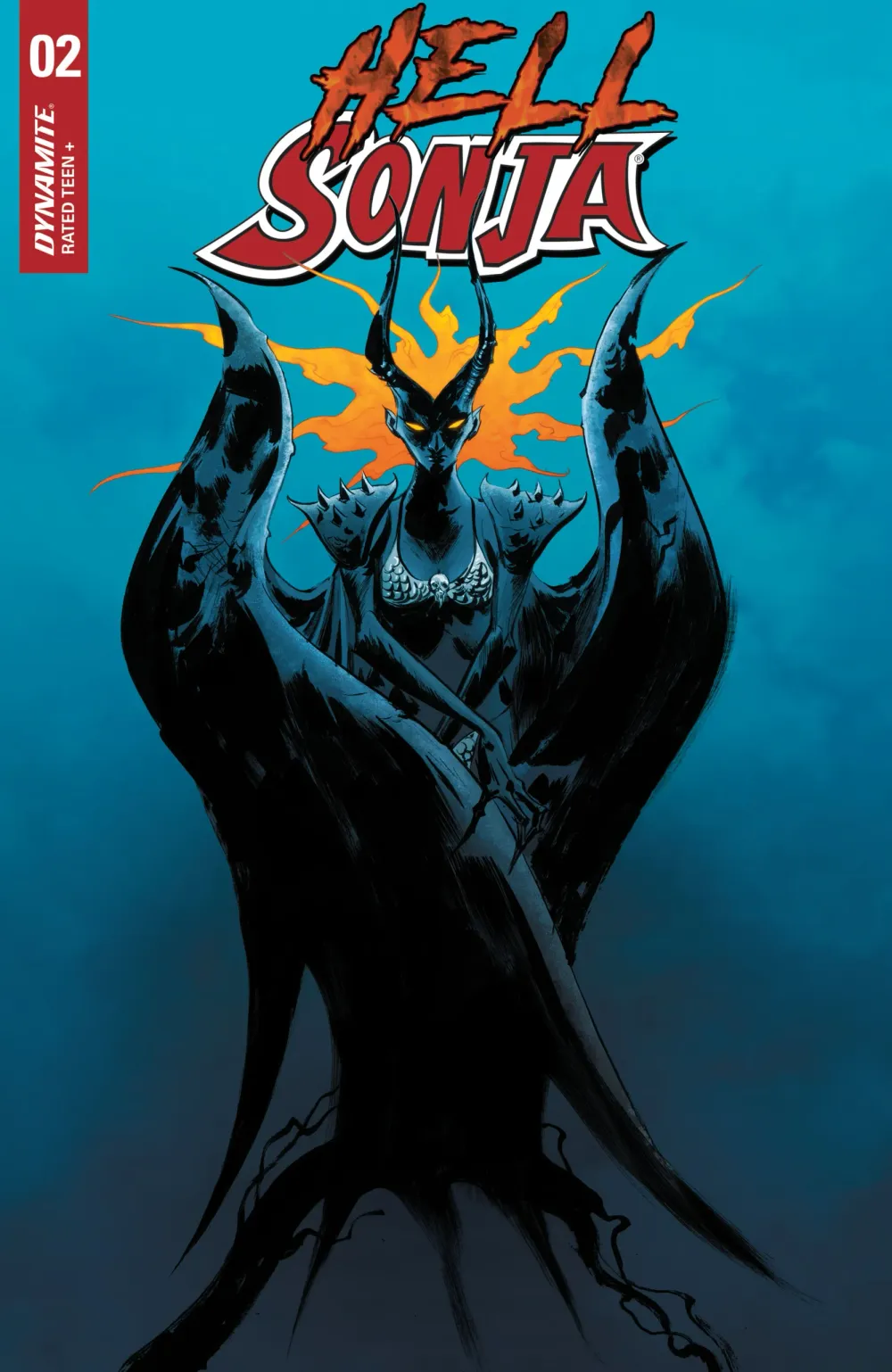
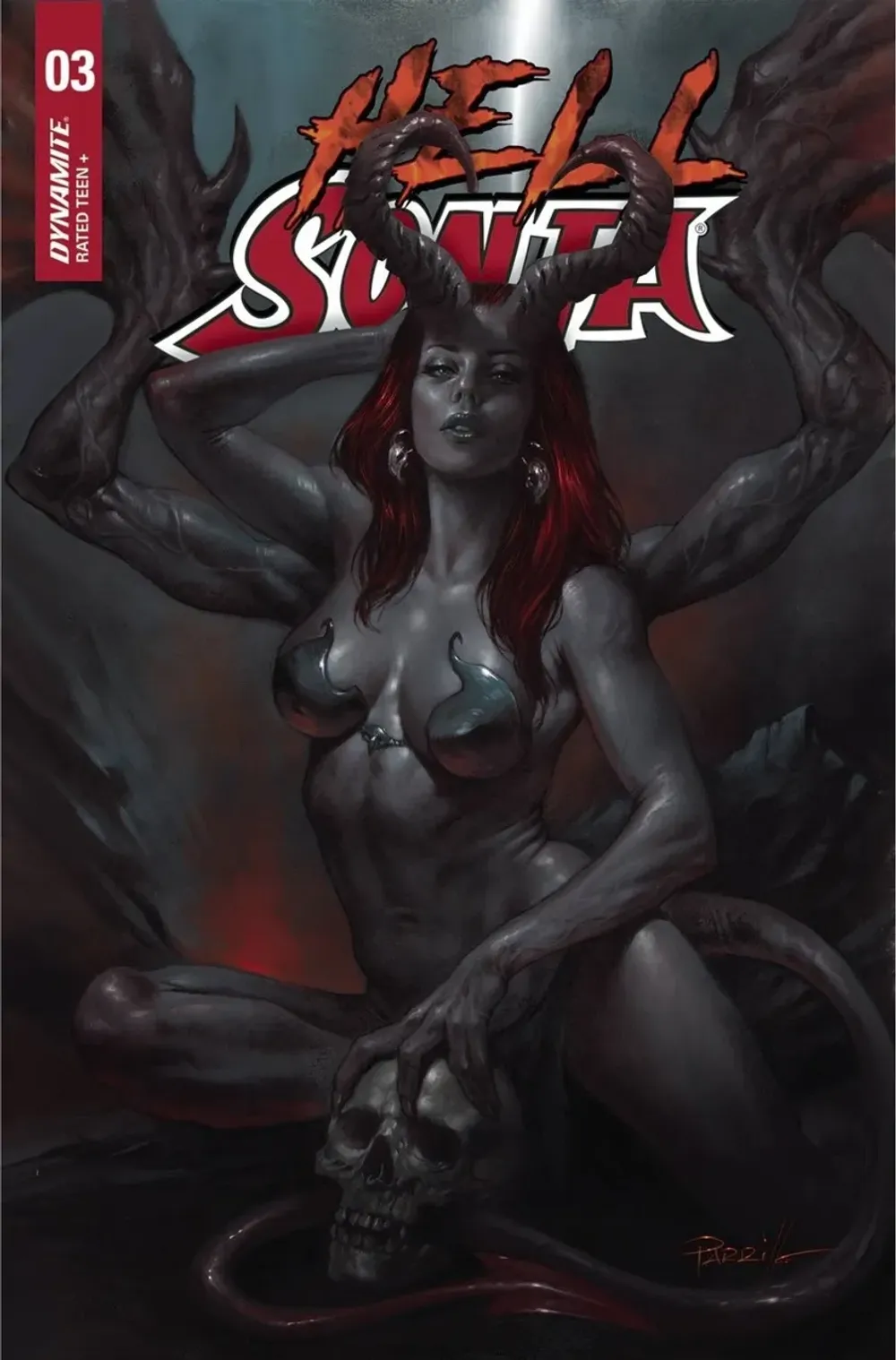
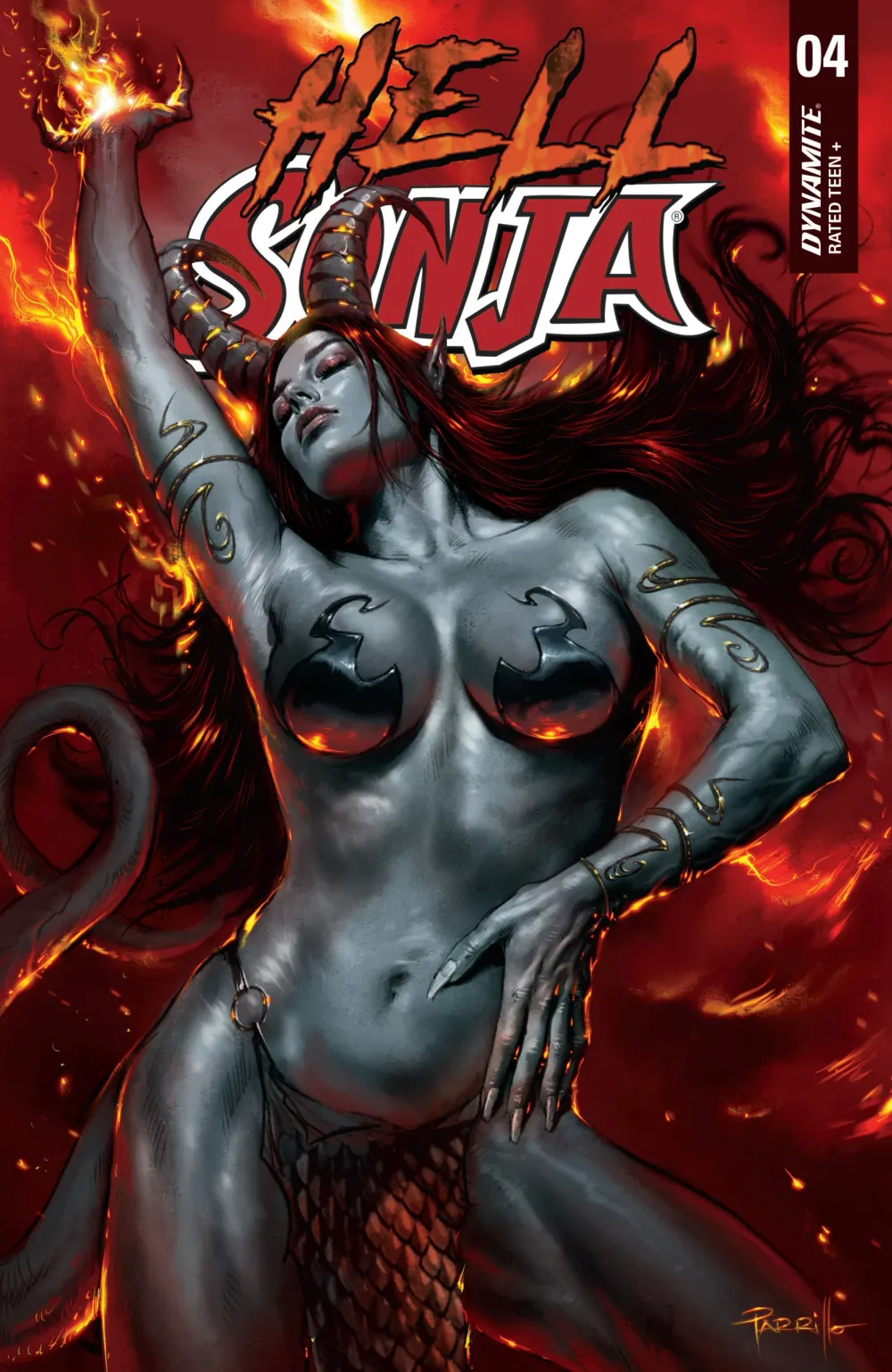
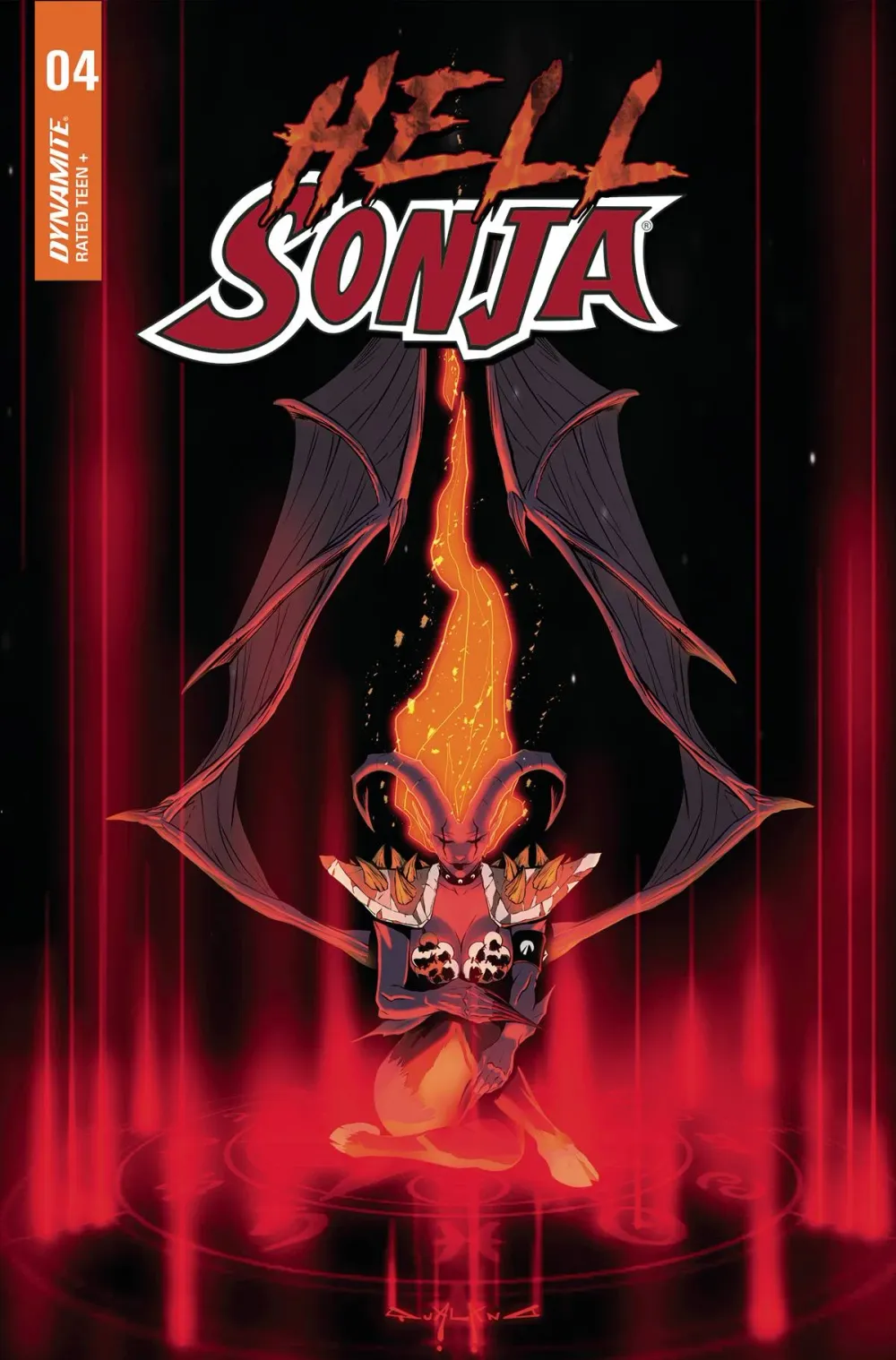
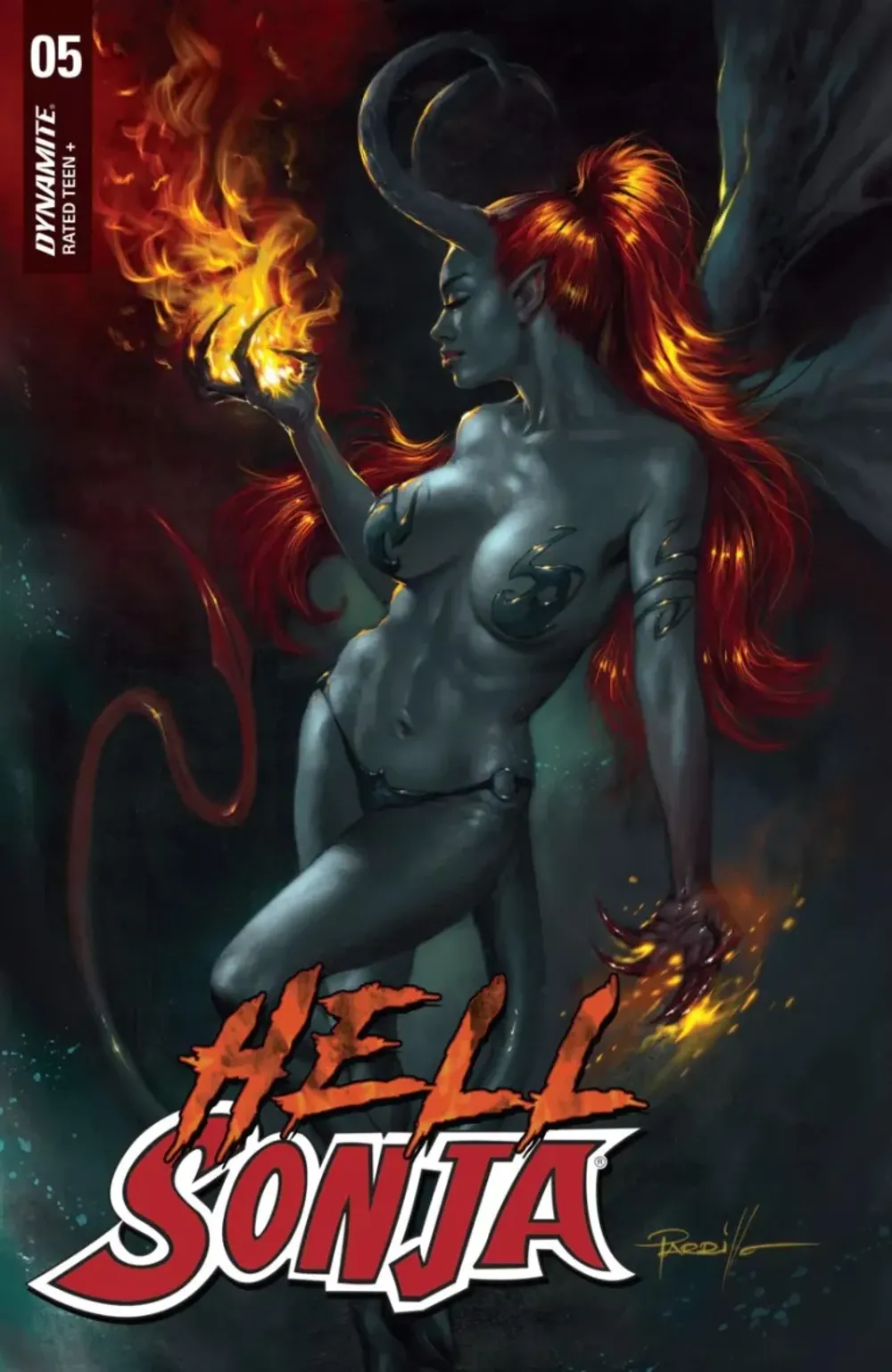
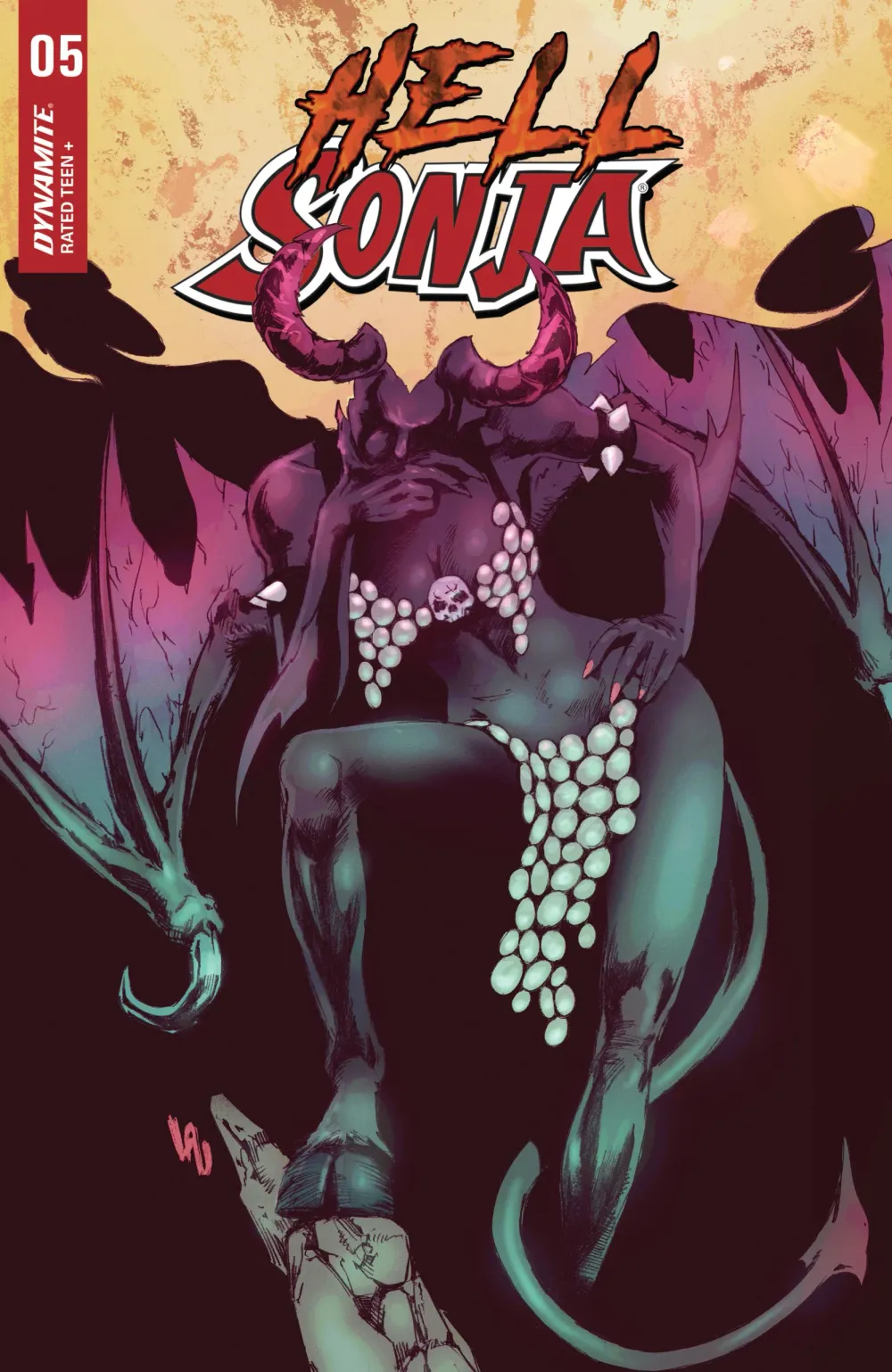
Covers: Lucio Parrillo (Cover A), Jae Lee (B), Junggeun Yoon (C), Joseph Michael Linsner (D), as well as photographic cosplay covers featuring Gracie the Cosplay Lass (E).
Issue 1.
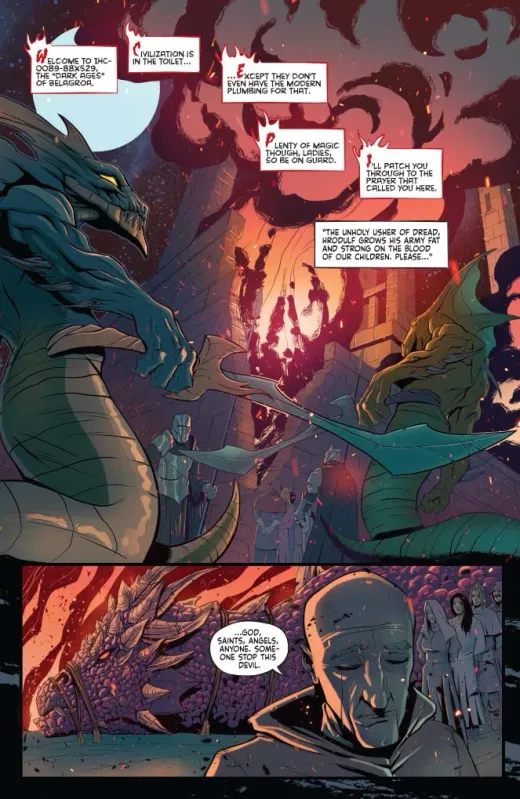
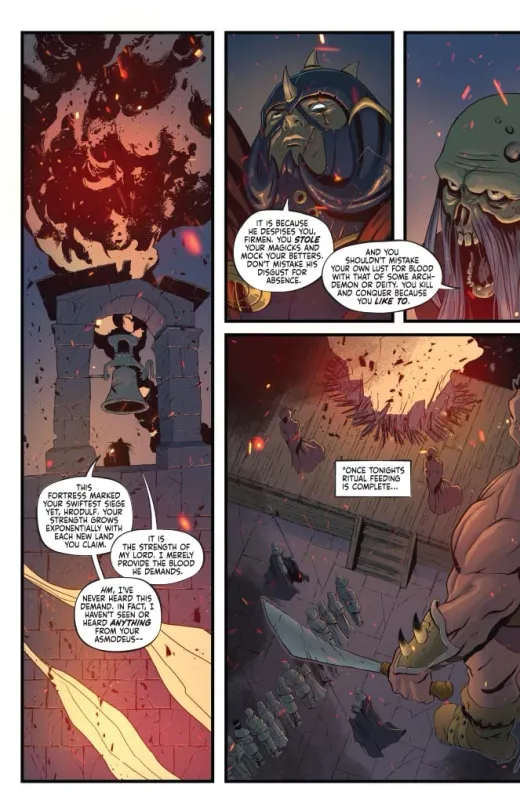
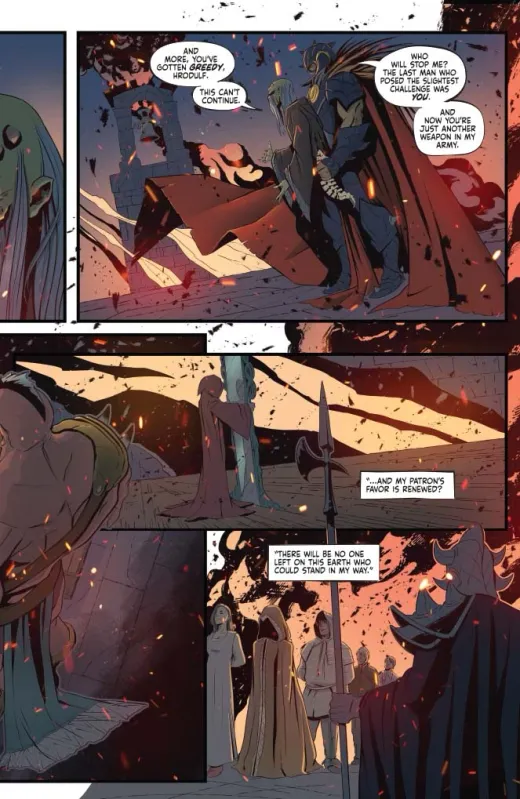
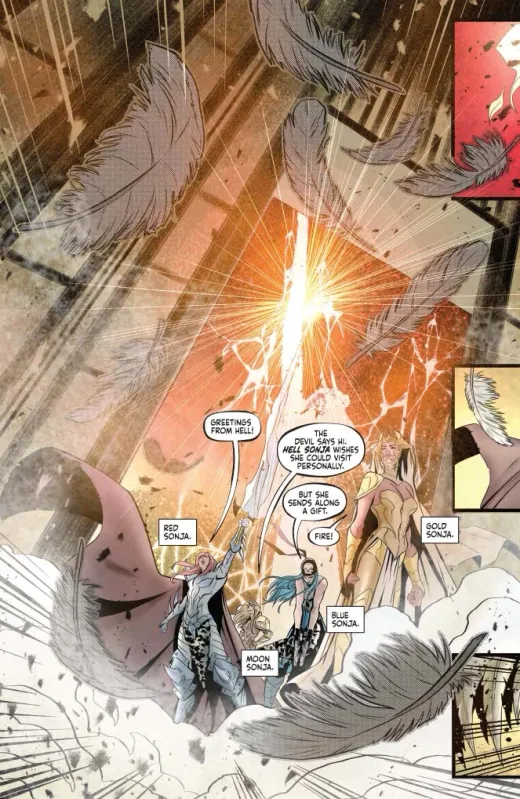
The comic begins like a classic sword-and-sorcery story. We find ourselves in a dark-fantasy world currently being conquered by a man named Hrodulf, who intends to sacrifice its inhabitants to the demon Asmodeus. Hastings quickly blows this convention apart: after one of the prisoners prays for help, the classic Red Sonja arrives on the scene—but she is not alone. She is accompanied by Blue Sonja with an assault rifle, Moon Sonja, who is an android, Gold Sonja—a smuggler with a stolen dragon—and others.
This genre mash-up, fully aware of its own absurdity, is the principal driving force behind the miniseries’ first issue. Drawing upon the idea of the Sonjaverse, Hell Sonja throws different varieties of pulp into a single title. Blue Sonja represents militaristic action cinema, Moon Sonja science fiction, Gold Sonja space opera, while Hell and Purple Sonja represent dark fantasy and horror. Hastings manages to combine them quite effectively, which is the comic’s greatest strength.
Across all five issues, the miniseries develops its vision of Hell and Heaven, building a surprisingly interesting mythology for the Sonjaverse. When we first encounter Hell Sonja, Hell is not so much a place of moral judgement in the Christian tradition as a cosmic mechanism. An ancient god made a bargain with the Sonjas: he gave them the strength to fight, but the souls of the enemies they defeated were to be sent to Hell. The god no longer exists, but the ‘hunger of Hell’ remains. If it is not fed souls, it will begin devouring the multiverse. Hell Sonja does not attempt to abolish this system; instead, she decides to choose for herself who will be used to satisfy its infernal appetite.
The idea is morally ambiguous—the Sonjas effectively become suppliers of ‘fuel’ for a literally monstrous system—but Hastings avoids delving too deeply into the more disturbing questions surrounding it: who deserves such a hellish fate and why, whether a victim’s prayer is sufficient grounds for identifying the guilty party, and whether any form of divine judgement exists at all. Nevertheless, the concept is not without perversity. In the first issue, its most interesting twist is that the prayers of people begging for help are answered not by Heaven, but by Hell.
Structurally, the comic clearly alludes to the once enormously popular television series The A-Team. Promotional material even includes the line: ‘if someone really bad is after you, you’re desperate enough, and no one else can help, maybe your prayer will be heard by Hell Sonja’. It is an obvious reworking of the series’ familiar formula. And the construction of Hell Sonja is indeed similar, albeit enriched with elements taken from RPGs: a specialist team in which every character has a different function and personality, character-card-style introductions listing worlds of origin, abilities and motivations, followed by a mission, a plan that immediately falls apart, improvisation by the heroines, and then a rapid move on to the next adventure.
The greatest weaknesses of the comic—and of the miniseries as a whole—are its sense of humour and rapid narrative pace. While the jokey tone can sometimes be used effectively, the pacing practically never slows down. An enormous number of ideas are packed into five issues, meaning that the characters frequently bombard us with excessively expository dialogue while the action races ahead at breakneck speed.
The positive and negative sides of the humour are already visible in the first issue. Hrodulf believes—and the comic initially allows the reader to believe—that Asmodeus really is the king of Hell. Hastings presumably chose the name deliberately: in older traditions Asmodeus does, after all, appear as a powerful demon and sometimes even as a king of demons. Yet this becomes the basis for a joke about mortals having no idea how Hell actually operates. Speaking of references beyond comics, it is also worth noting that Hastings alludes to Dante’s Inferno by mentioning the seventh circle of Hell, reserved for those guilty of violence—including tyrants and murderers—and therefore entirely appropriate for Hrodulf.
Unfortunately, elsewhere the humour weakens the comic. Virtually every character is reduced to a comic archetype, and almost every event—no matter how gruesome or dramatic—is punctuated by a joke, inviting comparisons with comics and films from the Marvel stable. In other words, anyone expecting horror—and they might reasonably have done so, since promotional materials list it as one of the principal genres alongside action/adventure—will be sorely disappointed. Although Hell, skeletons and demons all appear, the comic’s tone is humorous and adventurous, making it a work aimed more at admirers of pulpy fantasy.
Interestingly, the marketing is distinctly more erotic than the contents of the issue itself. Dynamite tempted readers with an enormous number of variant covers and incentive editions, many of which present more or less eroticised images of Hell Sonja. It is a classic Dynamite strategy: bad-girl imagery and pulp sexuality are heavily emphasised on the covers, while the comics themselves usually turn out to contain little of this straightforward eroticism.
Art
Pasquale Qualano is solid, although the energy of the page layouts makes a stronger impression than the drawings of specific characters. There are numerous tilted panels, overlapping frames and splashes extending beyond their borders. As a result, the issue reads quickly and the action scenes feel dynamic.
The comic works best when genres collide visually: Sonja in chainmail standing beside an assault rifle, a dragon against firearms, or a medieval castle combined with interdimensional technology. Ideas of this kind are the ones that remain most firmly in the memory.
Kike J. Díaz’s colours significantly strengthen the comic’s visual presentation. Most of the first section is immersed in oranges and reds, while later passages introduce cold greens associated with Moon Sonja and infernal energy. This creates a strong visual unity, although admittedly the overall effect can occasionally become a little too uniform.
But Which Red Sonja, Exactly?
She-devil with a sword has undergone several reboots, but that does not mean that one reboot completely erased the previous versions of the character. The Sonjaverse exists, after all, and within it every variation of the red-haired warrior continues to thrive.
The Marvel version of Sonja, created in 1973—with the famous origin added in 1975 involving the murder of her family, rape, the appearance of the goddess Scáthach, who grants Sonja her fighting abilities, and the oath that she will not be with a man unless he first defeats her in combat—was rebooted by Gail Simone in 2013. Dynamite had initially continued a model closer to the classic version of the character.
Simone’s Sonja is not raped, does not receive her combat abilities from Scáthach and makes no sexual oath. She survives the destruction of her community, fends for herself, is later enslaved and develops her abilities through years of gladiatorial combat.
The Red Sonja appearing in Hell Sonja is a variant conceived as the classic Sonja, derived from the model established by Marvel during the 1970s. The miniseries itself is a spin-off of Hastings and Qualano’s Sonjaversal.
In Hastings’s interpretation—which reworks the original origin without requiring another reboot—the red-haired warrior has rejected her oath and no longer wishes to kill for her god or send souls to Hell. Hastings interprets the divine gift as a transaction in which Sonja was exploited. The deity gives her strength, but every person she kills becomes fuel for the system. Sonja eventually realises what her ‘oath’ truly amounted to and refuses to continue participating in it.
I do not want to suggest that Hastings is carrying out a feminist deconstruction of the 1975 origin, but it is difficult not to notice that what was originally presented as Sonja reclaiming strength and agency after trauma is transformed here into an oppressive divine contract.
Issue 2.
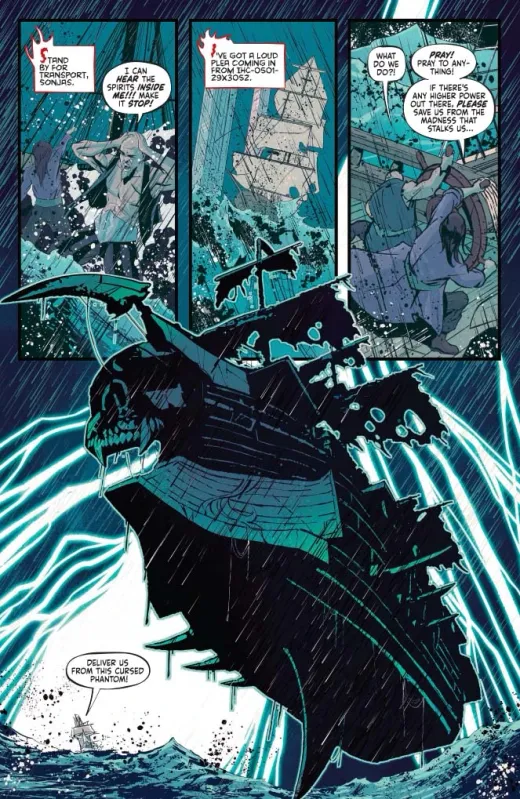
In our second encounter with the Sonja strike team, we travel with them to another Earth, whose highly advanced civilisation experimented with interdimensional travel. Naturally, the experiments went wrong. As a result, the world was flooded, and the remnants of humanity now live on the ocean above the ruins of the old civilisation. A mysterious ghost ship also roams the surface of the endless sea, driving those who encounter it insane. We therefore get a fine pulp mixture: post-apocalypse, ghost ship, interdimensional portals, Hell and body horror.
The ghost ship turns out to be more than just another haunted vessel. In reality, it is a colony of intelligent fungus whose spores cause psychological disturbances and can subsequently use human beings as hosts. Interestingly, the fungus refers to them as ‘wombs’, creating the impression that it does not regard them as victims so much as reproductive organs. Did Hastings actually intend to invoke the horror motif of the human—usually female—body as a site of monstrous reproduction and invert it by assigning that function to people regardless of sex, or did he simply think the word sounded cool? Unfortunately, I do not know.
What I do know is that the fungus is a more interesting antagonist than Hrodulf. It is a monster that cannot simply be shot or hacked apart, because every fragment of it contains spores. The heroines’ usual skills therefore become a threat to their own survival. This gives Moon Sonja more room to shine, as the problem requires analysis and a technological solution rather than yet another demonstration of brute force.
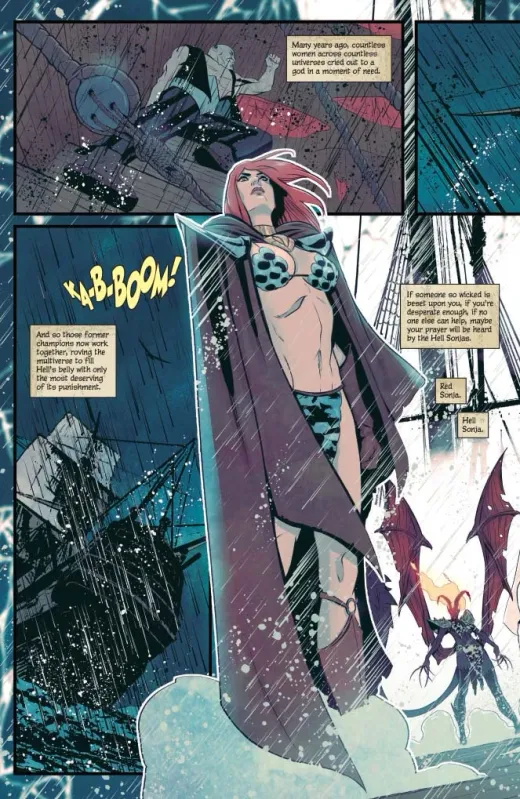
The second issue of the miniseries also provides further information about how Hell Sonja operates. Here, she comes across almost like someone managing a corporation. The other Sonjas are essentially working for her under contract. These agreements differ from one another; the deal made with Gold Sonja, for example, stipulates that after completing a certain number of missions, Hell Sonja will refrain from taking her beloved to Hell. Every failed mission, however, resets the counter. It is quite an interesting approach to the idea of trading in souls. In this context, the comic increasingly suggests that the title character is not a heroine at all, but at most the miniseries’ antiheroine.
Unfortunately, Hastings often follows good ideas with bad jokes. Every time we enter horror territory, the writer has someone do or say something stupid, destroying the tension he has just built. If we set the humour aside for a moment, however, another interesting issue emerges: the question of what qualifies someone—or something—as deserving of Hell. Is the fungus evil if it does not operate according to human morality, but according to its own logic of reproduction and colonisation? Does it deserve eternal damnation in Hell? And would sending it there while it is still alive violate any rules?
One of the comic’s recurring weaknesses is Hastings’s distrust of silence. Every good idea has to be followed by an explanation, a reaction and often a joke as well. This prevents Hell Sonja from acquiring the necessary weight, while its tone too often drifts towards the stereotypical humour of contemporary superhero comics.
Art
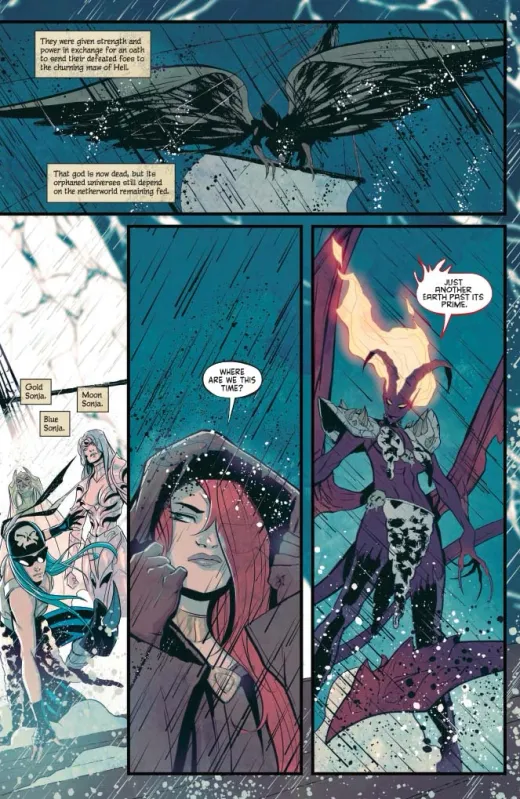
A substantial portion of the issue is presented in full two-page spreads. This gives the story a fairly cinematic, almost panoramic sense of scale. The enormous ship is given room to breathe, the ocean feels vast, and the action can move through several vertical panels within a single wide composition.
Colour is also used to organise the different worlds more clearly. The idea is hardly original, but it serves its purpose. The post-apocalyptic Earth is characterised by turquoise, navy blue and green, while Hell is defined by oranges, reds and pinks.
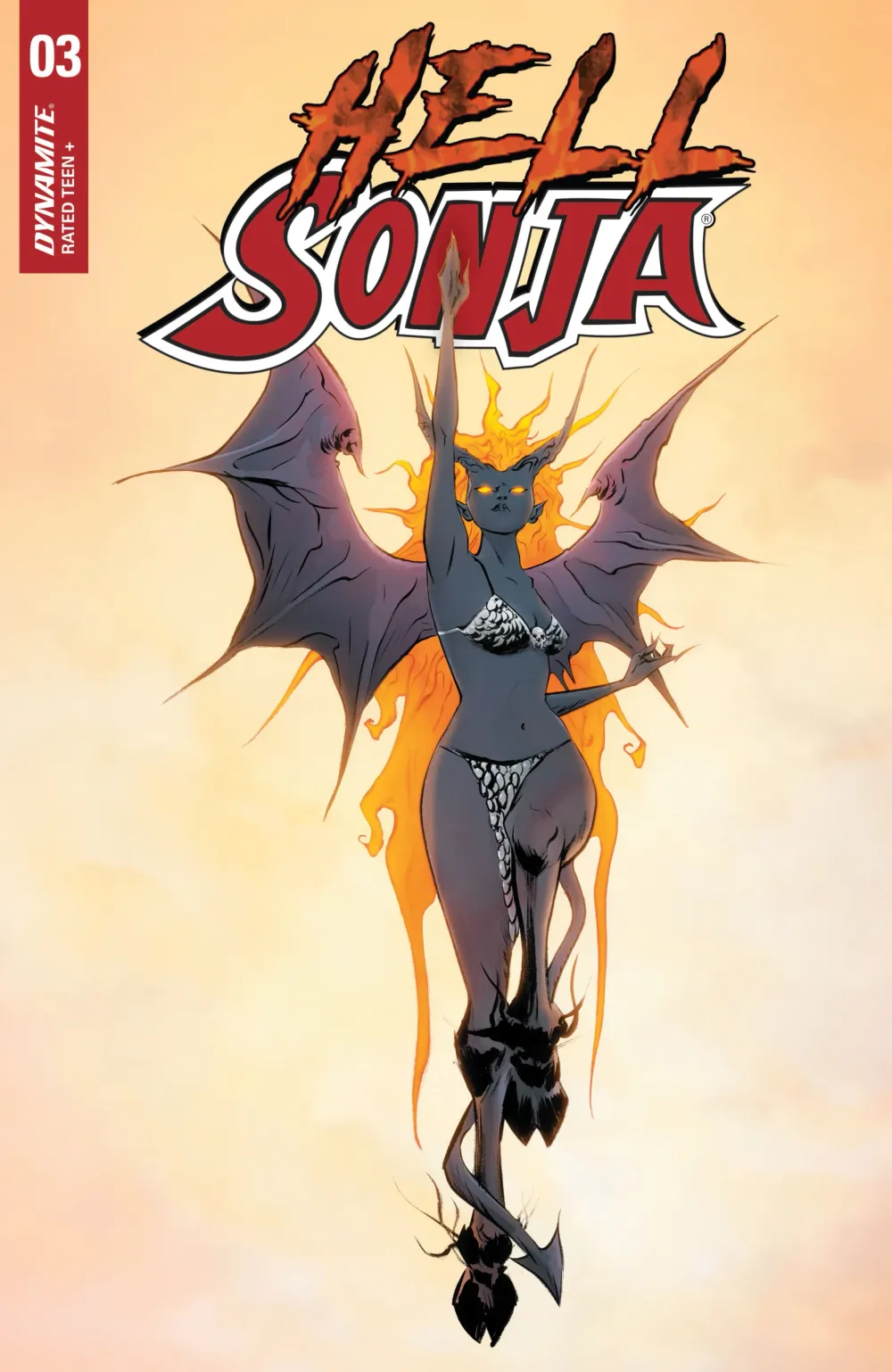
Issue 3.
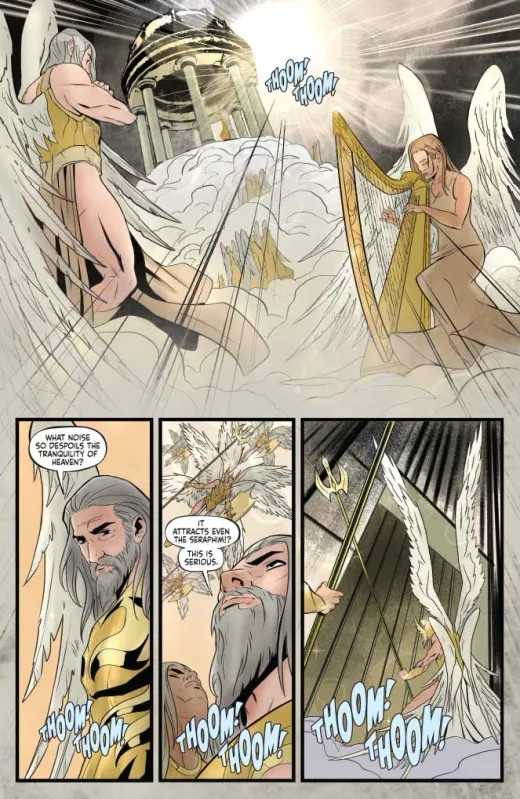
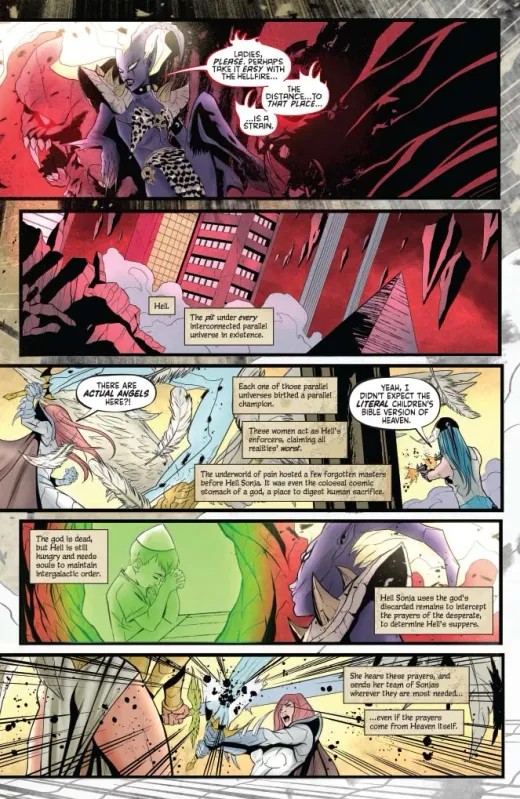
The third issue of the series is more interesting conceptually than the previous ones, but it gets bogged down narratively. The best idea in the issue—and one of the strongest in the entire series—is that God is dead, or at least has disappeared somewhere, while Hell and Heaven continue to function. We already knew from the first issue that Hell was a soul-hungry mechanism left behind by God. Now we discover that Heaven, too, is infrastructure abandoned by its owner. More than that, it is a planet-sized computer that stores the dead as data and generates a private paradise for each of them. It is something between the Christian Heaven with a cyberpunk twist and a cosmic operating system that continues to run after the administrator has died.
The idea of prayer is also treated more ironically here. A man named Harold, residing in a heavenly paradise—where paradise takes the form of a looping memory of a childhood birthday—is attacked by Root Rot. Being in Heaven, he naturally decides to seek help through prayer. The prayer, however, goes straight to Hell. Hell Sonja receives it and sends a rescue team into a helpless Heaven.
The fact that Heaven functions like a gigantic computer infrastructure opens the comic up to several interesting questions. It operates like a catalogue in which the dead are data stored in memory. Moon Sonja—herself an artificial intelligence—asks: ‘Can a human soul truly retain its humanity after being converted into digital data?’ In other words, is a copy of a person still the same person? This is a distinctly cyberpunk question concerning the continuity of identity after it has been copied or transferred into virtual reality.
Unfortunately, Hastings has so many ideas and so little space in which to develop them that these interesting problems receive only a few speech balloons of reflection before the action races onwards. The writer also somewhat conflates two separate questions here: whether a conscious digital person can exist at all, and whether a specific human identity can preserve continuity after being copied into a computer. In order to explain everything, he therefore has to rely upon a great deal of expository dialogue, and because much of it concerns technological concepts, a substantial portion of the issue is filled with technobabble reminiscent of the most excessive episodes of Star Trek: The Next Generation in that respect.
Another interesting idea is the antagonist. Root Rot is a play on words. In Unix and Linux systems, root is the privileged administrator account. In other words, Root Rot gains root access—the highest level of permissions, allowing it to take control of Heaven’s server. But root rot also refers to the rotting of plant roots, often associated with fungal or fungus-like pathogens. This, in turn, connects the antagonist with the fungus from the previous issue.
Although the issues initially appear to be only loosely connected, Hastings begins suggesting a stronger relationship between them through recurring ideas. In the previous issue, the Sonjas confronted biological decay; in the third, they face digital decay.
This cyberpunk rewriting of religion also includes seraphim—beings from Isaiah’s vision traditionally associated with the throne of God. Hastings takes their connection with divine space and transforms them into a kind of angelic system security, ensuring that no living being uploads its consciousness to the Heaven Server.
Thus, in the world of Hell Sonja, the division between Heaven and Hell does not correspond to any simple division between good and evil. Good people can end up in Hell—Red Sonja’s husband is condemned to it—and the entire heavenly-infernal system can be manipulated. Which, of course, is precisely what Hell Sonja does.
The ending of the issue also does something that significantly improves the miniseries as a whole: it shows that the ideas scattered across the previous instalments are beginning to form a single narrative. Unfortunately, this also makes Hell Sonja’s principal weakness even more apparent: its excessive density.
Within roughly twenty pages, Hastings wants to stage an assault on Heaven, introduce the cybernetic nature of Paradise, tell the hacker’s backstory, give every Sonja a moment of her own, include a discussion of digital identity, develop the story of Red Sonja’s husband, continue expanding the contract motif, return to the fungus from the previous issue and reveal the central antagonist. It is simply too much.
Qualano further complicates matters by using a large number of diagonal, intersecting panels. In Heaven, this actually works quite well—the frames resemble windows, fragments of data or a damaged interface—but combined with the already rapid script, it means that some pages are skimmed with the eye rather than genuinely read.
Issue 4.
The penultimate issue significantly raises the quality of the miniseries. First of all, it reveals more about the cosmology of the Sonjaverse. The comic presents the history of the universe as a succession of forces displacing those that came before them. The gods killed the Titans, heroes displaced the gods, and biological cells kill the heroes. In Hastings’s vision, everything larger eventually falls under pressure from something smaller. Revolution begins at the bottom.
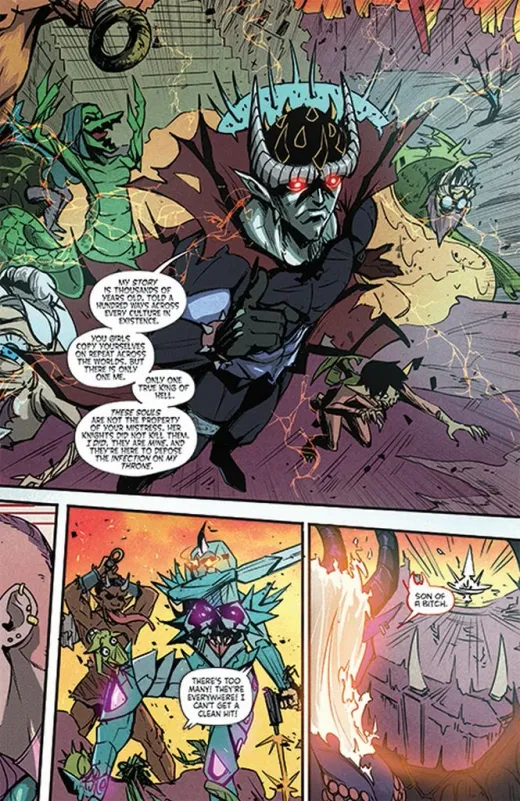
The fall of the gods does not, however, mean their complete disappearance. Quite the opposite: they have become a kind of cosmic parasite, living off energy derived from human beings. In this context, Hell exists entirely outside morality and functions as a refinery converting souls into fuel for the gods.
What matters in this world is not so much sin itself as the belief that one has sinned. If people can be convinced that they are sinners, they can also be made to believe that they deserve Hell. In other words, religious guilt is instilled so effectively that people willingly deliver themselves into the system that consumes them. It is quite an interesting approach to religion. Hastings punctuates it with grotesque humour, but this time the comedy fits the increasingly surreal nature of the world, which at moments recalls Grant Morrison’s famous run on Doom Patrol.
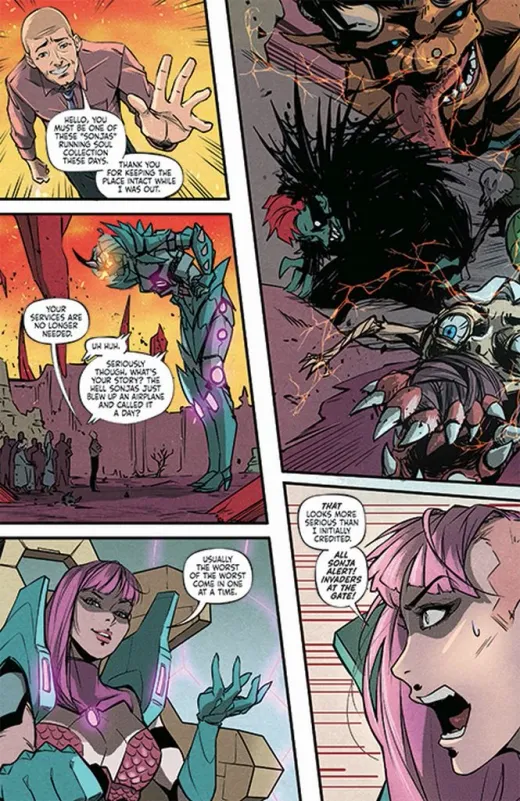
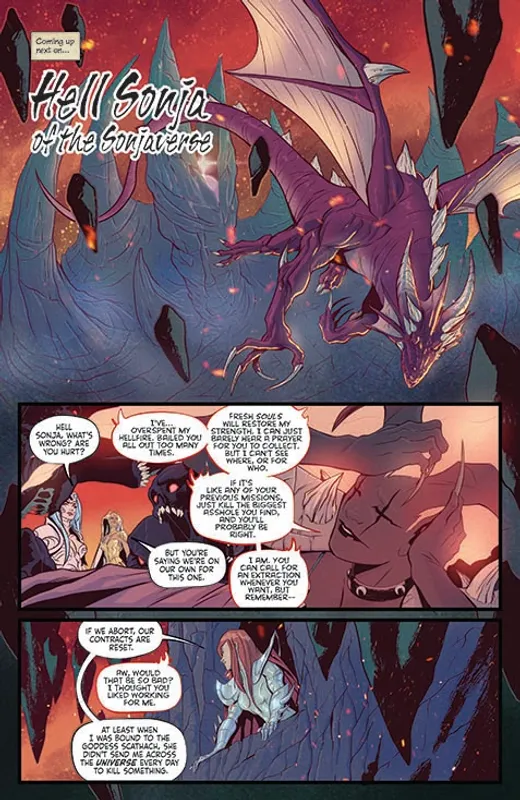
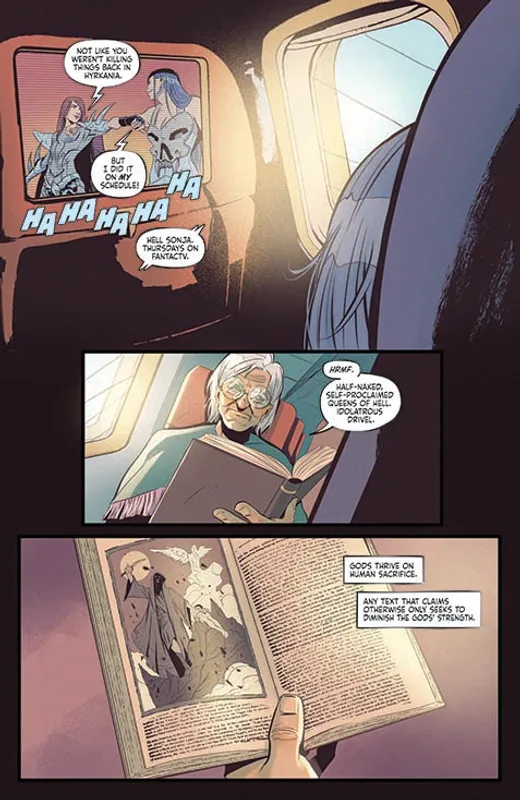
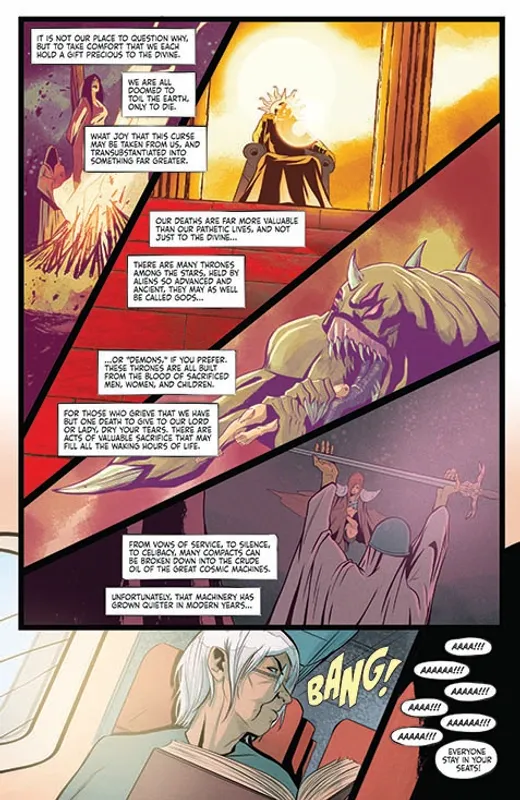
The Sonjas appear here aboard an aeroplane controlled by Asmodeus, whose passengers are his worshippers. The plane evokes Charon’s barge, although it is even more a grotesquely unreal gathering of cheerful murderers planning a collective ritual sacrifice.
Hastings also lists the rulers of Hell in this issue and slips several small Easter eggs into the enumeration. His list includes Anubis, Pluto, Hel, Lucifer, Hastur, Asmodeus, Nameless Godhead and Hell Sonja.
Hel—from Norse mythology—is both the name of the realm of the dead and its ruler. Within the broader mythology of Dynamite’s comic-book worlds, however, the name may also remind readers of Lady Hel, the ruler of Hell modelled upon Lady Death from Chaos! Comics.
Hastur, meanwhile, was a god of shepherds in Ambrose Bierce’s Haïta the Shepherd. Robert W. Chambers borrowed the name and used it in The King in Yellow, after which Howard Phillips Lovecraft picked it up from Chambers. Hastings therefore throws ancient mythology, Christian demonology and Lovecraftian motifs into a single cosmology, while simultaneously leaving the door open for further comic-book connections.
Like the previous issues, this one also suffers from an excess of ideas—enough material for two or three instalments is crammed into a single issue. It is fast and chaotic, but these are the same criticisms I have repeated every time I have encountered Hell Sonja, so let us move on to the art.
Art
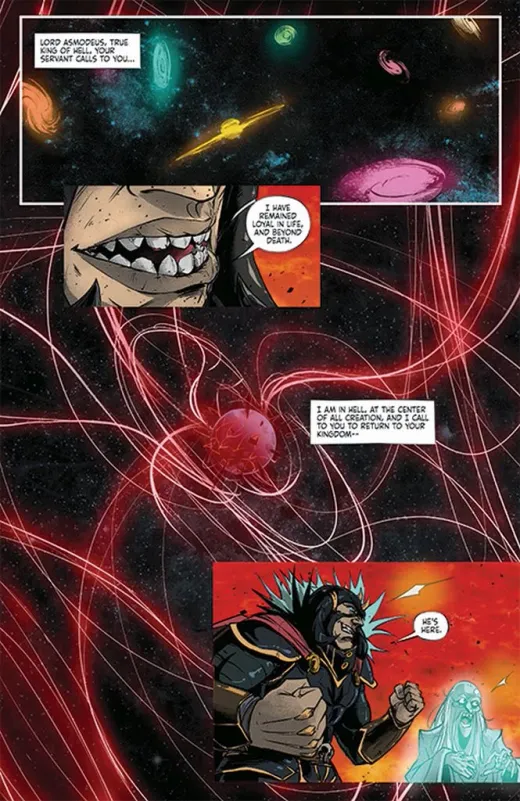
Qualano makes very effective use of the confined space inside the aeroplane. Narrow panels and rows of seats create a claustrophobic impression, after which the comic suddenly opens into an enormous image of cosmic gods and Hell. The scale literally leaps from several dozen people trapped inside a metal fuselage to the entire dying multiverse.
The page showing the conversation between Red Sonja and Hell Sonja is also particularly attractive: diagonal panels cut through the ordinary space of the aeroplane with demonic imagery. The supernatural literally intrudes into reality.
Meanwhile, the final image of the aeroplane crashing into the mountain is exceptionally simple, but precisely for that reason it works better than some of the more crowded sequences.
Issue 5.
One of the strengths of the miniseries, brought here to its logical conclusion, is that Hastings never morally absolves Hell Sonja. Her confrontation with Asmodeus is not a clash between good and evil, but rather between evil and lesser evil. At the same time, however, the writer reminds us that her function is crucial to the survival of the multiverse, which would most likely collapse under Asmodeus’s rule. This significantly simplifies the conflict, because regardless of the characters’ morality, the comic makes it very clear whom we are supposed to support. As a result, the resolution lacks any greater sense of perversity or play with the reader’s expectations.
Hell Sonja is also capable of using the system under her control to reincarnate souls in other realities. Hastings thereby provides a kind of diegetic justification for the Sonjaverse: Red Sonja can die in one world and then be reborn in another Hyrkania, becoming not so much a single immortal individual as a recurring archetype. As long as Hell Sonja remains in control of the system, further variants of Sonja can therefore continue to emerge throughout the multiverse.
The miniseries’ finale leaves mixed feelings. On the one hand, it contains an interesting, almost Lovecraftian idea of cosmic horror and is visually appealing. On the other, it amounts to an enormous deus ex machina that leaves the reader unsatisfied. To make matters worse, Hastings immediately returns to his goofy humour afterwards.
Fortunately, he also includes a kind of epilogue, which I will not spoil here. It concerns the fate of Red Sonja—or, more precisely, her archetype—and is morally ambiguous, slightly sad and slightly cynical. Yet even here, the writer cannot resist inserting a joke that defuses the dramatic weight of the scene.
Art
Issue five is somewhat weaker visually than the previous instalments. The reason is the change of artist. Contrary to the information provided on Dynamite’s official website, the artwork was drawn by Andres Labrada, who replaced Qualano.
Unfortunately, his work is less polished, particularly when it comes to faces and character anatomy. The whole issue gives the impression of having been produced in a hurry. The colours by Ellie Wright help considerably, however. In particular, the pink-and-purple multiverse stands out strongly against the infernal oranges and reds of the earlier scenes.
Miniseries rating: 7/10